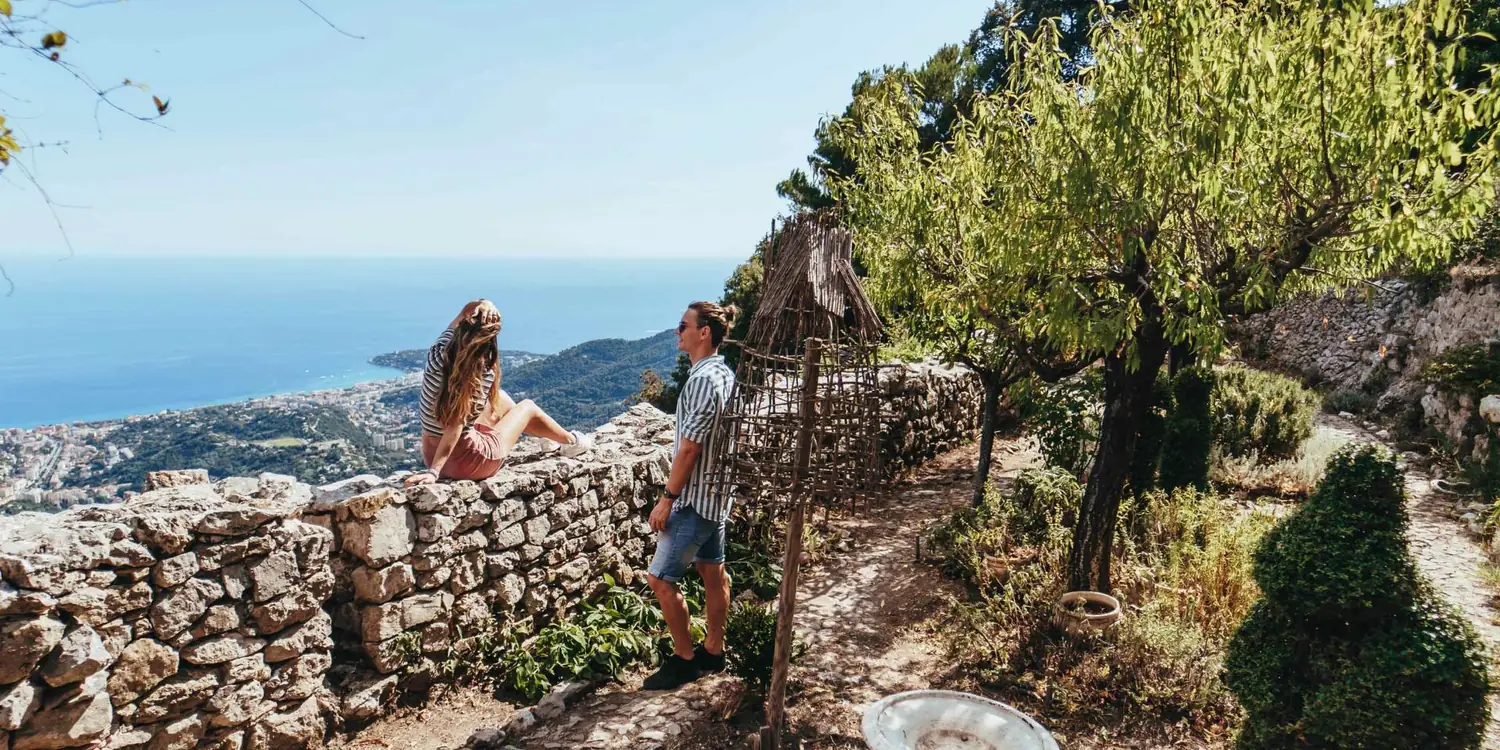
There is a Menton that most visitors never see. They stay on the promenade, eat a lemon tart, photograph the Cocteau museum, and leave. But drive fifteen minutes inland — the road climbing in tight switchbacks through olive groves and dry-stone terraces — and the coast dissolves. The air changes. The stone changes. The pace, emphatically, changes.
On 25 August 2026, the Menton Riviera & Merveilles tourist office organises a full-day guided excursion to two of the most atmospheric villages in the arrière-pays: Sainte-Agnès and Gorbio. The departure point is the Office de Tourisme at 8 avenue Boyer, Menton. Pricing details are to be confirmed directly with the organisers at menton-riviera-merveilles.fr.
The Villages
Sainte-Agnès sits at roughly 671 metres above sea level — high enough that on a clear morning you can trace the curvature of the bay from Bordighera to Cap Ferrat. It is frequently cited as the highest coastal village in Europe, a claim the locals repeat with quiet, entirely justified pride. The streets are barely wide enough for two people walking abreast; cats occupy the sunniest ledges; bougainvillea forces its way through the gaps between medieval walls. The village is also home to a fortified military site dating to the Maginot Line extensions of the 1930s — a reminder that this beautiful frontier was, not so long ago, a strategic one.
Gorbio, a few kilometres to the south-west, is smaller and, if anything, quieter. A single enormous elm — planted, by tradition, during a plague epidemic in the seventeenth century — still shades the central square. The fountain still works. The pétanque terrain is still used. These are not reconstructed villages for tourism; they are places where people live, and the distinction is felt immediately.
'Rencontres d'artisans passionnés' — the programme's phrase for the craft encounters — suggests something more than a demonstration. In villages this size, the artisan and the village are inseparable.
What the Day Holds
The excursion is structured around three elements: guided commentary at both villages, meetings with local craftspeople, and lunch at a restaurant in the area. The guided visits promise cultural and historical context for what you are seeing — the kind of layered explanation that turns a pretty façade into a legible history. The artisan encounters are part of a broader regional effort to keep traditional savoir-faire alive in the back-country villages, where depopulation has been a persistent pressure since the mid-twentieth century.
Lunch, at a local restaurant, is the natural pause that the Provençal rhythm demands. In this part of the Alpes-Maritimes, a midday meal is not incidental — it is structural. Expect the cooking to reflect the altitude and the season: perhaps a daube, a tian of late-summer vegetables, something involving the lavender honey for which the area is known.
The excursion is listed under the keyword 'sport', which in French tourist office parlance typically signals an active outing — expect walking on uneven cobbled streets and some incline. Comfortable shoes are not a suggestion.
For those who have spent time on the Côte d'Azur and felt, at some point, that the coast had given them everything it had to give, the arrière-pays offers a different register entirely. The light is harder up here, the shadows sharper, the silence more complete. Sainte-Agnès and Gorbio are not hidden — they appear in guidebooks, they have their summer visitors — but they retain a quality of remove that the coastal towns, for all their beauty, cannot manufacture.
The 25th of August falls in the last week of the French summer season, when the crowds on the Promenade du Soleil are still thick but the mood has already shifted — a slight loosening, a sense that September is near. It is, in other words, precisely the right moment to turn away from the sea and look up.