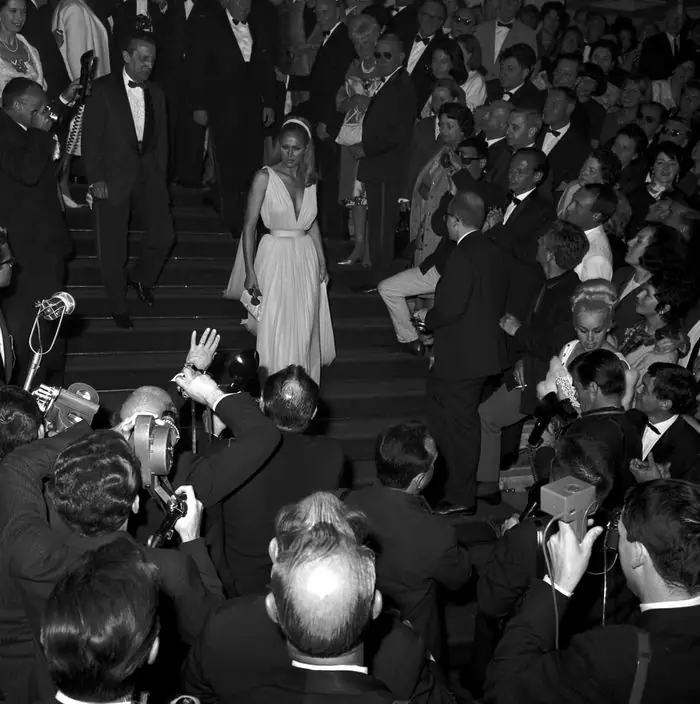
There is a particular quality to the light in late summer on the Côte d'Azur — flat, white, merciless — that has a way of making everything look like a film still. Walk into the Archives départementales des Alpes-Maritimes on the Boulevard du Mercantour in Nice, however, and the light gives way to something cooler and more deliberate: the controlled atmosphere of a building that holds 42 linear kilometres of public and private records, the accumulated paper memory of an entire département. It is an unlikely setting for glamour. Which is, of course, precisely the point.
From 1 September 2026 until 21 May 2027, the Archives are hosting Regards Croisette — Cannes: 80 ans de cinéma, a free exhibition marking eight decades of the Festival de Cannes. Entry is open to all, without charge or reservation.
A Festival That Almost Never Was
The story the exhibition tells begins with an absence. The first international film festival at Cannes was originally scheduled to open on 1 September 1939. It did not. The world chose that particular weekend to go to war, and the programme was cancelled before a single reel had turned. Seven years passed. When peace finally came, the festival opened in the autumn of 1946 — and the international stars who arrived on the Croisette that season helped establish, almost immediately, the mythology that has proved so durable ever since.
'A festival one thinks one knows — wrongly.' That is the premise the curators have set themselves, and it gives the show its particular edge.
The exhibition draws on photographs, posters and archival documents spanning the period from 1939 to 1982, tracing the festival across four decades of postwar history. What is striking about that span is how much turbulence it contains: Cold War tensions, the upheavals of 1968, financial crises, political controversies. The exhibition's implicit argument is that Cannes absorbed all of it — scandals, international friction, the occasional spectacular walkout — without losing its reputation for rigour and a certain hard-won elegance.
What the Archive Reveals
The Archives départementales des Alpes-Maritimes are not a glamorous institution by design. Their six statutory missions — collecting, preserving, classifying, communicating, promoting and supervising records — belong to the grammar of public administration rather than cultural spectacle. Yet it is precisely this institutional seriousness that makes the collection so valuable. The photographs and documents here have not been curated for nostalgia; they have been preserved because they constitute evidence.
For a visitor who knows the festival only through its contemporary incarnation — the red carpet, the press scrums, the branded yachts moored off La Croisette — the archival material is quietly disorienting. The early images show a festival that was smaller, stranger and more provisional than the institution it became. The posters chart the evolution of a visual language. The documents reveal the administrative machinery behind the myth.
Nice is the natural base for this kind of visit. The city sits roughly thirty kilometres east of Cannes along the coast, well connected by train — the journey takes under forty minutes — and with its own deep relationship to cinema, art and the particular social world the Riviera has always attracted. The Archives themselves are on the Boulevard du Mercantour, away from the tourist circuits of the old town and the Promenade des Anglais, in the quieter, more functional northern quarters of the city. That distance from the postcard version of Nice feels appropriate for an exhibition about the gap between image and reality.
The show runs for nearly nine months, which means it accommodates the full arc of the Riviera's seasons: the last of the summer heat, the quieter autumn, the mild Côte d'Azur winter, and the return of warmth in spring. Any of those moments offers a different texture to the visit. Come in October, when the light softens and the summer crowds have thinned, and the walk from the archives back into the city has an unhurried quality that suits the material well.
For anyone with a serious interest in cinema history, or in the cultural geography of the French Riviera, the exhibition at the Archives départementales is a reminder that the most revealing documents are rarely the ones that were meant to be seen. The Cannes festival has generated an enormous quantity of official imagery over eighty years. What survives in an archive is something else: the record of how things actually happened, before the myth had time to settle.