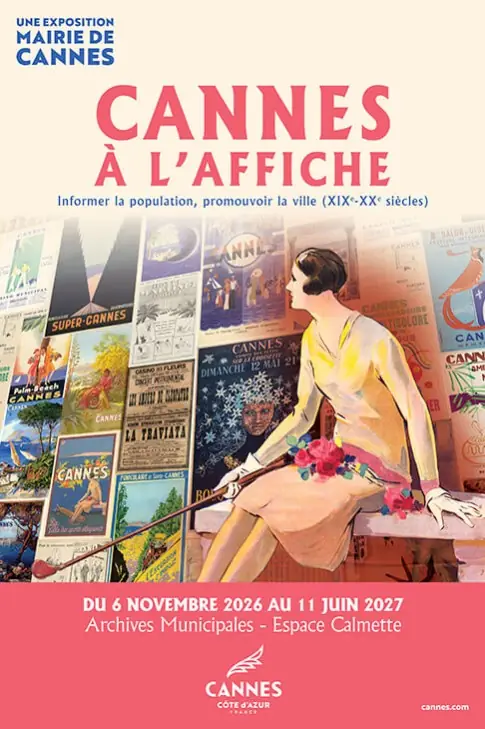
There is a particular quality to old printed paper — the slight give of it under your fingertips, the way ink sits differently on stock that was never meant to last. At the Espace Calmette, tucked into a quiet street behind the bustle of central Cannes, the municipal archives have pulled back their shelves to reveal something that most cities quietly possess but rarely show: the full visual record of how a place spoke to its own people, and to the world beyond.
Running from 6 November 2026 to 11 June 2027, the exhibition Cannes à l'affiche presents a curated selection of posters drawn from the city's own municipal collections, spanning the nineteenth and twentieth centuries. Entry is free. The venue, at 18 rue Docteur Calmette, is the Espace Calmette — Cannes's contemporary archives centre — which makes the setting itself part of the argument: these are not borrowed treasures from a national institution, but documents that belong to the city and have been kept here all along.
The Poster as Public Speech
The exhibition is organised around a deceptively simple premise: the poster, before it became a collector's object or a design-school reference, was a tool for catching the eye of a passer-by. The selection covers the full range of what a city needed to say — administrative notices, legal announcements, political messages, commercial advertising — and in doing so, it maps the changing relationship between civic authority and the public street. A municipal decree and a hotel advertisement share the same medium; what separates them is tone, colour, and the particular urgency of their moment.
The technical turn that made all of this visually possible was chromolithography. From the late nineteenth century onward, the process allowed printers to build images from layered colour — a slow, skilled craft that gave illustrators and commercial artists the means to produce work of genuine pictorial ambition at scale. The posters that emerged were not merely functional; they were, by any reasonable measure, prints. Artists and professional designers brought to them the same compositional thinking they applied to other work, and the walls of a French city became, for a few weeks at a time, a kind of open gallery.
'L'affiche comme outil de communication visuelle destiné à informer et à frapper le regard du passant' — the exhibition's own framing captures what made the medium matter: it had to work instantly, in the open air, against every competing distraction.
Cannes, Framed and Promoted
What gives this particular collection its additional layer of interest is the role Cannes itself played in the story of touristic self-promotion. By the late nineteenth century, the town had already been reshaped by the arrival of the railway and the sustained attention of British and Russian aristocracy — Lord Brougham's long winters here in the 1830s are the origin story the city still recites. But awareness had to be manufactured and maintained, and the poster was one of the primary instruments for doing so. The exhibition draws out this strand explicitly: posters promoting Cannes as a destination for tourism, culture, and sport sit alongside the administrative and political material, showing how a single medium served both the internal life of a municipality and its outward projection to potential visitors.
That dual function — speaking inward and outward simultaneously — is perhaps what makes the collection feel so contemporary. The questions it raises about image, audience, and the management of a city's reputation have not become less relevant; they have simply migrated to other surfaces.
The Espace Calmette is not a large venue, which suits the material well. Archives are intimate by nature, and the scale here encourages the kind of close looking that these objects reward. Visitors who make the short walk from the Croisette will find themselves in a different register of the city entirely — one measured not in film premieres or yacht berths, but in the patient accumulation of civic memory.
The exhibition runs through the spring and into early summer, which means it will be open during the Cannes Film Festival in May — a quietly ironic context for a show about the long history of public image-making in a city that has become, in the past eighty years, perhaps the most photographed promotional backdrop in Europe. Worth noting the continuity.