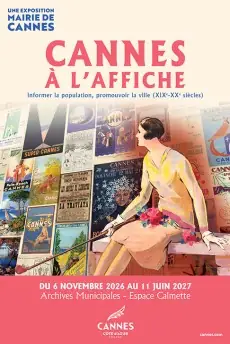
There is a particular pleasure in reading a city backwards — not through its monuments or its menus, but through the paper it once stuck to its walls. At the Espace Calmette, tucked into the rue Docteur Calmette in the older, quieter quarter of Cannes, the municipal archives hold exactly this kind of evidence: sheets of chromolithographed colour that once shouted at passers-by from hoardings, kiosks and station walls, and that now, behind glass, speak at a more considered volume.
On Friday, 20 November 2026 at 3 p.m., the Espace Calmette — Cannes' contemporary archives centre — hosts a one-hour guided visit of the exhibition Cannes à l'affiche : informer la population, promouvoir la ville (XIXe–XXe siècles). The visit, which requires advance reservation, costs €5.50 at standard rate, €3.50 for Cannes residents and Pass Culture holders, and is free for under-18s, job-seekers, and holders of a mobility inclusion card.
The Poster as Urban Mirror
The exhibition draws from the city's own municipal collections to trace a medium that was, for roughly a century, the primary technology of mass communication. Before radio, before cinema newsreels, before the internet turned every surface into a screen, the illustrated poster was how a city spoke — to its residents about regulations and elections, to its visitors about sunshine and regattas and grand hotels. The show examines this dual function without collapsing it into nostalgia: the administrative poster (legal notices, civic obligations) sits alongside the promotional one, and the tension between the two is part of what makes the material interesting.
The chromolithographic revolution of the late nineteenth century is the technical hinge on which the whole story turns. Before chromolithography made it possible to print in multiple colours at commercial scale, the public poster was largely typographic — legible, functional, visually inert. The process that arrived in the 1870s and 1880s changed everything. Artists could now design for the street with the same ambition they brought to the canvas; the result was a new genre that blurred the line between advertising and fine art. Toulouse-Lautrec in Paris, Alphonse Mucha across Europe — the poster became a collector's object almost as soon as it became a mass medium.
Cannes, Imagined and Sold
For Cannes specifically, the stakes were high. The town's transformation from a modest fishing village into one of Europe's most fashionable winter resorts was, in no small part, a project of image management. Lord Brougham's accidental sojourn in 1834 may have set the social machinery in motion, but it was the railway's arrival in 1863, and the promotional apparatus that followed, that converted a reputation into an industry. The posters in this exhibition are artefacts of that conversion: they show how Cannes wished to be seen — by the English aristocracy, by the Parisian bourgeoisie, by the international sporting set who came for the sailing and the tennis — and how that wished image was refined, updated and occasionally reinvented across the decades.
Tourism, culture, sport: the exhibition maps all three promotional registers. A city that hosted regattas, casino evenings and early film screenings needed different visual languages for each, and the archive preserves the evidence of how those languages were developed and deployed.
'L'affiche illustrée' — the illustrated poster — was not merely decoration. It was the first interface between a city and its audience.
The guided format matters here. Cannes' municipal archives are a specialist institution, and the exhibition's material rewards the kind of contextual reading that a knowledgeable guide provides. An hour is a considered duration: long enough to move through the chronology with some care, short enough to leave the visitor wanting to look again.
Reservation is obligatory. The Espace Calmette is at 18 rue Docteur Calmette, 06400 Cannes. For those who believe that the most honest portrait of a place is found not in its official history but in what it chose to advertise — this afternoon offers a quietly compelling argument in favour of that view.