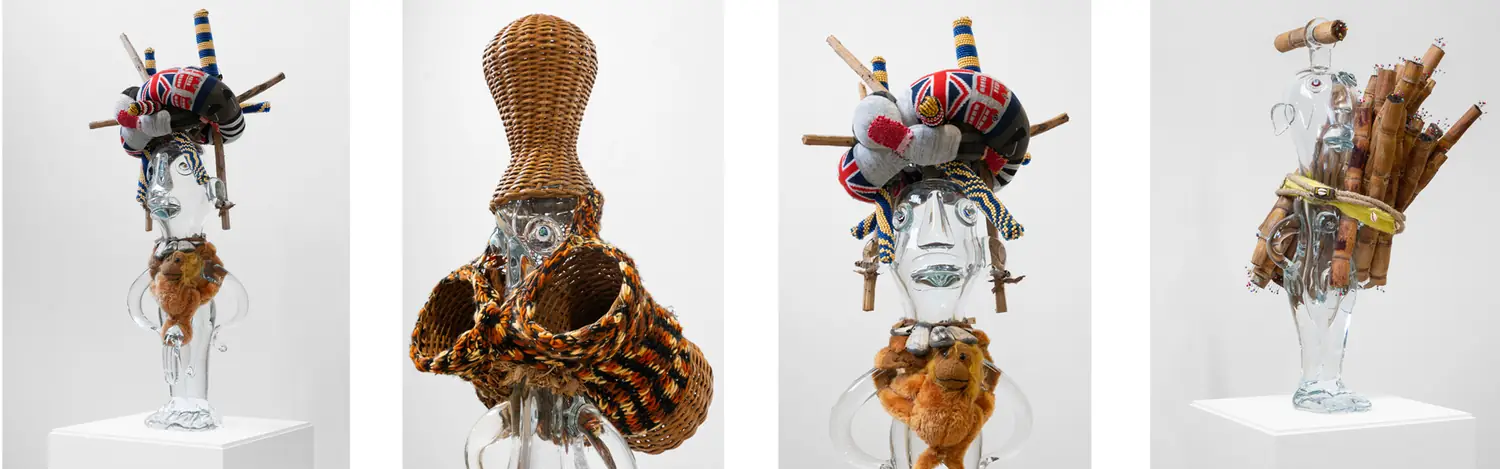
There is a particular quality of light in Vallauris in summer — thick, almost resinous, the kind that collects in the courtyard of the old château and refuses to move until evening. The town sits a few kilometres inland from the Golfe-Juan, its streets still carrying the faint mineral smell of fired clay, a reminder that potters have worked this hillside since the Romans. It is not a place that performs for visitors. It simply continues, and that self-sufficiency is part of what makes it worth the detour.
At the centre of the château complex stands the Romanesque chapel that houses the Musée National Picasso — La Guerre et la Paix. In 1952, Pablo Picasso painted directly onto the barrel-vaulted interior two monumental compositions: 'La Guerre' and 'La Paix'. The panels, rendered in his most declarative manner, have remained in place ever since, classified as a national monument. The chapel does not hang art; it is art. Which makes it an unusually demanding space for any artist invited to respond to it.
A Commission Written for This Space
During the summer of 2026, the museum extends precisely that invitation to Pascale Marthine Tayou. The Cameroonian-Belgian artist — born in Yaoundé in 1967, long based in Ghent — has been asked to create a project conceived specifically for this chapel in Vallauris. The exhibition opens on 4 July 2026.
Tayou's practice resists easy summary. Over three decades he has worked across sculpture, installation, video and drawing, consistently returning to questions of identity, migration, globalisation and the friction between cultures. His installations tend to be physically generous — cascading objects, vivid colour, materials sourced from multiple continents — yet the underlying arguments are precise. He is not an artist who decorates a room; he reorganises the logic of it.
'Le musée national Pablo Picasso – La Guerre et La Paix invite l'artiste Pascale Marthine Tayou à présenter un projet spécialement conçu pour la chapelle de Vallauris.'
The phrase 'spécialement conçu' — specially conceived — carries weight here. This is not a travelling retrospective finding a temporary home. Whatever Tayou produces will have been made in direct dialogue with the vaulted stone interior, with Picasso's painted panels, with the chapel's history as a site where an artist once made a statement about the cost of war and the possibility of peace. The conversation implied by that context is not a comfortable one, and there is every reason to think Tayou will not make it comfortable.
Vallauris Beyond the Museum
The town itself rewards an unhurried morning. The main street, Avenue Georges Clemenceau, is lined with ceramic workshops — Vallauris became synonymous with studio pottery in the postwar decades, partly because Picasso's presence here between 1948 and 1955 drew international attention to its craftspeople. The Musée Magnelli, housed in the same château complex, holds a significant collection of abstract art alongside a ceramics museum. The market on Place de la Libération, directly outside the chapel entrance, runs on weekend mornings and deals in the produce of the arrière-pays: olives, lavender honey, courgette flowers.
For those arriving from the coast, Vallauris is roughly equidistant between Cannes and Antibes — twenty minutes by car, longer and more interesting by the local bus that winds up through the pines. Golfe-Juan, the nearest train stop on the Marseille–Ventimiglia line, is a fifteen-minute walk downhill from the château.
The exhibition continues through the summer of 2026; visitors are advised to check the museum's official website — musees-nationaux-alpesmaritimes.fr/picasso — for confirmed opening hours and any ticketing arrangements, which had not been announced at the time of writing.
To stand inside that chapel in July, with Picasso's war horse rearing across the vault and Tayou's response occupying the same air, is to be in the presence of two artists thinking hard about the same questions across seventy years of distance. Vallauris has always been a town that takes the making of things seriously. This summer, the chapel gives that seriousness a new form.