There is a particular quality of light on Le Suquet, the old hill quarter that rises above Cannes like a footnote the city keeps forgetting to explain. From the esplanade of the Castre, you can see the Lérins islands lying flat in the bay, the Croisette curving away below, and — if the mistral has done its work — the Alps faint and white to the north. It is the kind of view that makes the building behind you easy to overlook. Which would be a mistake.
The Musée des explorations du monde occupies a former monastery on Place de la Castre, a setting that already carries the weight of accumulated journeys. This summer, the museum turns its attention inward — to its own holdings — with 'De l'Orient à Cannes', an exhibition presenting the museum's restored oriental collection. It runs from 29 June to 9 September 2026, with evening openings on Wednesday nights through July and August.
A 19th-Century Reverie, Carefully Restored
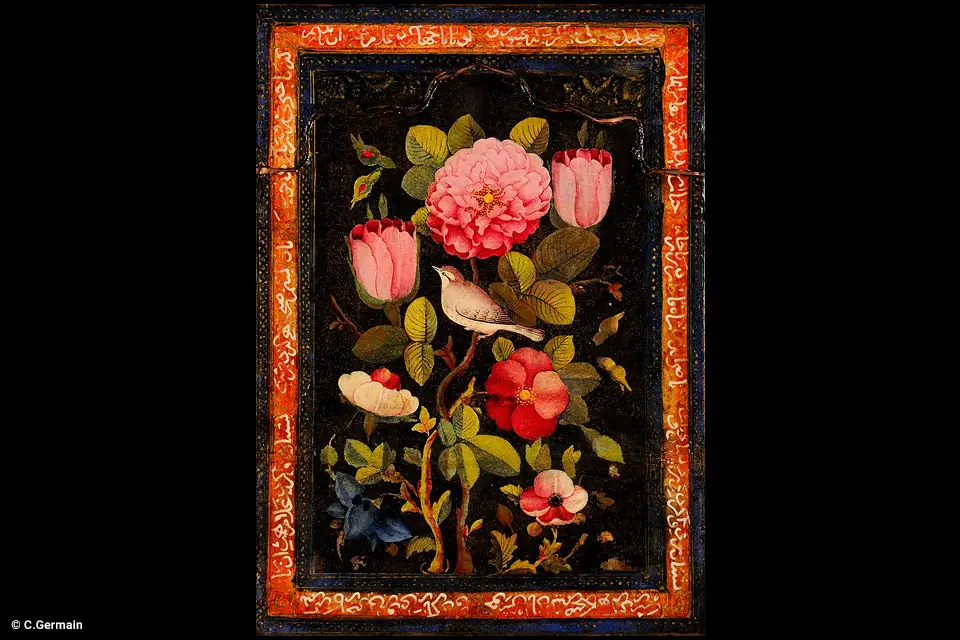
The exhibition takes as its subject the orientalist imagination of the 19th century — that particular European longing for an East that was as much invented as observed. Objects of refined craftsmanship sit alongside depictions of gardens: the poetic and the botanical in conversation. The restored pieces are the centrepiece, and the curatorial framing is honest about what orientalism was — a vision, a projection, a dream shaped as much by desire as by documentation.
The 19th century produced a vast literature of that dream along this coast. Painters, writers, and collectors arrived in the South of France carrying notebooks and an appetite for the exotic; some continued east, others simply imported what they could. The objects now in the Castre collection are traces of that movement — the residue of journeys real and imagined, filtered through the hands of craftsmen whose names the collectors rarely thought to record.
'Elle offre une vision paradisiaque à la fois poétique, artistique et botanique' — the museum's own description of the exhibition, and a useful reminder that paradise, in the orientalist tradition, was always a garden.
The botanical dimension deserves attention. Garden imagery in orientalist art was never merely decorative; it carried a symbolic charge inherited from Persian poetry and Islamic architecture alike — the garden as paradise, as order imposed on wilderness, as a space where beauty was a form of argument. Seeing that iconography restored and re-presented in a medieval monastery above the Mediterranean gives it an additional layer of resonance.
What to Expect on a Visit
The museum's address — Place de la Castre, Le Suquet — is worth taking seriously as a destination in itself. The walk up through the old town, past the covered market and the steep lanes of the quarter, is part of the experience. Allow time before or after.
Practical matters: - Standard admission is €6.50, with a reduced rate of €3.50 for visitors aged 18–25, holders of the Cannes Pass Culture, and groups of ten or more adults - Free entry for under-18s, students, job-seekers, and visitors with a disability card (plus one companion) - Guided visits are available at an additional €2 on top of the entry ticket - Opening hours vary by month; Wednesday evening openings in July and August offer a cooler, quieter alternative to the midday heat
The Wednesday nocturnes are worth planning around. Cannes in July is a city of considerable noise and movement at street level; the Castre at dusk, with the bay going gold below and the galleries relatively uncrowded, is a different proposition entirely.
For a summer that will otherwise be defined by beach clubs and festival schedules, 'De l'Orient à Cannes' offers something the Croisette rarely does: a reason to climb the hill, slow down, and look at something that required patience to make and has required patience to preserve. The restored collection is the occasion; Le Suquet, as ever, provides the frame.