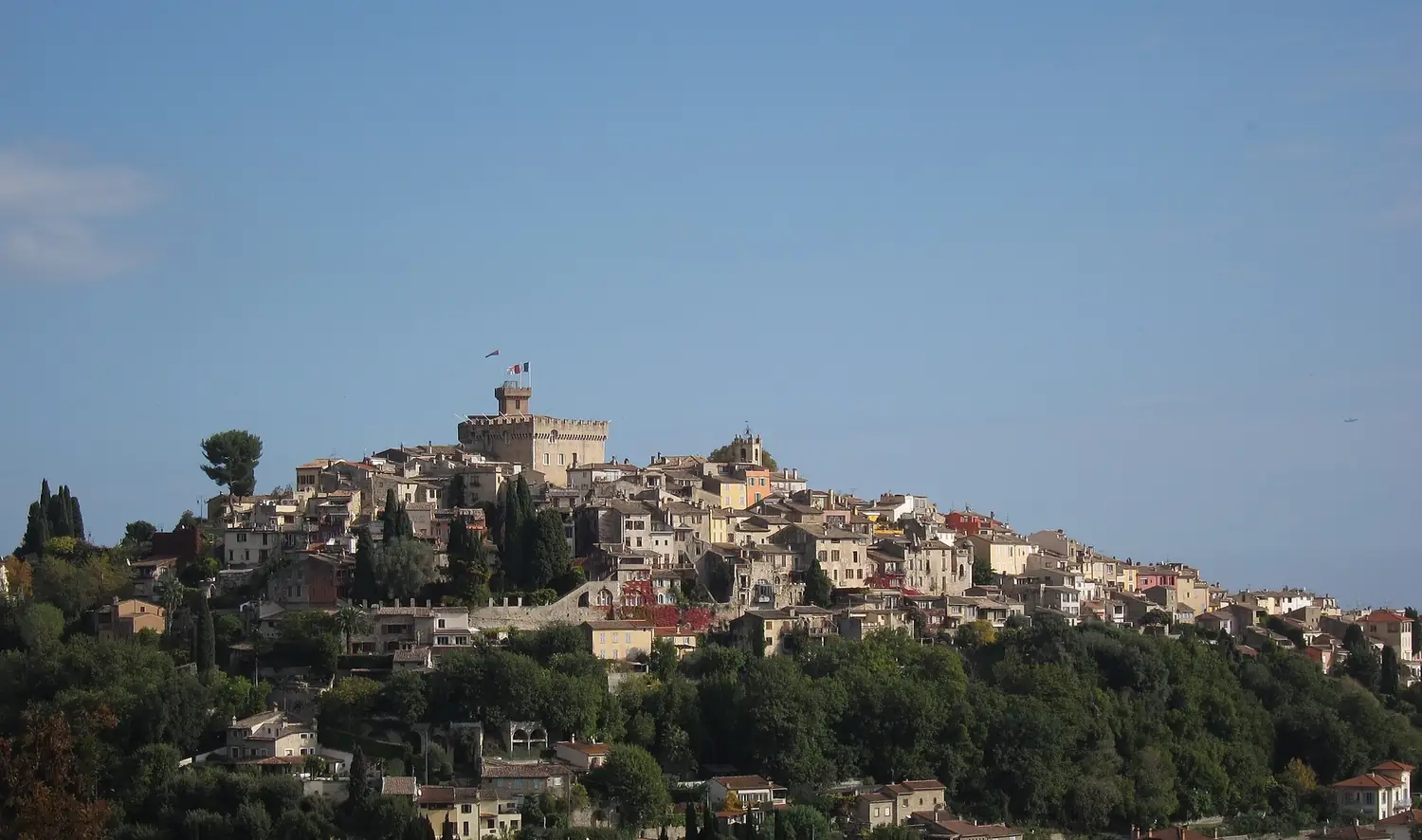
There is a particular stillness to the Haut de Cagnes on an October afternoon. The medieval quarter rises above the coast in tiers of ochre and shadow, its lanes too narrow for anything faster than a slow walk, its views over the Baie des Anges wide enough to stop conversation entirely. It is the kind of place that has always attracted artists — Renoir spent his final years on this hillside, and Soutine, Modigliani and Simone de Beauvoir each found their way here at some point. That history does not feel decorative. It feels present.
It is against this backdrop that the Musée du Bijou Contemporain — Espace Solidor opens L'Art de la Citation on 24 October 2026. The exhibition is housed within the Place du Château complex in the heart of Haut de Cagnes — a setting that is itself a kind of cultural quotation, a living medieval structure repurposed as a space for contemporary thought.
The Idea Behind the Work
The exhibition was conceived by curator Elsa Vanier and brings together eleven makers of contemporary jewellery, each of whom has drawn, deliberately and explicitly, from the work of recognised artists to create something new. The premise is as rigorous as it sounds: these are not tributes or homages in the loose, sentimental sense. They are acts of formal dialogue — a jeweller studying a painter, a sculptor, a photographer, and then translating what they find into wearable form. The result is a conversation across media, across time, and in some cases across centuries.
The French tradition of la citation — the quotation — carries weight in visual culture. To cite another artist is to acknowledge a lineage, to place your own work within a larger argument. In literature it signals erudition; in music, influence; in the visual arts, it can be an act of critique, reverence, or reinvention. That jewellery — an art form often dismissed as decorative or minor — should be the medium through which these citations are made is precisely the point. A brooch can hold as much intellectual freight as a canvas, if the maker asks it to.
'Eleven creators, eleven dialogues with recognised artists' work — each piece a translation into metal, stone, and form.'
What to Expect in the Galleries
The Espace Solidor occupies rooms within the château that have their own presence — thick walls, uneven light, the faint smell of old stone. Works of contemporary jewellery tend to reward close looking in a way that larger objects sometimes do not: scale forces attention, and the decisions a maker takes at two or three centimetres become legible in a way they would not at two metres. Visitors here will have the chance to read those decisions carefully, moving between eleven distinct artistic sensibilities and the source works that inspired them.
Because the exhibition opens in late October, the crowds of high summer are long gone. The Haut de Cagnes at this time of year belongs largely to those who sought it out. The light is lower and more directional, the colours of the hillside shifting from the bleached palette of August toward something richer. It is, by most accounts, the more interesting season to be on the Côte d'Azur.
Cagnes-sur-Mer sits between Nice — twenty minutes east — and Antibes, and is straightforward to reach by regional train. The château quarter is a short walk uphill from the lower town, and the effort of the climb is part of the arrival. There are small restaurants on the Place du Château and in the lanes below; none of them are in a hurry.
For anyone with a sustained interest in contemporary craft, in the relationship between fine art and applied art, or simply in the question of what it means to make something new from something already made, this exhibition offers a precise and considered answer. Eleven makers. Eleven conversations. One medieval room on a hill above the sea.