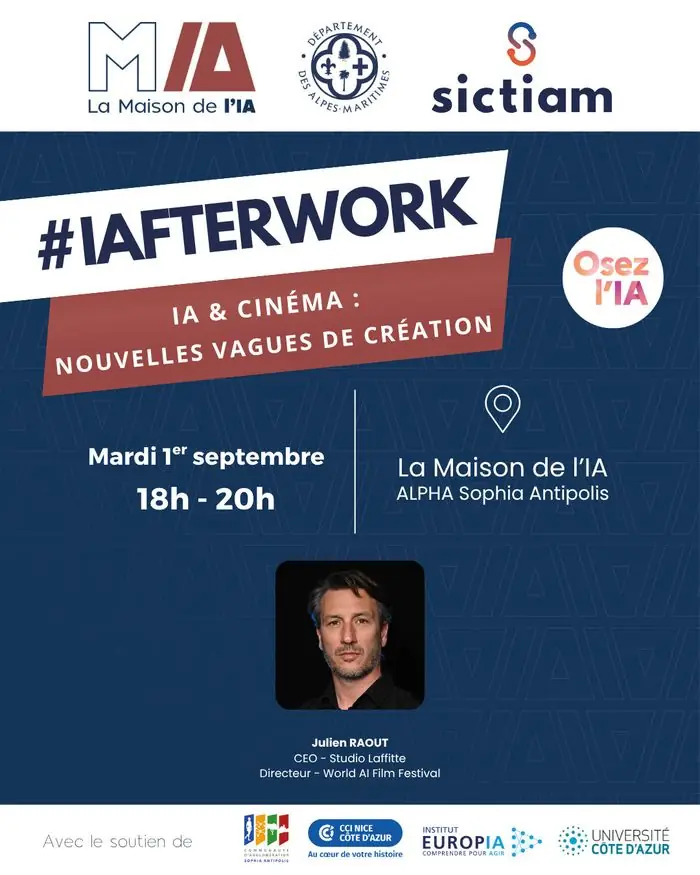
There is a particular quality to early September evenings on the Côte d'Azur — the light softens without surrendering, the heat relents just enough, and the Sophia Antipolis technology park, ordinarily given over to the quiet hum of research and code, takes on a different register. On the first of September, the Pôle Alpha in Biot will host the eleventh edition of the IAFTERWORK series, and the subject this time is one that has unsettled creative industries across the globe: artificial intelligence and cinema.
The IAFTERWORK gatherings have built a reputation in the region as a forum where technologists, creators and the simply curious meet on equal footing — no keynote grandstanding, no vendor theatre. This eleventh edition, running from 18h to 20h, arrives at a deliberate moment: it is conceived as a prelude to the Cinema & Moving Image Summit taking place in nearby Saint-Paul de Vence, extending the conversation from the formal conference circuit into something more immediate and interactive. Entry is free, by registration.
What the Evening Holds
The programme moves across the full arc of what AI is already doing to audiovisual creation — from the early stages of scriptwriting and scenario development through to image generation, visual effects, and the synthesis of video sequences. The format is designed to keep things concrete: analyses of how the tools are being used, clips and film extracts chosen to illustrate specific points, and live demonstrations of the software that practitioners are reaching for today. The organisers describe it as an exchange — a temps d'échange interactif — which in practice means there is room for the audience to push back, ask questions, and bring their own experience into the room.
The ethical dimension is not treated as an afterthought. Questions around authorship, the displacement of craft roles, and the provenance of training data run through the evening's framing from the outset. These are not abstract anxieties; they are live disputes inside production houses, guilds and film schools from Los Angeles to Paris. Hearing them discussed in a room of engineers, directors and artists on the edge of the Alpes-Maritimes has a particular charge.
'L'IA bouleverse déjà les codes de la création audiovisuelle et ouvre de nouvelles perspectives aux réalisateurs, scénaristes et artistes, en posant des questions éthiques.' — programme description, IAFTERWORK #11
The Setting and Its Context
Biot sits above the bay of Antibes, a medieval village of glassblowers and arcaded squares that has, over the past four decades, found itself neighboured by one of Europe's most significant technology clusters. Sophia Antipolis — the science park that stretches across the plateau between Biot, Valbonne and Mougins — houses research centres, startups and the European offices of multinationals. The Pôle Alpha, on the Route des Chappes, is part of this infrastructure: a working venue for the ecosystem rather than a showpiece, which gives events held there a certain no-nonsense quality that suits the IAFTERWORK format well.
The proximity to Cannes, twenty minutes to the south-west, is never incidental when cinema is the subject. The Croisette and its festival belong to the world of premieres and prizes; Sophia Antipolis belongs to the world of what comes next. The tension between those two cultures — one rooted in the romance of the auteur, the other in the logic of the algorithm — is precisely what the evening is designed to examine.
Admission is free and open to all, but places require advance registration, which is standard for the IAFTERWORK series and keeps the conversation at a workable scale. The evening runs from 18h to 20h — long enough to go somewhere, short enough to hold its shape.
For anyone spending early September between Nice and Cannes with a serious interest in where image-making is heading, this is a two-hour commitment that asks very little and offers, at minimum, a sharper set of questions to carry into the rest of the season.