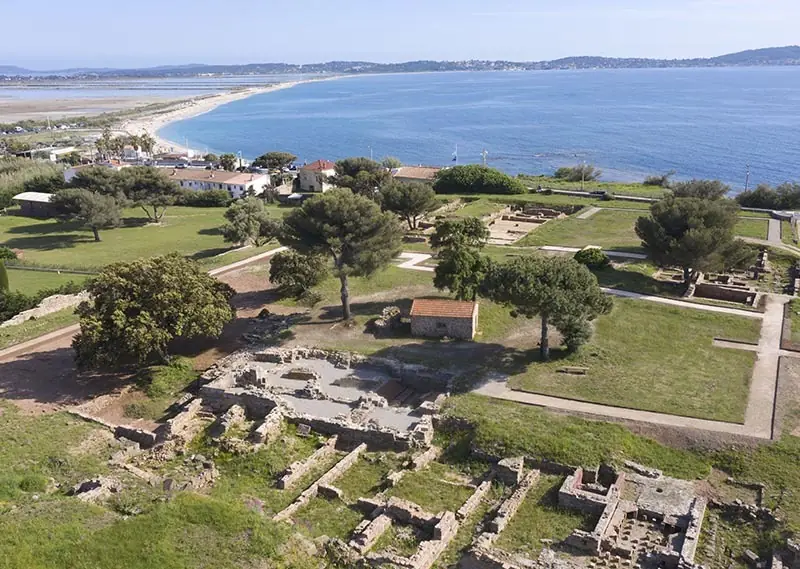
The mistral had dropped overnight, and by half past seven the light over the Almanarre peninsula was already doing what Provençal light does in June — arriving sideways, low and honey-coloured, making every worn edge of limestone look deliberate. The road that leads out from Hyères toward the coast passes salt flats and reed beds before the ground lifts, just slightly, into a promontory above the sea. It is here, on that modest rise, that the walls of Olbia have been standing — in one form or another — for more than two thousand years.
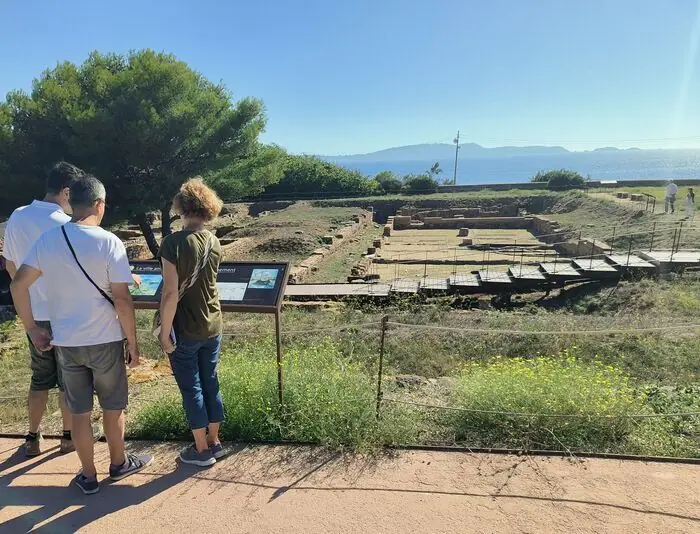
On 12, 13 and 14 June 2026, the Site archéologique d'Olbia at Route de l'Almanarre, 83400 Hyères, opens its gates for a parcours autonome — a self-guided walk through the archaeological park. There is no ticket to buy, no reservation to make, and no guide to follow. Entry is free and available on a first-come basis, within the capacity of the site. The vestiges are accessible from 11h30 to 16h30, with last entry one hour before closing. Visitors with reduced mobility are welcome, and an audioguide is available on loan for the visually impaired. The visit takes between 45 and 60 minutes, structured around a series of stations; the support material can be downloaded in advance from hyeres.fr.
A Colony at the Edge of the Greek World
Olbia is not a ruin in the romantic sense — not a single column rising from scrub. It is something rarer: a complete Greek urban plan, preserved in its entirety, and the only surviving example of a network of fortress-colonies founded by Massalia (modern Marseille) from the fourth century BC onward. The first Olbians were citizen-soldiers from Massalia — farmers and fishermen by practice, but colonists by mission, tasked with securing the maritime trade routes that ran along this stretch of coast. They built with intention: fortifications, streets with drainage channels and raised pavements, a collective well, residential blocks subdivided into houses and workshops, thermal baths, sanctuaries. The grid they laid down was not abandoned when Rome arrived; it evolved. Visitors today can trace a full millennium of urban history across a single site.
Then, centuries later, another layer: the vestiges of a medieval abbey, Saint-Pierre de l'Almanarre, discovered within the same perimeter. The site holds Greek, Roman and medieval time simultaneously, without apology.
'Les vestiges mis au jour permettent aux visiteurs de comprendre l'évolution urbaine d'une ville antique sur 1000 ans.'
What a Morning Here Actually Looks Like
The walk is unhurried by design. Forty-five to sixty minutes is the estimate, but the pace is entirely your own. The station-based itinerary — available as a downloadable guide from hyeres.fr before you arrive — structures the route without narrating it into submission. You move between the remains of a fortification wall and the outline of a Roman street, between the hollow of a collective cistern and the ghost of a sanctuary floor, reading the explanatory panels at whatever speed suits the heat and your curiosity.
The setting amplifies everything. Olbia sits on its slight headland with the Mediterranean visible beyond the site boundaries — the same water the Massalian colonists crossed, the same horizon their merchant ships worked. The Giens peninsula closes the view to the south; the Îles d'Hyères — Porquerolles, Port-Cros, the Île du Levant — float offshore in the haze. It is the kind of landscape that makes historical imagination easy, almost involuntary.
For those planning the visit practically: the site is accessible to visitors with reduced mobility, and the audioguide loan service for visually impaired visitors is available on-site. No advance booking is required, though the free-entry format means that popular morning hours may fill quickly. The surrounding area — the Almanarre beach, the salt lagoons of the Giens peninsula — offers a full day's worth of reason to stay in this corner of the Var.
Hyères is one of the oldest resort towns on the French Riviera, favoured by the British aristocracy in the nineteenth century precisely because it sits slightly apart from the more theatrical glamour of Cannes and Nice. That quality of restraint — serious landscape, serious history, fewer crowds — persists. A June morning at Olbia, with the stones warm and the sea in view, is a fair summary of what the town does best: offering the coast on its own terms, without performance.