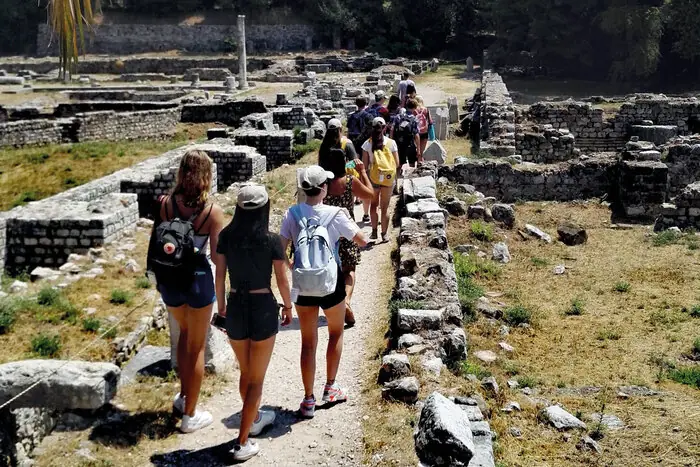
There is a particular quality of light on the Cimiez hill in early summer — slanted, unhurried, filtered through the umbrella pines that have colonised the old Roman terraces. By half past eight in the morning, before the heat settles in earnest, the stones here still hold a faint coolness. It is the right hour to walk among them.
On 13 and 14 June 2026, the Musée archéologique de Cimiez opens its grounds for an archéo-balade — a guided archaeological walk through two of the site's most significant ensembles: the ancient thermal quarter and the early Christian episcopal complex. No reservation is required, though flat shoes and a hat are advised, which tells you something about the nature of the morning: this is an outdoor affair, conducted under open sky, across real ground.
The City Beneath the City
Cimiez was not always a residential neighbourhood of quiet villas and rose gardens. For several centuries, it was Cemenelum — the administrative capital of the Roman province of Alpes Maritimae, a territory that stretched from the coast into the Alpine interior. The town had its forum, its amphitheatre, its baths. When the Western Empire contracted and the centre of gravity shifted to the coast below, Cemenelum did not disappear so much as it subsided — layer by layer, garden by garden — into the hill.
The excavations carried out between 1950 and 1969, on land acquired by the municipality of Nice, brought much of it back. The museum's collections reflect the full texture of provincial Roman life: official documents alongside private objects, civic inscriptions alongside domestic fragments. The reach extends beyond Cimiez itself — artefacts from across the region are represented here, including objects recovered from the wreck of the Fourmigue C, found off the coast near Golfe-Juan, a reminder that this stretch of the Mediterranean has always been a corridor of movement and exchange.
'The thermal quarter and the episcopal complex together tell the story of a town that changed its faith without abandoning its bones.'
The thermal baths at Cemenelum are among the best-preserved Roman remains on the Côte d'Azur. Three distinct bathing complexes have been identified on the site — northern, southern, and eastern — each representing a different period of construction and social use. To walk through them with a guide is to understand not just the engineering, but the rhythm of daily life they once organised: the sequence of cold and hot rooms, the social function of the caldarium, the sheer civic ambition encoded in the stonework.
The episcopal group — the groupe épiscopal — tells a later chapter. As Christianity became the religion of the empire and then of its successor states, the old Roman infrastructure was repurposed, overbuilt, reimagined. Baptisteries were carved from earlier structures. The hill that had housed a Roman administration became a Christian one. The layers are literal: you can, in places, see them.
What the Morning Holds
The walk is guided, which matters on a site of this density. Without orientation, the thermal ruins can read as a pleasant confusion of stone walls and grassy gaps. With it, the spatial logic of a Roman town becomes legible — the relationship between public bathing, civic identity, and urban planning snaps into focus.
A few practical notes for those planning to attend:
- Entry is on a first-come basis, with no advance booking
- Flat-soled shoes are essential; the terrain is uneven in places
- A hat is recommended — the site is largely unshaded by mid-morning
- The museum is located at 160 avenue des Arènes de Cimiez, in the north of Nice
The Cimiez neighbourhood itself rewards the journey. The Franciscan monastery and its gardens sit nearby; the Matisse Museum occupies a seventeenth-century villa a short walk away. Nice's old town, with its Baroque churches and morning market on the Cours Saleya, is twenty minutes downhill by foot or a few minutes by tram.
June in Nice runs warm and bright, the days long enough that an early start leaves the afternoon entirely free. The archéo-balade begins at 8:30 — early enough that the hill is still quiet, the light still oblique, the stones still cool to the touch. There are worse ways to spend a Saturday morning than standing in a Roman bathhouse, two thousand years of Mediterranean history arranged at your feet.