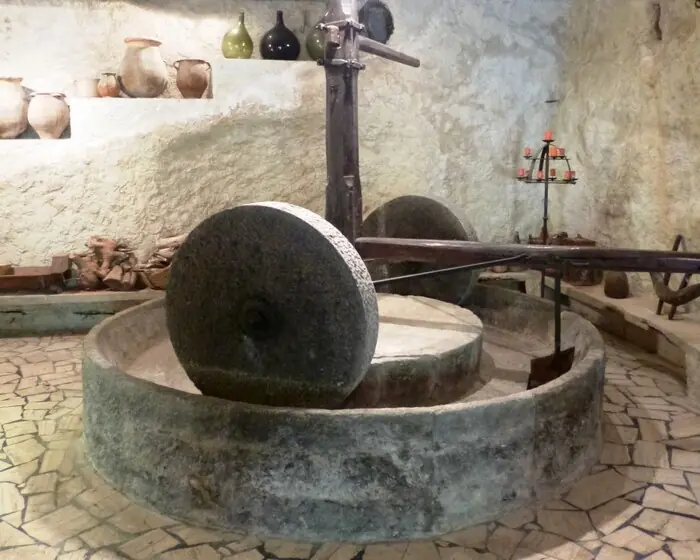
There is a particular quality of light in Ramatuelle in September — lower than in July, less aggressive, the kind that catches the dust motes above old stone and makes them look deliberate. The crowds that descend on Saint-Tropez each summer have largely retreated by then, and the village — perched on its ridge above the Maures massif, its streets barely wide enough for two people to pass — returns to something closer to itself. It is in this interval, between the season's end and the autumn rains, that the Moulin à huile du Faubourg makes most sense.
On 18 and 19 September 2026, as part of the Journées Européennes du Patrimoine — the annual European Heritage Days that open thousands of historic sites across the continent — the oil mill on rue du Clocher will open its doors to visitors, free of charge. It is one of those events that rewards the traveller who plans ahead but travels slowly.
A Mill on a Street Named for a Bell Tower
The address alone tells a small story. Rue du Clocher — the street of the bell tower — runs through the old faubourg, the historic suburb that grew beyond Ramatuelle's medieval walls. The moulin à huile, an olive oil mill, sits within this fabric of Provençal vernacular architecture: thick walls built to keep out both heat and cold, spaces designed around function rather than ornament. Olive milling is one of the oldest continuous industries of the Var département. The coastal hills between Toulon and Saint-Tropez have grown olives since antiquity, and the infrastructure that processed them — the mills, the stone presses, the great wooden beams of the screw presses — became as embedded in village life as the church or the market square.
Mills of this kind were not picturesque by design. They were working buildings, often running through the night during the harvest months of November and December, when families would bring their olives and wait their turn. The smell of fresh-pressed oil — green, grassy, faintly peppery — would have been the smell of the season. Many such mills across Provence have since been converted, abandoned, or lost entirely. That one survives in Ramatuelle, and that it is being made accessible to the public, is worth noting.
What the Weekend Offers
The European Heritage Days framework is straightforward: sites that are normally closed, or rarely open to casual visitors, make themselves available over a single September weekend. Entry to the Moulin à huile du Faubourg is free. The visit takes place across both days, with doors opening at 13:00 on Friday 18 September.
What a visitor actually encounters inside will depend on the mill itself — its condition, its equipment, the degree to which the original machinery survives. What can be said with confidence is that buildings of this type typically retain their stone grinding wheels, their press beds, and the channels cut into the floor to guide the oil. These are not reconstructions. They are the things that were used.
Ramatuelle is twelve kilometres from Saint-Tropez by road, and the drive through the Maures — past cork oaks and vineyards, the hills silvered with olive trees — is part of the experience. The village has a weekly market, several good restaurants, and the kind of café terraces where an espresso can reasonably take an hour. September is an excellent month to be here: the rosé harvest in the surrounding Côtes de Provence vineyards is either underway or freshly complete, and the light, as noted, is doing its best work.
'Le patrimoine, c'est ce que nous recevons et ce que nous transmettons' — the phrase the Heritage Days organisers return to each year, and one that a working mill, still standing, makes concrete rather than abstract.
For a traveller already on the Côte d'Azur in mid-September, or one planning a route through the Var, the mill on rue du Clocher offers something that most of the region's heritage sites do not: the chance to stand inside a building that was built to do something specific, and still looks as though it could.