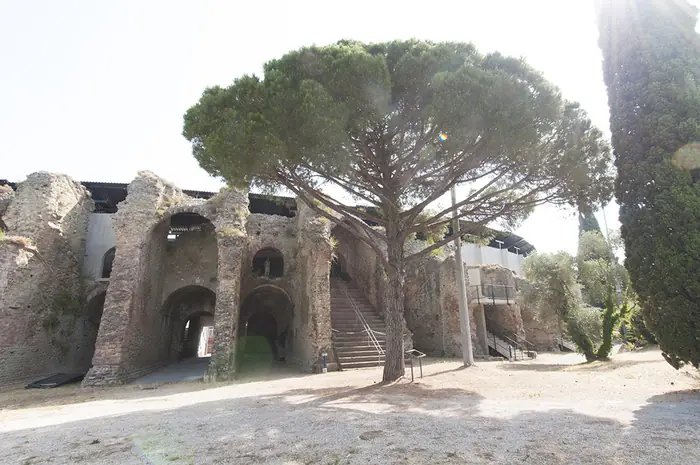
The Var coast in early June carries a particular quality of light — low in the morning, almost white by noon, casting hard shadows across pale stone. At 296 Rue Henri Vadon, on the northern fringe of Fréjus, those shadows fall across walls that have been absorbing them for nearly two thousand years. The Amphithéâtre romain, known locally as the Arènes, sits just outside what was once the Porte des Gaules — the old Gallic gate — in a position that was never accidental. Roman urban planners placed amphitheatres at the edge of cities deliberately: visible from the road, impossible to ignore, a statement of colonial power addressed as much to arrivals as to residents.
On 13 and 14 June 2026, the monument opens its gates for a dedicated two-day visit event, offering access to one of the best-preserved Roman structures on the French Riviera. The arena at 296 Rue Henri Vadon is the address; the hours begin at 8:00 in the morning, when the stone is still cool and the crowds have not yet gathered. Admission conditions are to be confirmed via the city's heritage office at ville-frejus.fr.
Forum Iulii and the Weight of Elliptical Stone
Fréjus — Forum Iulii in its Roman incarnation — was founded by Julius Caesar and developed under Augustus into one of the most significant naval and administrative centres of Gallia Narbonensis. The amphitheatre was erected at the beginning of the second century CE, its elliptical tiers designed so that every inhabitant of the colony could share, simultaneously, the same spectacle: beast hunts, gladiatorial combat, public ceremony. At its peak, the structure held upwards of ten thousand spectators — a considerable figure for a provincial town, and a measure of the ambitions its founders held for this stretch of coastline between the Maures massif and the sea.
What stands today is the product of a long, layered history of use and reuse. Through the medieval period and into the modern era, the amphitheatre's dressed stone was systematically quarried to build the city that grew up around it — a fate common to Roman monuments across Provence, where the past has always served the present with a certain pragmatism. The result is a ruin that reads, in places, like a palimpsest: Roman courses interrupted by medieval repairs, gaps where entire sections were carried away to become someone's church wall or market arcade.
'Les vestiges encore visibles aujourd'hui sont le résultat de plusieurs siècles d'utilisation et de réemploi des matériaux pour construire la ville médiévale et moderne.' — Ville de Fréjus, patrimoine
Conservation, Slowly and Carefully
Between 2008 and 2012, the amphitheatre was the subject of a substantial conservation and enhancement project under the Plan Patrimoine Antique — a national framework for the protection of ancient sites. The work was not reconstruction in any theatrical sense; it was stabilisation, documentation, and the careful presentation of what survives. The result is a monument that makes no attempt to look more complete than it is, which gives it a credibility — and a melancholy — that fully restored sites sometimes lack.
Visiting across the two June days, a guest moves through the elliptical interior where the central arena floor once held sand to absorb what the games produced. The surviving tiers give a clear sense of the original geometry; the ellipse, so characteristic of Roman amphitheatre design, pulls the eye inward and downward toward the empty space at the centre. Early morning is the hour to come: the light is directional, the stone reads in three dimensions, and the site belongs, briefly, to whoever has made the effort to arrive before the heat settles in.
Fréjus rewards those who move slowly through its Roman layer. The amphitheatre is one node in a network that includes the city's Roman theatre, its aqueduct, the remains of the harbour installations that once serviced the imperial fleet, and the archaeological museum at the Villa Aurélienne. Two days at the Arènes can reasonably anchor a longer itinerary through a town that most Riviera itineraries overlook in their rush toward Cannes or Saint-Tropez.
The arena will be here, as it has been for nineteen centuries — patient, elliptical, and entirely indifferent to the season. The question is simply whether you arrive while the morning light still makes the stonework worth reading.