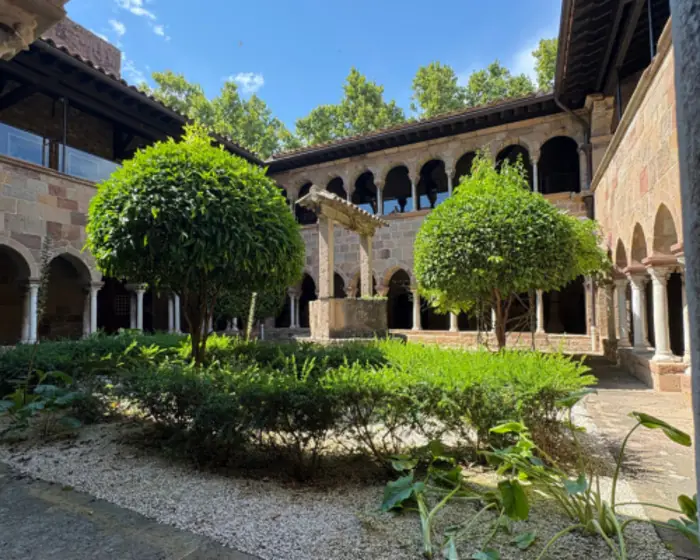
There is a particular quality to the light in Fréjus in mid-September — still warm, but no longer the bruising heat of August. The tourists have thinned. The stone breathes again. It is precisely this time of year, when the Var coast settles back into itself, that the town reveals what it has always quietly held: a layered, still-legible history stretching from Roman colony to medieval bishopric, compressed into a few city blocks around the cathedral quarter on Rue de Fleury.
On 19 and 20 September 2026, the Cloître de la cathédrale de Fréjus opens its doors free of charge as part of the Journées Européennes du Patrimoine — the annual European Heritage Days that, each autumn, unlock monuments and institutions across the continent that spend the rest of the year either ticketed or quietly closed. The cloister will be open from 10h to 18h on both Saturday and Sunday, with the last entry at 17h30.
A Complex Built Across a Millennium
The cathedral ensemble at Fréjus is not a single building but a constellation of four: the episcopal palace (now the town's Hôtel de Ville), the cathedral itself, a baptistery, and the canonical ensemble — of which the cloister forms an integral part. Construction unfolded between the 5th and 16th centuries, on ground that was already old when the first Christian builders arrived. The ancient Roman city of Forum Julii — founded by Julius Caesar and later developed by Augustus as a naval base — had occupied this very site, and the medieval builders worked, consciously or not, within its bones.
The cloister itself is a corridor of passage rather than a place of contemplation. Its function was practical: to connect the various buildings of the episcopal complex, to move clergy and canons efficiently from one space to another. This distinction matters. Where a monastic cloister is typically an enclosed garden of silence, Fréjus's version was always more corridor than sanctuary — a working artery of an institution that managed both spiritual and civic life in the region for centuries. Understanding that shifts how you move through it.
'Ce dernier était un lieu de passage permettant de desservir les différents bâtiments, il n'était donc pas un lieu de recueillement.' — from the official description of the site
What to Expect on the Day
The visit is self-guided — visite libre — which means the pace is your own. There is no group to follow, no timed slot beyond the closing hour. Visitors can approach the architecture on their terms: linger on the carved capitals, trace the geometry of the arcades, read the layering of centuries in the masonry itself. The cloister's galleries, with their painted wooden ceiling panels, are among the most reproduced images of the site — though they reward direct attention rather than a photograph.
The surrounding cathedral ensemble adds further depth to any visit. The baptistery is among the oldest surviving in France, its octagonal form drawing on late-antique precedent. The cathedral's nave carries the weight of Romanesque restraint. Together, the complex offers something that the more celebrated monuments of Provence — the Pont du Gard, the arenas at Arles — do not quite replicate: a sense of continuous, uninterrupted occupation, from the Roman city through to the present municipality.
Fréjus sits between Saint-Raphaël and Saint-Tropez on the Côte d'Azur, easily reached by train or road. The cathedral quarter is walkable from the centre. September remains a comfortable month for the coast: the sea is still swimmable, the markets still running, the rosé still cold. A morning at the cloister followed by lunch in the old town is an entirely reasonable plan.
The address is 58 Rue de Fleury, 83600 Fréjus. Admission is free on both days. Further information is available at cloitre-frejus.fr.
Fréjus has been many things — Roman port, episcopal seat, garrison town, Riviera suburb — and the cloister has stood through most of it, connecting rooms, connecting centuries. For two days in September, it connects visitors as well.