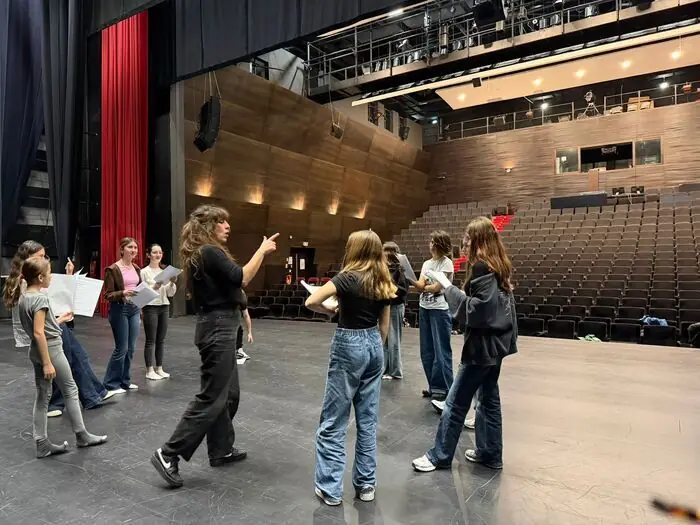
There is a particular quality of silence in an empty theatre. Not the silence of absence, but of anticipation — the hush of a space that holds its breath between performances. At Le Carré Sainte-Maxime, tucked along the Route du Plan de la Tour on the edge of a town better known for its marina and the shimmer of the Gulf of Saint-Tropez, that silence belongs almost entirely to the people who work there. On one Saturday each September, it is briefly, generously shared.
On 19 September 2026, as part of the Journées Européennes du Patrimoine — the annual European Heritage Days that open France's cultural institutions to the public — Le Carré Sainte-Maxime unlocks the parts of the building its audiences never normally see. Three sessions are scheduled: 10h00, 14h00, and 17h00. Groups are kept deliberately small, no more than ten people per group, three groups per session, so the experience retains the feeling of a private tour rather than a school visit. Arrivals are asked to present themselves at the box office fifteen minutes early. The tour is open to anyone aged eight and above, provided younger visitors are accompanied by an adult.
What the Stage Looks Like from the Wrong Side
The itinerary moves through three distinct stages, each one peeling back a different layer of how a performance is made. First, participants are led through the spaces that remain closed on any normal evening: the plateau itself, the backstage area, the dressing rooms, the technical control booth, the catwalks above the stage. These are not decorative spaces. They are working rooms — marked by cable runs, prop storage, the particular smell of stage paint and old wood — and seeing them in daylight, without an audience filling the house, reframes every performance you have ever watched from a seat.
The second stage turns to craft. The theatre's technical team walks visitors through the disciplines of sound and lighting design: what it means to balance a mix for a live voice against a full band, how a lighting state is built cue by cue, why the angle of a single fixture can change the emotional temperature of a scene. These are professions largely invisible to audiences, which is precisely the point — their success is measured by the degree to which they go unnoticed.
The third stage is participatory. Visitors are invited onto the grand plateau to try theatre practice for themselves. The specifics of what that involves will depend on the team leading the session, but the offer is clear: not observation, but experience.
'Partager son quotidien, ses savoirs-faire' — to share the everyday work and the skills behind it — is how the theatre describes its intention. It is an unusually honest ambition for a heritage open day.
A Town That Takes Its Culture Seriously
Sainte-Maxime sits across the bay from Saint-Tropez, separated by perhaps four kilometres of water and a considerable difference in temperament. Where its neighbour trades on spectacle and celebrity, Sainte-Maxime has always maintained a quieter, more residential character — a place where families return year after year, where the promenade fills with walkers rather than photographers. Le Carré Sainte-Maxime fits that register precisely. It is a genuine municipal theatre, programming across the full calendar rather than only in summer, serving a community rather than a season.
The Journées Européennes du Patrimoine, held each September across France and beyond, were conceived to make heritage accessible in the broadest sense — not only châteaux and cathedrals, but the living institutions that shape how a place understands itself. A working theatre qualifies on every count. The programme at Le Carré runs from drama and dance to music and young audiences' work; the building, the team, and the accumulated knowledge of how to mount a production are as much a part of the region's cultural fabric as any stone monument.
For visitors already on the Côte d'Azur in mid-September — a moment when the crowds of August have thinned, the light has softened to something more copper than white, and the restaurants have their tables back — this is a morning or afternoon that earns its place in the itinerary on its own terms. The practical details are straightforward: arrive at 107 Route du Plan de la Tour, allow roughly an hour, and bring a curiosity that does not require spectacle to be satisfied. The theatre will do the rest.