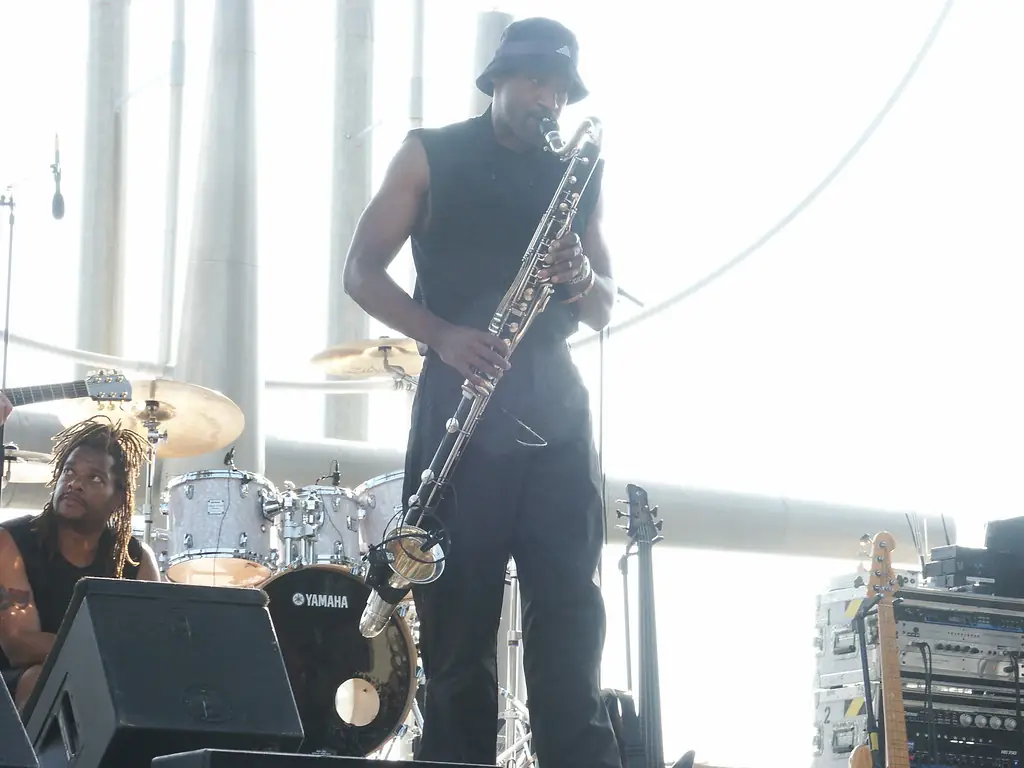
There is a particular quality to the air at Pinède Gould after dark in July — salt from the bay, resin from the stone pines overhead, and the low hum of an audience settling into canvas chairs as the last of the daylight bleeds out over the Esterel. Antibes has been doing this for decades, and it has never quite lost the sense that something is about to happen.
On 14 July 2026, Jazz à Juan occupies its habitual stage at Boulevard Edouard Baudoin for a programme that pairs two singular vocalists with a trio that has been quietly building one of the more interesting reputations in contemporary European jazz. The evening closes, at 23h00, with a fireworks display — which, given the date, is as much civic ritual as artistic flourish.
The Lineup
Mae Defays is a Belgian singer whose phrasing sits somewhere between the classic French chanson tradition and the cooler idiom of modern jazz vocal. She does not oversell a lyric. Laura Anglade, Franco-American and Paris-based, has made a reputation on both sides of the Atlantic for a voice that is warm without being sentimental — she handles the American songbook with the kind of ease that suggests genuine affection rather than repertoire management. Sharing the bill rather than competing for it, the two artists bring complementary sensibilities to a single midsummer night.
Banksia Trio rounds out the programme. Named for the Australian flowering shrub — hardy, particular, not immediately obvious — the group has developed a sound that rewards attention: chamber-inflected, rhythmically precise, with the kind of internal logic that makes you notice what is left out as much as what is played.
The Stage and Its History
Jazz à Juan is among the oldest jazz festivals in Europe, founded in 1960 on this same strip of Provençal coastline. The Pinède Gould — a pine grove on the edge of the Golfe-Juan — became the setting almost by accident and has remained so by conviction. Miles Davis played here. Ray Charles played here. The festival has never moved indoors, which means that on any given July evening, the music competes gently with the Mediterranean and, on 14 July, with the national holiday itself.
Antibes and Juan-les-Pins, separated by little more than a coastal promenade, have long occupied a specific register in the imagination of jazz: glamorous but not ostentatious, serious about music without being solemn about pleasure. The Côte d'Azur in high summer is a crowded, expensive, occasionally exhausting proposition — but Jazz à Juan has always managed to feel like the reason you came rather than the thing you do when the beach gets too hot.
'The pine grove at night, with the sea a few hundred metres away and the music carrying clearly through the trees, remains one of the most civilised concert settings in the South of France.'
Bastille Day adds a layer of occasion that the festival does not need to manufacture. By the time the fireworks begin at 23h00, the audience will have spent several hours in a pine grove by the sea, listening to three acts whose approaches to jazz — vocal, instrumental, European, American — form something like a small argument about what the music is and can be. The argument is conducted politely, in the dark, under the pines.
For visitors arriving from Nice or Cannes, Juan-les-Pins is twenty minutes by train — a detail worth noting, since parking along this stretch of coast in July is its own particular adventure. The festival website at jazzajuan.com carries current ticketing information. Arrive early enough to walk the promenade before the set begins; the light on the Golfe-Juan at dusk is the kind of thing that makes the evening feel longer than it is, in the best sense.