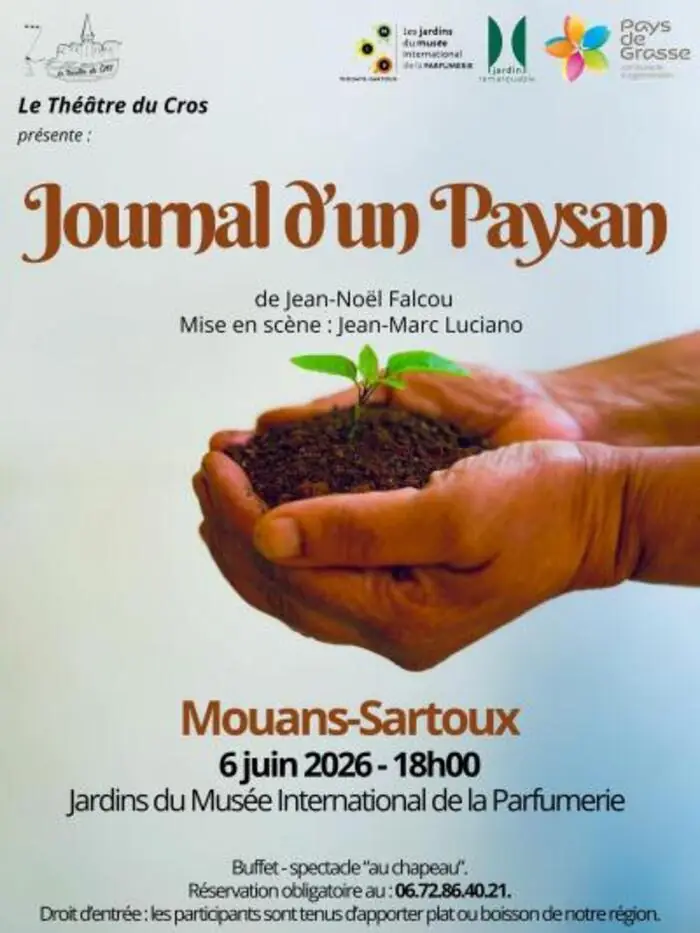
There is a particular quality of evening light in the hills above Mouans-Sartoux in early June — the kind that turns limestone walls amber and makes the air feel thick with something floral and faintly resinous. The gardens of the Musée international de la parfumerie, set back from the road at 979 Chemin des Gourettes, are not a grand formal park but something more intimate: terraced plantings that recall the working flower fields this corner of the Alpes-Maritimes once was. It is exactly the right place to hear a farmer speak.
On Saturday 6 June, the theatre company Théâtre du Cros brings Journal d'un paysan — Jean-Noël Falcou's book, awarded the Prix Livre engagé pour la planète at the Festival du Livre de Mouans-Sartoux — to the stage, or rather to the grass, in a buffet-spectacle format with payment au chapeau (by the hat, as the French tradition goes: you give what you can at the end). The show begins at 18:00. Admission is not ticketed in the conventional sense; it is a gesture of reciprocity between audience and performer.
A Son of Flower Pickers Stages a Farmer's World
The production is directed by Jean-Marc Luciano, himself the son of orange blossom pickers — a biographical detail that is not incidental. The Grasse region built its global reputation for perfume on the labour of families like his, who harvested jasmine, rose de mai, and orange blossom by hand at dawn, generation after generation. That knowledge has thinned considerably over the past half-century, squeezed by industrial extraction, shifting economics, and the slow disappearance of the pays grassois smallholder. Luciano brings that lived memory to the direction.
Falcou's original text is described as a daily testimony of a regional farmer's life, moving through the seasons — not a romanticised pastoral but a working account of a métier that has become, in the production's own words, méconnu: little known, poorly understood. The theatrical adaptation carries what the Théâtre du Cros calls "the smell of earth, of orange blossom, of rose and lavender" — a phrase that, in this setting, is less metaphor than geography.
"Ce spectacle à l'odeur de terre, de fleur d'oranger, de rose et de lavande est une immersion dans un métier fondamental, devenu méconnu." — Théâtre du Cros
The Garden as Stage
The Musée international de la parfumerie itself occupies a villa and its grounds that trace the full arc of perfume history, from ancient Egypt to the contemporary industry headquartered nearby in Grasse. Its gardens are not a backdrop but a participant: the plants growing here are, in many cases, the same varieties whose harvests Falcou writes about. Watching a play about the rhythms of agricultural life in Provence while seated among orange trees and rose bushes is an act of context that no indoor theatre can replicate.
Mouans-Sartoux, a small commune of around ten thousand between Cannes and Grasse, has cultivated an unusually serious literary culture for its size. Its annual Festival du Livre — one of the most attended book fairs in France relative to the size of the town — has long emphasised engaged, socially conscious writing. That Journal d'un paysan won the festival's prize for environmental commitment says something both about the book and about the community that chose it.
For the evening of 6 June, guests are invited to bring themselves and whatever they wish to contribute. The buffet format means the event is social before it is theatrical — food and conversation first, then the performance as the light drops and the garden cools. There are no reserved seats, no dress code implied, no interval announcements. The hat goes round when the story ends.
If you are spending early June on the Côte d'Azur and find yourself curious about what this coast looked like before the hotels and the marinas — about the labour and the seasons that gave the perfume industry its raw material — then an evening in these gardens, listening to a farmer's voice carried by someone who grew up among the flowers, is a reasonable way to spend a Saturday.