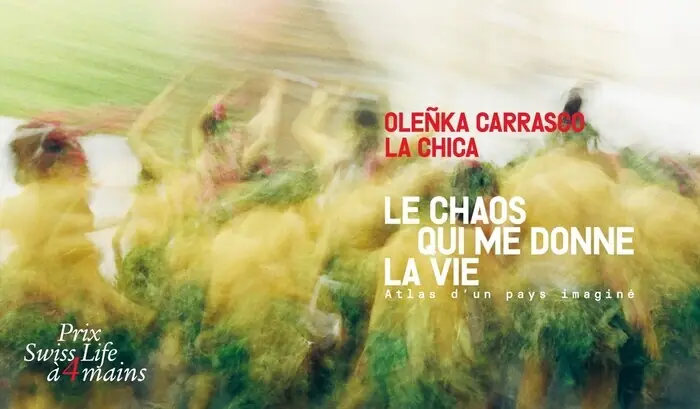
There is a particular quality of light in the Château de Mouans-Sartoux on a June morning — cool stone corridors giving way to the open geometry of the Espace de l'Art Concret, a space that has always known how to hold silence as much as sound. It is the right kind of place, then, to encounter an exhibition that asks you to listen as carefully as you look.
From 12 June through 31 October 2027, the EAC presents Le Chaos qui me donne la vie. Atlas d'un pays imaginé — the laureate work of the 7th edition of the Prix Swiss Life à 4 mains, awarded by the Fondation Swiss Life. The prize, singular in France, is given every two years to a collaborative project created jointly by a photographer and a composer. This edition it goes to Oleñka Carrasco and la Chica, whose joint work forms the centrepiece of a long summer installation at the château.
A Prize Built on Dialogue
The Prix Swiss Life à 4 mains — the name is literal: four hands, two disciplines — was conceived around a simple but demanding premise: that image and music, when genuinely co-created rather than merely combined, can produce something neither could alone. Oleñka Carrasco and la Chica have taken that premise seriously. Their project is structured in four chapters, developed across three actual territories — Guadeloupe, Trinidad and Tobago, and French Guiana — and one imagined one: Venezuela itself, present in memory and sensation rather than in the artists' current reach.
The root of the work lies in El Callao, a town in the Venezuelan interior shaped by Caribbean migration drawn by gold mining. Calypso, Creole language, carnival — these are the living residue of that movement, and they form the sonic and visual raw material the artists have gathered. Set against that history is an acute contemporary fact: nearly 7.9 million Venezuelans have left their country, one of the largest displacement crises in the world. The project holds both registers at once — the long-accumulated culture of a place, and the rupture of mass exile.
'Nous développons, à quatre mains, une traversée sensorielle de l'exil, où image et musique deviennent des langages capables de circuler au-delà des frontières.' — Oleñka Carrasco et la Chica
What the Exhibition Asks of You
The format is immersive in a precise sense. Photographs and music are woven together not as illustration and soundtrack but as parallel languages — the artists' own framing — each capable of carrying meaning the other cannot. Visitors are encouraged to bring their own earphones: throughout the exhibition, QR codes unlock musical compositions tied to specific images, making the experience genuinely personal in pace and attention. You move through the four chapters at your own rhythm, choosing when to pause and when to listen.
This is not incidental. The subject — what persists, transforms, or shifts when one lives away from one's country — resists a single viewing speed. The cartography Carrasco and la Chica have assembled is made of echoes and displacements, proximity and distance, presence and absence. It is a work that rewards stillness.
For those who want to extend the encounter, an artist's book is available at the EAC bookshop. The Espace de l'Art Concret, housed within the Château de Mouans-Sartoux at the heart of the village, is itself worth the detour — founded in 1990, it remains one of the few French institutions dedicated specifically to concrete and abstract art, with a permanent collection and a programme that consistently reaches beyond its scale.
Mouans-Sartoux sits between Cannes and Grasse, a quiet inland town that tends to be overlooked in favour of its coastal neighbours. That is, broadly speaking, its advantage. The château grounds are unhurried; the village has the texture of a place that has not organised itself around tourism. The exhibition runs through the end of October, which means it spans the full arc of the Riviera season — from the white heat of July to the softer, emptier afternoons of autumn, when the light through the château windows turns amber and the crowds have thinned to almost nothing. Either end of that season offers its own version of the same work.