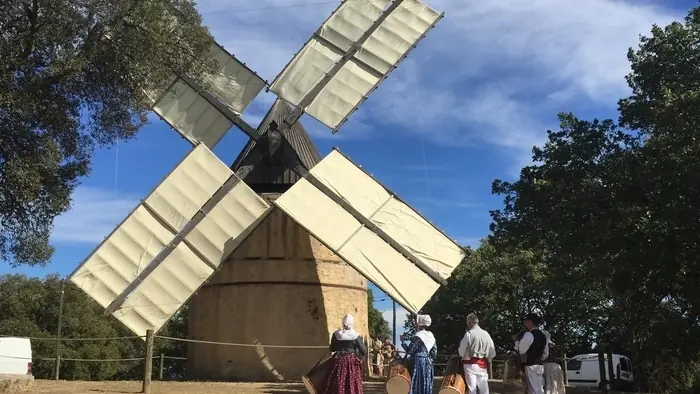
There is a particular kind of silence on the Paillas ridge that has nothing to do with the absence of sound. The wind is almost always present up here — a steady, directional pressure that bends the scrub pines and carries the smell of thyme and warm stone across the Var hillside. It is exactly the kind of wind a miller would have prayed for.
The Moulin de Paillas stands at the highest point above Ramatuelle, a small commune of vine-covered slopes and medieval lanes tucked behind the Saint-Tropez peninsula. The mill is not ancient in the way that crumbling towers are ancient — it was rebuilt stone by stone to its original design in 2002, a careful act of restoration rather than reconstruction for its own sake. The result is a working structure that carries genuine historical memory even as its joints are relatively young.
Two Days on the Ridge
On 19 and 20 September 2026, the mill opens to visitors as part of the Journées du Patrimoine, France's annual weekend of open heritage sites. The association 'Les Amis des Moulins de Ramatuelle' — the Friends of the Ramatuelle Windmills — organises the visits themselves, offering continuous free guided access with detailed explanations of the mill's history and mechanics. On Saturday, visits run from 10:30 to 12:30 and again from 15:00 to 18:00. Sunday hours extend slightly differently: 10:30 to 12:30 in the morning, then 14:00 to 18:00 in the afternoon.
Sunday carries something extra. Weather permitting — and on this ridge, the wind is rarely absent — the association will carry out an entoilage et mise au vent: the spreading of canvas sails and the turning of the mill into the wind. It is a practical demonstration rather than a performance, the kind of thing that requires cooperation from the elements. Provençal musicians will be present, and a pétanque court will be available. The afternoon acquires a particular texture: the slow creak of timber, the click of boules on dry ground, the sound of a galoubet or a tambourin drifting across the hillside.
What a Mill Actually Means Here
The Var département was once dotted with windmills. The plateau above Ramatuelle, exposed on all sides to the winds that funnel through the Maures massif, was a natural site for milling grain — a practical geography that shaped the landscape long before the peninsula became synonymous with summer crowds and yacht harbours. The Moulin de Paillas is one of the last physical witnesses to that working history, and the association that looks after it treats the site with corresponding seriousness. Their explanations, visitors consistently note, go well beyond the surface.
'The mill belongs to the landscape here the way the vineyards do — it is not decoration, it is evidence.'
To stand inside a restored post mill and understand how the cap rotates to face the wind, how the millstones are dressed, how a family might have organised their week around the grinding — this is a different register of knowledge from reading a plaque. The guides from 'Les Amis des Moulins de Ramatuelle' provide exactly that kind of grounded, specific account.
The view from the ridge is, almost incidentally, one of the finest on the Côte d'Azur: the Gulf of Saint-Tropez to the north, the Îles d'Or — Porquerolles, Port-Cros, the Île du Levant — visible on clear days to the south and west, the vineyards of Ramatuelle and Gassin laid out below in their late-September amber. September is, in many respects, the best month to be on this part of the coast. The summer traffic has thinned; the light has acquired that particular Mediterranean quality — lower, more golden, longer in the afternoon — and the villages are returning to something closer to themselves.
The mill is free to visit. No booking details are provided; the association runs visits continuously throughout the open hours. Wear shoes suited to uneven ground, and allow more time than you think you will need. The ridge has a way of keeping people longer than planned.