There is a particular quality of light in the hills above Nice in early June — not yet the bleached glare of high summer, but something softer, almost conspiratorial, the kind that makes limestone walls glow amber and coaxes every leaf into sharp relief. La Gaude sits in this light, a compact village of pale stone perched above the Var valley, close enough to the coast to catch a salt breeze but far enough inland to feel genuinely removed from the Promenade's theatre. It is the sort of place you pass through on the way to somewhere else, and then, one day, don't.
On 6 and 7 June 2026, a gate at 21 allée la treille will open onto something that most visitors to the Côte d'Azur will never see: a private botanical garden that has been growing, transforming, and quietly accumulating wonder since 1991. The visits are deliberately small — eight people per session, entry five euros — which means the experience is closer to being invited into someone's life than attending a public event.
A Garden With a Pun at Its Heart
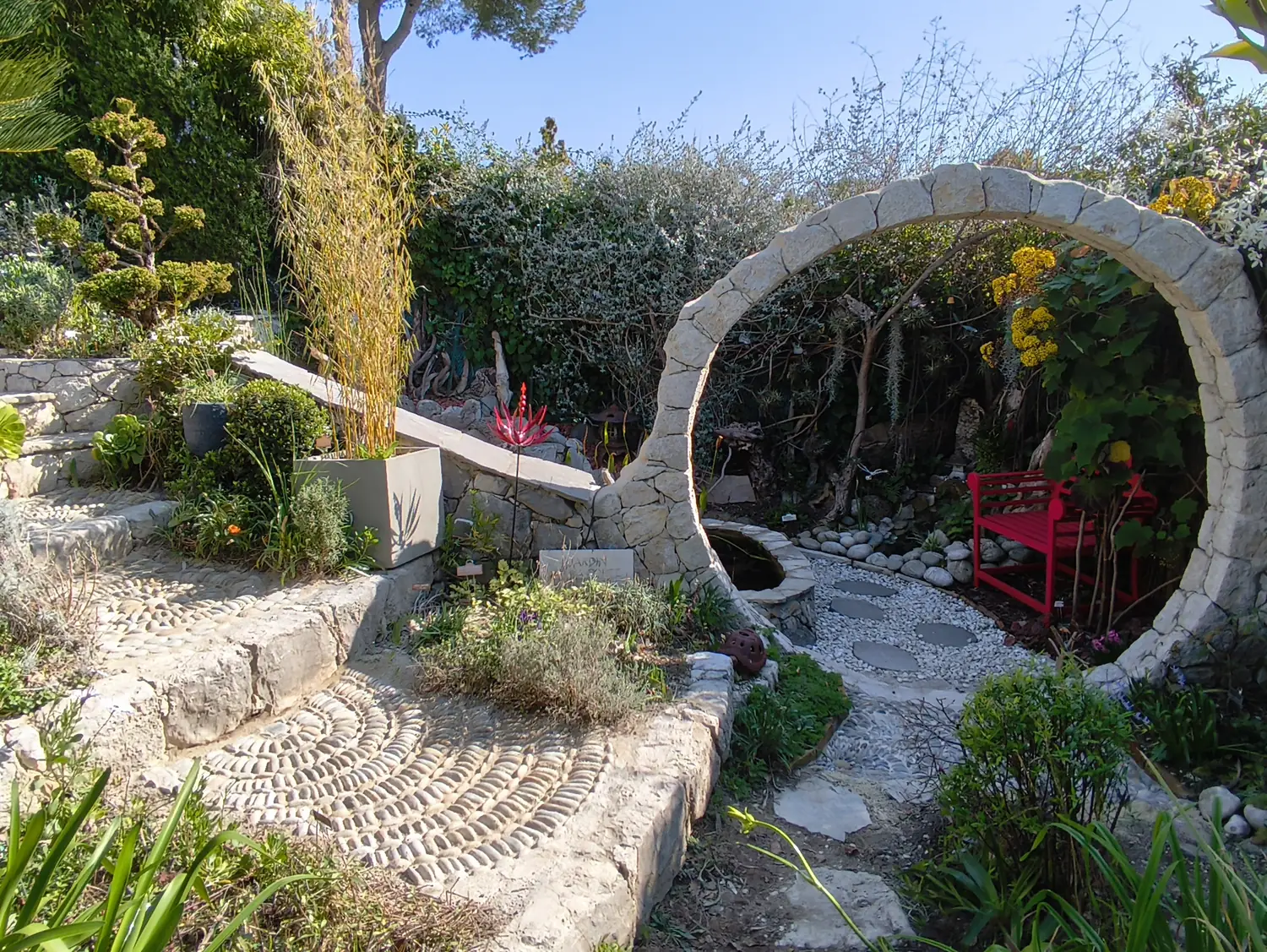
The name Sauvages et belles à croquer is a double entendre that resists clean translation. Croquer in French means both to eat something raw and to sketch a subject with quick, confident strokes. The garden, in other words, is simultaneously edible and drawable — and its creators, Marie-Christine and Bernard, are illustrators by profession, which explains everything and nothing at once. Marie-Christine is also a self-taught botanist and the author of books on wild plants and edible flowers. Bernard works in stone: the Vence limestone that forms the garden's walls, its arch, and the Porte de Lune — the Moon Gate that leads into a miniature Japanese garden — is his. So are the calades, the traditional Provençal pebble pathways laid from pudding-stone gathered in the surrounding hills.
What they have built together across roughly 450 square metres is not a garden in the tidy, horticultural-show sense. It is closer to an argument — a sustained, affectionate argument — about what a garden can be asked to do. More than 700 species and varieties coexist here: Mediterranean natives alongside exotics, ornamental plants beside edible weeds that most gardeners would pull without a second thought. The French word adventices — plants that arrive uninvited — is used without apology. Here, the uninvited are often the most interesting guests.
What the Visit Actually Involves
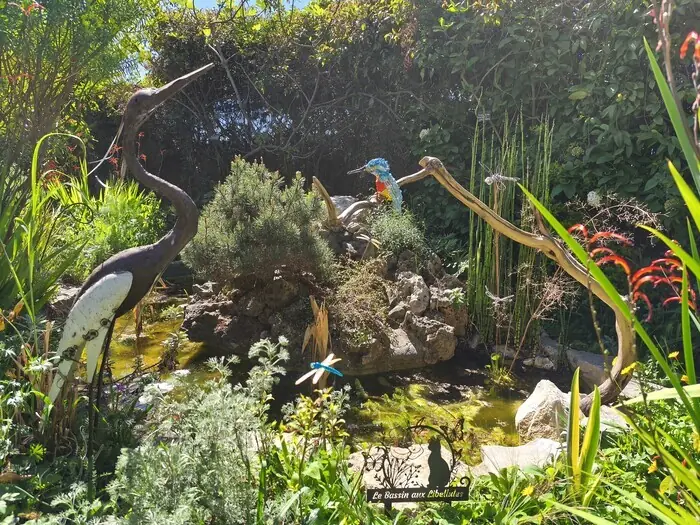
The path through the garden is deliberately sinuous. You do not see everything at once; the layout is designed to withhold and then reveal, offering different vantage points as you move between the lower section — where small basins attract birds and insects — and the upper rockery. Plant labels are everywhere, a quiet insistence that names matter, that knowing what you are looking at changes the looking.
Scattered throughout are what the garden's creators call petites créatures — small figures and spirits of place tucked among the foliage, the kind of detail that rewards slow attention. A collection of succulents in pots, bonsai, shade-loving specimens: these act as punctuation between the garden's different registers, linking the wild to the cultivated, the Mediterranean to the Japanese, the edible to the purely beautiful.
A practical note worth taking seriously: the visit involves stairs. The terrain is uneven, the path rises and falls, and the intimacy of the space means there is no flat, accessible alternative route. Groups are capped at eight, which is not a marketing gesture but a genuine constraint of the site.
"Un lieu pour rêver et s'émouvoir des merveilles que nous offre la Nature" — Marie-Christine and Bernard, on their own garden.
The Côte d'Azur has no shortage of formal gardens open to the public — the Villa Ephrussi de Rothschild in Saint-Jean-Cap-Ferrat, the Jardin Exotique in Monaco, the gardens of the Villa Thuret on the Cap d'Antibes. What those places offer in grandeur and history, this garden answers with something rarer: the evidence of two people's sustained attention over more than three decades, the accumulation of choices made season by season, the particular intelligence of a botanist who also draws and a sculptor who also gardens.
For anyone spending time on the Riviera in early June and willing to drive twenty minutes into the hills, this is the kind of morning that tends to linger. Not because it is spectacular in the obvious sense, but because it is specific — rooted in a particular place, shaped by particular hands, and open, for two days only, to eight people at a time.