A Garden Outside of Time
The road into the Domaine de la Magdeleine runs along one of Fréjus's quieter residential streets, yet the moment the canopy closes overhead, the city recedes entirely. Towering specimen trees filter the June light into something softer and more oblique, and the air carries the faint, resinous warmth particular to arid-adapted plants in high summer. What lies behind the gate is not a garden in any conventional sense — it is a living archive, assembled over nearly nine decades and still growing.
On Saturday 6 June at 15:00, the Pépinière de Cactées et Plantes Grasses Kuentz opens for a guided visit led by Henri Kuentz himself, moving through the glasshouses and open-air beds of what is officially recognised as the oldest cactus and succulent nursery in France. The address — 327 rue du Général Brosset, in the Domaine de la Magdeleine — is modest on paper; the reality is something considerably more arresting.
From Belfort to the Var, Since 1937
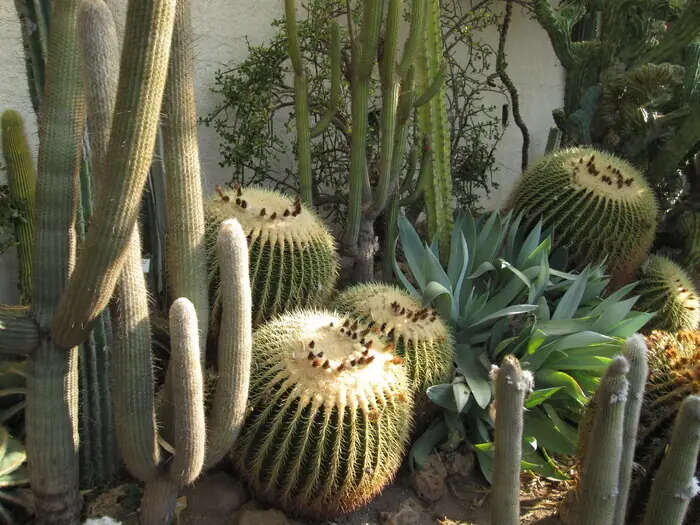
The nursery's origins lie not on the Côte d'Azur but in Belfort, in the far northeast of France, where the Kuentz family first established its collection. The move to Fréjus in 1937 was, in retrospect, a botanical stroke of logic: the Var département offers the kind of dry, luminous Mediterranean climate — long summers, thin soils, reliable sun — that cacti and succulents require to thrive rather than merely survive. Over the decades that followed, the collection grew to encompass more than 1,000 varieties of cacti, exotic plants, and plantes grasses, ranging from compact globular forms to specimens of considerable height and age.
The site itself has been formally recognised by the city of Fréjus as a Site Patrimonial Remarquable within the local urban plan, listed under 'Parcs et Jardins de grand intérêt' and noted for the presence of a remarkable historic building on the grounds. That designation is not merely bureaucratic: it reflects the unusual density of mature trees and the sense of enclosure they create, shielding the collection from the outside world in a way that feels both deliberate and slightly miraculous.
'Un univers enchanteur, hors du temps, protégé par une abondante végétation et des arbres remarquables.' — Pépinière Kuentz
Fréjus itself is a city accustomed to layered time. Founded as Forum Julii by Julius Caesar and later expanded into a significant Roman naval base under Augustus, it holds one of the most complete concentrations of Roman remains in Provence — an amphitheatre, an aqueduct, the traces of a harbour that has long since silted into farmland. The Kuentz nursery sits within this same tradition of quiet, accumulated longevity, though its scale is botanical rather than imperial.
What the Visit Offers
Henri Kuentz leads the group personally through the glasshouses and the garden, where thousands of varieties — small and large, flowering and structural — are displayed across a site that rewards slow attention. The architectural quality of mature cacti is easy to underestimate until you stand beside a specimen that has been growing in the same spot for half a century: the geometry becomes genuinely compelling, the textures — ribbed columns, clustered spines, smooth paddles — almost sculptural in strong afternoon light.
For visitors arriving from the coast, the excursion pairs naturally with Fréjus's other quieter pleasures:
- The Episcopal complex in the old town, with its early Christian baptistery dating to the fifth century
- The Roman theatre and amphitheatre, both within walking distance of the centre
- The covered market on Place Paul-Vernet for provisions before or after
Practical details remain straightforward: the visit begins at 15:00, and no ticket price is listed in the available information — it is worth confirming directly with the nursery before travelling.
June on the Var coast is the last comfortable moment before the full weight of summer descends. The light is long and lateral in the late afternoon, the crowds not yet at their August intensity, the landscape still carrying some residual green from spring. It is a considered moment to walk slowly through 88 years of botanical patience — and to find that a nursery, of all things, can feel like the most grounded place on the coast.