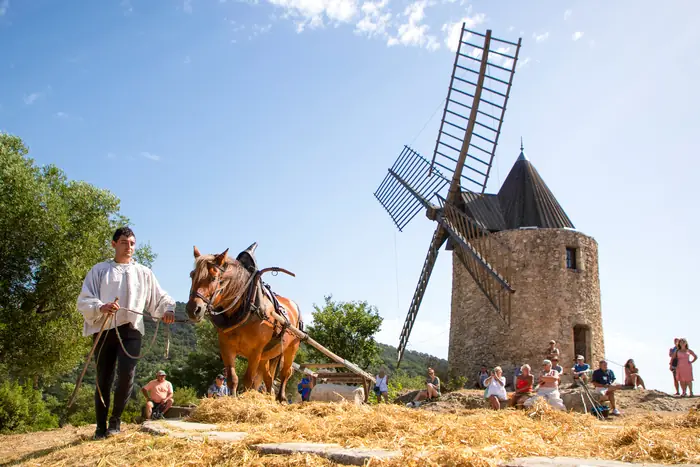
There is a particular quality to early summer evenings in the Var. The heat of the day softens without disappearing, the light turns amber over the stone villages, and the air carries something ancient — thyme, warm dust, the faint memory of grain. It is exactly the kind of evening on which a working windmill, perched above the rooftops, begins to make a great deal of sense.
On Saturday 27 June 2026, the commune of Grimaud hosts the Fête du Moulin at the Moulin Saint-Roch, beginning at 18:30. The occasion is the Journées du Patrimoine de Pays 2026 — a national initiative that, for one weekend each year, invites communities across France to throw open the doors of their lesser-known heritage sites: the chapels, the lavoirs, the oil presses, the mills. Entry is free, and no reservation is required.
A Village That Has Always Watched Over the Coast
Grimaud is one of those Provençal villages that earns its views. The medieval bourg sits on a hillside above the Gulf of Saint-Tropez, its ruined castle and Romanesque church of Saint-Michel visible from the water on clear days. The village was founded by the Grimaldi family — the same dynasty that would eventually give Monaco its name — and the stones here carry that weight quietly, without performance. The Moulin Saint-Roch belongs to this landscape as naturally as the pine trees that surround it: a structure built to catch the wind off the Mediterranean, to turn wheat into flour, to feed a village that had no particular interest in being picturesque.
Windmills of this type — the moulin à vent of Provence — were once common across the Var and the Bouches-du-Rhône. Many have crumbled. Those that remain are, more often than not, the result of patient restoration by local associations and municipal services who understood that a functioning mill is a different proposition entirely from a ruin with an information panel.
What the Evening Holds
The programme assembled for this edition is modest in scale and entirely coherent in spirit. Three elements, each handled by people who know what they are doing:
- Démonstration de dépiquage et pains chauds** by the association l'Escolo Dei Sambro — a threshing demonstration followed by freshly baked bread, the kind of sensory argument for heritage that no exhibition catalogue can replicate.
- Música et danses traditionnelles by the association l'Escandihado, bringing the folk repertoire of Provence — the farandole, the tambourin — back to a setting where such music was never decorative, only functional.
- Guided tours of the mill itself, led by Grimaud's own Service Culture et Patrimoine, who can speak to the mechanics, the history, and the restoration with the authority of those who have spent time with the building rather than merely reading about it.
The combination is deliberate. Bread, music, and an open door: these are not embellishments but the core of what a fête du moulin was always meant to be — a community gathering around a working place, acknowledging that the machine and the people who used it are both worth remembering.
'Patrimoine de pays' — heritage of the land — is a phrase that resists translation. It points not to monuments but to the accumulated practical knowledge of a place: how to mill, how to press olives, how to build a dry-stone wall that will outlast the person who built it.
For visitors arriving from Saint-Tropez or Sainte-Maxime, Grimaud is a short drive inland — a world away in character. The village rewards an early arrival: the streets are narrow, the light on the castle walls is best before sunset, and the walk up through the bourg to the mill is steep enough to justify the bread that awaits. Come with no particular agenda, comfortable shoes, and an appetite. The evening will supply the rest.