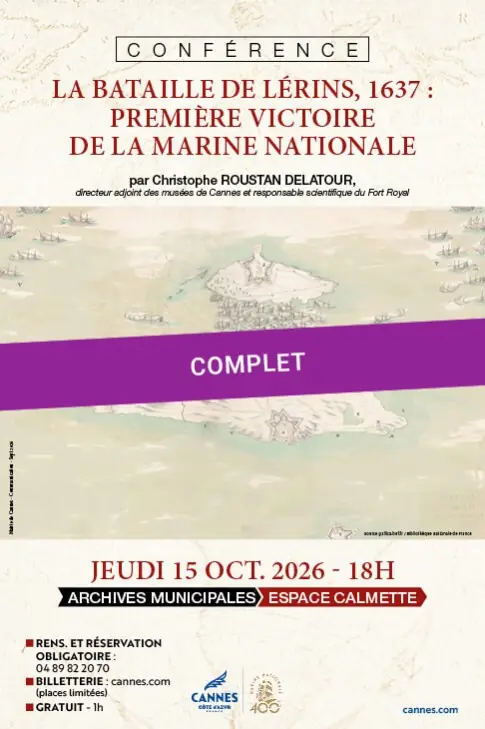
The Lérins Islands sit less than two kilometres off the Cannes waterfront — close enough that on a clear afternoon you can make out the stone walls of the Fort Royal on Île Sainte-Honorat without binoculars. Most visitors who take the ferry across know the islands for their Cistercian monastery, their eucalyptus shade, their silence. Fewer know that in March 1637, those same shores were the site of the largest forced landing on French soil between the age of Richelieu and the Allied operations of 1944. On Thursday 15 October 2026 at 18:00, that chapter of buried history comes back to the surface.
The event is a single lecture, running one hour, at the Espace Calmette — Archives contemporaines at 18 rue Docteur Calmette in Cannes. Admission is free, though reservation is required — and the event has already sold out, which says something about local appetite for a story that rarely appears in the standard histories of the Ancien Régime. The speaker is Christophe Roustan Delatour, deputy director of the Cannes museums and the scientific director of the Fort Royal itself. He is, in other words, precisely the person you would want guiding you through the archaeology and the archival record of what happened here.
A Cardinal's War, Fought at the Water's Edge
The context matters. By the mid-1630s, Cardinal Richelieu had spent years attempting to transform France from a land power into something capable of projecting force at sea. The Lérins Islands — strategically placed between the Gulf of Lion and the Ligurian coast — had been seized by Spanish troops in 1635, a provocation that sat uncomfortably close to the French mainland. What followed in March 1637 was a coordinated reconquest: a naval force, acting under Richelieu's direct instigation, landed on the islands under fire and drove the Spanish garrison out. The French Marine nationale counts this engagement as its first victory. This year marks the 400th anniversary of that institution, and the lecture is part of a broader season of commemoration.
The historical weight of the event tends to be obscured by what came after. The campaigns of Louis XIV, the battles of the Grand Siècle, the drama of Versailles — all of it crowds out the quieter, more provisional moments when French institutions were still finding their form. The 1637 battle is one of those moments. It was not a famous victory. It was, rather, a working one: a demonstration that a disciplined amphibious operation was possible, that the coast could be defended from the sea as well as from the land.
'Cet événement constitue le plus important débarquement de vive force sur les côtes françaises avant les opérations Overlord et Dragoon de 1944.'
What Archaeology Has Since Recovered
What makes the lecture particularly compelling — and what distinguishes it from a purely archival exercise — is the contribution of both terrestrial and underwater archaeology. Excavations around the Fort Royal and in the waters surrounding Sainte-Honorat have begun to recover material traces of the Spanish occupation: fortifications, artefacts, the physical evidence of a garrison that held these islands for nearly two years. Roustan Delatour, in his role as scientific director of the fort, has been directly involved in this work. The lecture is therefore not a reconstruction from documents alone but a synthesis of the documentary and the material record.
The venue itself is worth noting. The Espace Calmette houses Cannes's contemporary archives — a working institution rather than a showpiece, the kind of place where the administrative and cultural memory of a city is actually kept. It is an appropriate setting for a talk about recovering what has been mislaid.
For anyone spending time on the Côte d'Azur that October, the evening offers something that the standard cultural calendar rarely provides: a precise, expert account of a specific event in a specific place, delivered by someone who has spent years excavating the evidence. The Lérins Islands will look different from the ferry the following morning. The walls of the Fort Royal, the shallow water between the two islands, the particular angle of the coast as it curves back toward Cannes — all of it will carry a little more weight. That, in the end, is what good history does to a landscape.