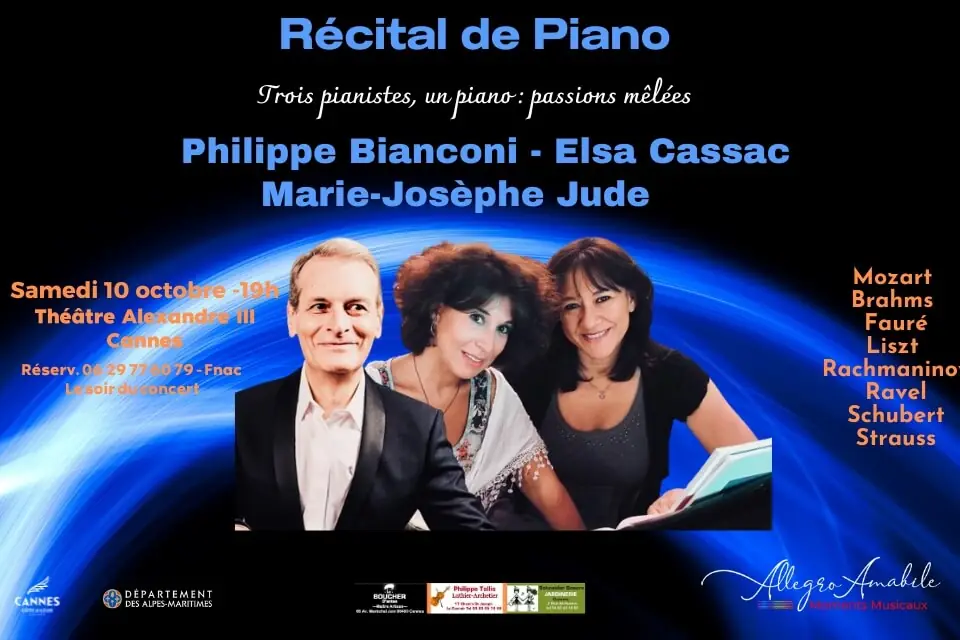
There is a particular stillness that settles over the Théâtre Alexandre III just before a recital begins. The hall, tucked along the boulevard of the same name in central Cannes, belongs to a different tempo than the Croisette a few minutes' walk away — no yachts, no film-industry theatre. Just gilded moulding, upholstered seats, and the low murmur of an audience finding its place. On the evening of Saturday, 10 October 2026, that stillness will be broken in an unusual way: three pianists will share a single piano for ninety minutes, trading the bench between solos, leaning in for four-hand duos, and, at moments, pressing all six hands to the keys at once.
The premise is not a gimmick. Philippe Bianconi, Marie-Josèphe Jude, and Elsa Cassac are each accomplished soloists in their own right, and the programme they have assembled — works by Rachmaninov, Brahms, Schubert, Ravel, Liszt, and Fauré — is drawn from the heart of the Romantic and post-Romantic repertoire. What changes is the social geometry of the performance: the piano, ordinarily a solitary instrument, becomes a shared space, a negotiation of touch and timing conducted in real time before an audience.
The Architecture of Sharing
Four-hand piano music has a long and underappreciated history. Schubert wrote some of his most intimate pages in the format — the Fantaisie in F minor, the dances, the marches — conceived for two players at a domestic upright, knees almost touching. Brahms and Ravel both arranged and composed for the medium. The addition of a third voice, six hands on eighty-eight keys, is rarer still, and demands a physical and musical trust that years of solo practice cannot fully prepare a performer for. The instrument itself imposes the terms: there is no second piano to retreat to, no separate acoustic space. Every decision — tempo, dynamics, the precise weight of an entry — must be felt as much as heard.
'Des moments intenses et des surprises musicales dans un esprit de fusion des talents' — the organisers' own phrase for the evening, and it is an honest one.
The programme alternates between these configurations — solo, duo, trio — which means the evening has an inherent dramatic structure even before a note is played. A Liszt solo gives way to a Brahms four-hand arrangement; a Fauré piece dissolves into something written for all three. The audience watches not only the music but the choreography of three bodies at one instrument, the small negotiations of elbow room and pedal use that are invisible in a conventional recital.
An Evening in Cannes, Off-Season
October is a good month to be in Cannes. The summer crowds have thinned, the light over the Esterel turns amber earlier in the afternoon, and the restaurants along the Suquet fill with locals rather than tourists. The city has a cultural season that runs largely beneath the radar of its more famous film and television festivals, and the Théâtre Alexandre III is one of its anchors — a mid-sized venue scaled for chamber music and recitals rather than spectacle.
The evening begins at 19h00. Tickets are priced at 32 € full price, 25 € for members, and 12 € for under-eighteens — the last category worth noting, given that the format is unusually legible for younger listeners who might find a standard two-hour solo recital harder to sustain. The physical drama of three pianists sharing a single instrument tends to hold attention in a way that a lone figure at the keyboard sometimes does not.
What the evening offers, finally, is a particular kind of concentration. Three musicians, a repertoire spanning roughly a century of European piano writing, and the constraint of a single instrument that forces everything — ego, habit, interpretation — into close proximity. The Théâtre Alexandre III will be warm, the programme will be familiar enough to be welcoming and strange enough to be interesting, and somewhere in the second half, when all six hands find the keys together, the audience will understand why the organisers called it passions mêlées — passions mixed, entangled, briefly indistinguishable from one another.