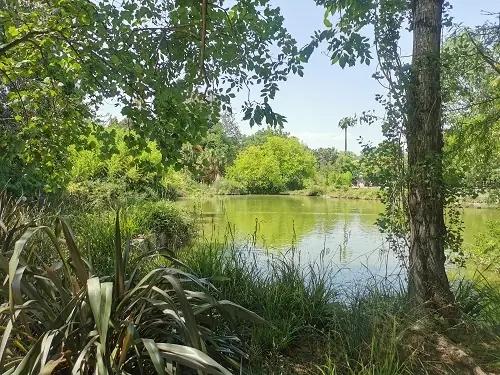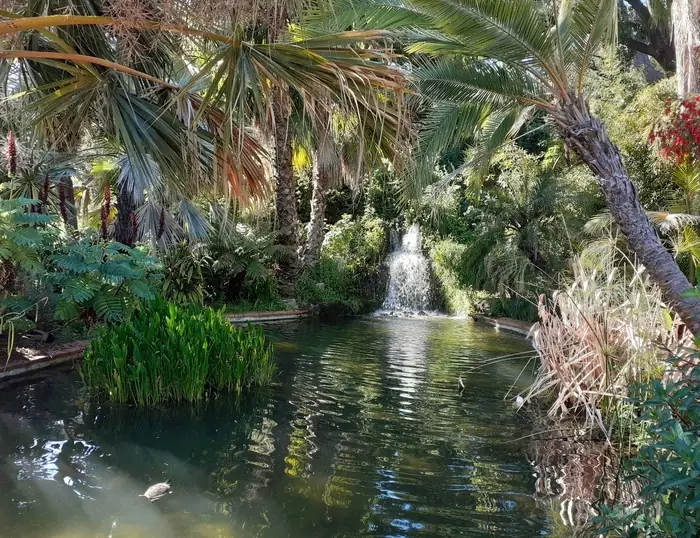
The morning light in Hyères arrives at a particular angle — low, Mediterranean, filtering through palms in a way that turns the air itself faintly gold. By ten o'clock on a June Friday, the city has already been awake for hours. But inside Parc Olbius Riquier, time moves differently. The wide allées hold the cool of the night a little longer. A cascade murmurs somewhere behind the ferns. The scent of warm earth and something faintly tropical — hibiscus, perhaps, or the dense interior of the greenhouse — drifts across the lawns.
On 5 June 2026, the park will host a guided visit designed specifically for blind and partially sighted visitors, along with their companions. The visit is described as both historical and sensory — historique et sensorielle — an approach that asks participants to experience this seven-hectare landscape through means other than sight: texture, fragrance, sound, the specific weight of humid greenhouse air against the skin. The session begins at 10:00 and is limited to ten participants with their accompanying guests, a number small enough to allow genuine attention.
A Park With a Long Memory
The land itself carries considerable history. Olbius Riquier, a local benefactor, bequeathed this terrain to the city of Hyères in 1868. For twenty-six years it served as an acclimatisation annex of the Jardin d'Acclimatation in Paris — a testing ground, essentially, for species arriving from warmer latitudes. The layout was drawn up by G. Aumont and M. Chevalier, collaborators of the landscape architect J.P. Barillet-Deschamps, whose influence shaped several of Paris's great public gardens during the Second Empire. When the park opened to the public in 1877, it operated simultaneously as a public garden, an acclimatisation garden and a zoological garden — an ambition that explains the generous scale of its design: broad allées, wide lawns, a lake, a cascade, mature trees of considerable girth.
That original composition has survived largely intact. What has changed is the zoo, which has gradually given way to new landscaped areas. What remains is a botanical collection of real depth — palms that are uncommon even on the Côte d'Azur, a rockery of succulents, and a heated greenhouse whose hibiscus collection runs to multiple varieties and colours. It is, by any measure, a garden built to engage all the senses, which makes the choice of setting for this particular visit feel less like coincidence and more like logic.
'Sa composition paysagère perdure avec ses larges allées, de vastes pelouses, de grands arbres, un lac et sa cascade.' — Parc Olbius Riquier
What the Visit Offers
Hyères sits at the eastern edge of the Var, sheltered by the Massif des Maures and open to the sea — a microclimate that has attracted northern Europeans since the nineteenth century, when the town became one of the earliest winter retreats on what would later be called the Côte d'Azur. Robert Louis Stevenson spent a winter here. Queen Victoria passed through. The mild air and the particular quality of the light were the point, but so was the vegetation: the ability to grow things here that would not survive further north.
The sensory visit draws on that horticultural legacy directly. Participants can expect to move through spaces defined by contrasting textures — smooth bark against rough stone, the waxy surface of a succulent leaf, the soft resistance of lawn underfoot — as well as shifting temperatures and scents. The greenhouse alone, with its dense tropical planting and warm, moisture-laden air, offers a complete change of register from the open garden outside.
Practical details to note: - The visit takes place at 37 Avenue Ambroise Thomas, Hyères, on Friday 5 June 2026 at 10:00. - Places are strictly limited to ten participants, each welcome to bring an accompanying person. - Further information is available through the Hyères tourism office at hyeres-tourisme.com.
There is something clarifying about a garden encountered on these terms — stripped of the visual shorthand that usually organises how we move through a landscape, the other information rushes in. The sound of the cascade becomes a landmark. The temperature drop near the lake becomes a map reference. A park that has stood since 1877 offers itself differently when you are asked to read it this way, and the reading, one suspects, is considerably more complete.