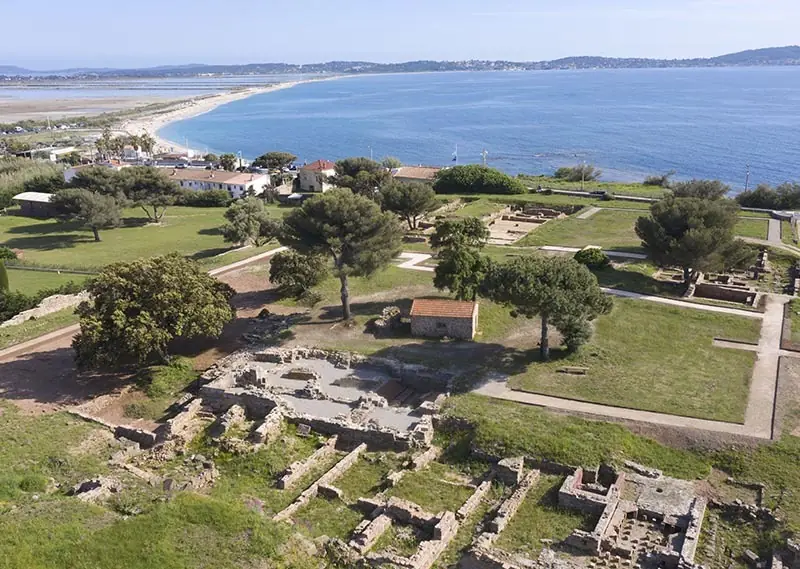
The road to Olbia runs flat along the coast, past salt marshes and the faint smell of sea grass baking in the June heat. You turn off the Route de l'Almanarre and the Mediterranean opens wide to your left, while ahead, barely raised above the shoreline, a grid of ancient stone walls comes into focus — roofless rooms, a collective well, the ghost of a street still wide enough to walk two abreast. It is one of those places that asks you to slow down before you have even read a single explanatory panel.
This summer, from 12 to 14 June 2026, the Site archéologique d'Olbia hosts Histoires d'Hyères, a focused dossier exhibition presenting the most significant archaeological finds made in and around Hyères during 2025. The show is a collaboration between three institutions whose work rarely reaches a general public in this form: the Service Archéologique Départemental du Var (SADV), the Institut national pour la recherche en archéologie préventive (Inrap), and the Laboratoire d'Archéologie Médiévale et Moderne Méditerranéenne (LA3M). Taken together, they represent the full scientific chain — from the moment a digger's blade touches soil to the moment a find is dated, catalogued and understood.
A Year of Exceptional Finds
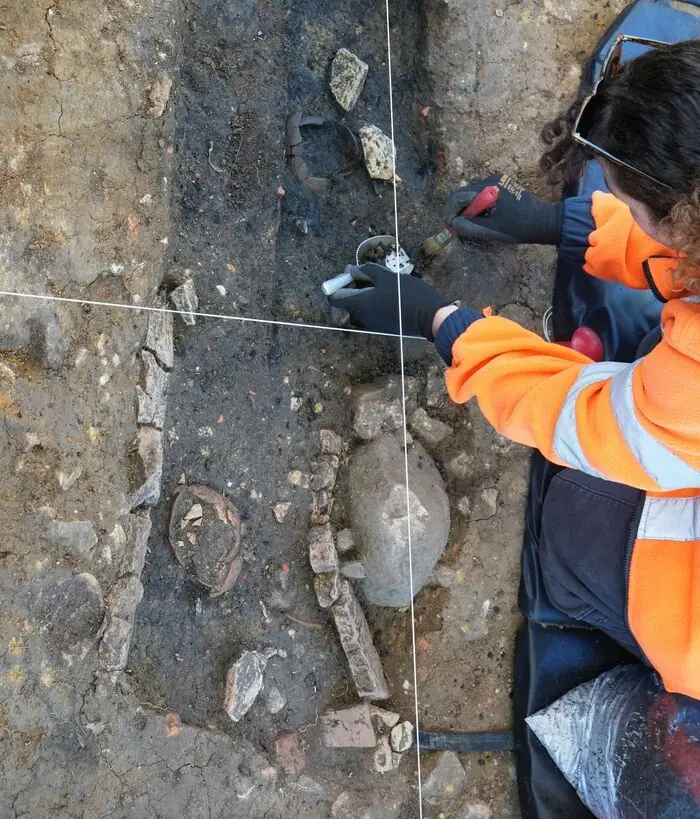
The 2025 excavation season proved unusually productive on two fronts. At Olbia itself, both preventive and programmed digs uncovered new residential blocks — îlots d'habitation — along with a Roman necropolis, adding another layer to a stratigraphic record that already spans a millennium. Across town, at the Château d'Hyères, fieldwork brought to light previously unknown medieval structures and burial sites, reframing what historians thought they understood about occupation patterns on that hilltop. The exhibition draws these two threads together, presenting the raw evidence and the interpretive work that turns sherds and bone into history.
'Les opérations de fouilles préventives et programmées ont mis au jour de nouveaux îlots d'habitation et une nécropole romaine à Olbia, ainsi que de nouveaux édifices et des sépultures médiévales au château d'Hyères.'
Olbia's significance in the wider story of the ancient Mediterranean is easy to understate. Founded in the fourth century BC by Massalia — Greek Marseille — as part of a network of coastal garrison-colonies, the site was settled by soldier-farmers whose primary brief was to protect Massaliote sea trade along this stretch of the Ligurian coast. What makes Olbia exceptional, and what draws archaeologists back season after season, is structural: it is the only surviving example of these Massaliote fortress-colonies whose entire ground plan remains intact. Elsewhere, ancient cities were built over, their geometries erased by centuries of subsequent occupation. Here, the original orthogonal grid — streets with drainage channels and raised pavements, houses subdivided into shops and living quarters, communal baths and sanctuaries — can be read almost as its founders laid it out.
Layers Within Layers
The site did not freeze at any single moment. Visitors who spend time with the stratigraphy will find Greek, Hellenistic and Roman phases stacked one upon another, the town adapting to changing political realities over roughly a thousand years. And then, in the medieval period, a different kind of occupation entirely: the ruins of the abbey of Saint-Pierre de l'Almanarre, discovered within the same perimeter, a reminder that sacred geography has its own long memory. The 2025 discoveries at the Château add yet another dimension — a medieval Hyères growing and changing at the same time as Olbia's Roman iteration was already ancient history.
For a visitor arriving over the three-day run of the exhibition, the experience works on several registers at once. There is the open-air site itself, which can be walked in the early morning before the Var sun becomes insistent, the low walls casting long shadows across excavated floors. There is the dossier exhibition — panels, photographs, recovered objects, field drawings — which translates the archaeologists' working process into something legible and, at its best, quietly gripping. And there is the unusual pleasure of seeing a site interpreted through very recent science: the Roman necropolis and the medieval burials at the château were still being analysed when this show was being assembled.
Practical matters worth noting before you go:
- The site is on Route de l'Almanarre, 83400 Hyères, easily reached by car from the town centre or from the peninsula road toward the Giens tombolo.
- Admission conditions were not announced at time of writing; check the official site at hyeres.fr for updated information before your visit.
- The three-day window — 12, 13 and 14 June — is short. If you are planning a stay on the Côte d'Azur that week, this is worth building an itinerary around rather than leaving to chance.
There is something clarifying about archaeology presented on the ground where it happened. No reconstruction, no dramatised audio guide — just the evidence, the people who gathered it, and a site that has been telling the same slow story for twenty-four centuries. Olbia in June, with the sea close and the light already sharp by mid-morning, is as good a place as any to pay attention to it.