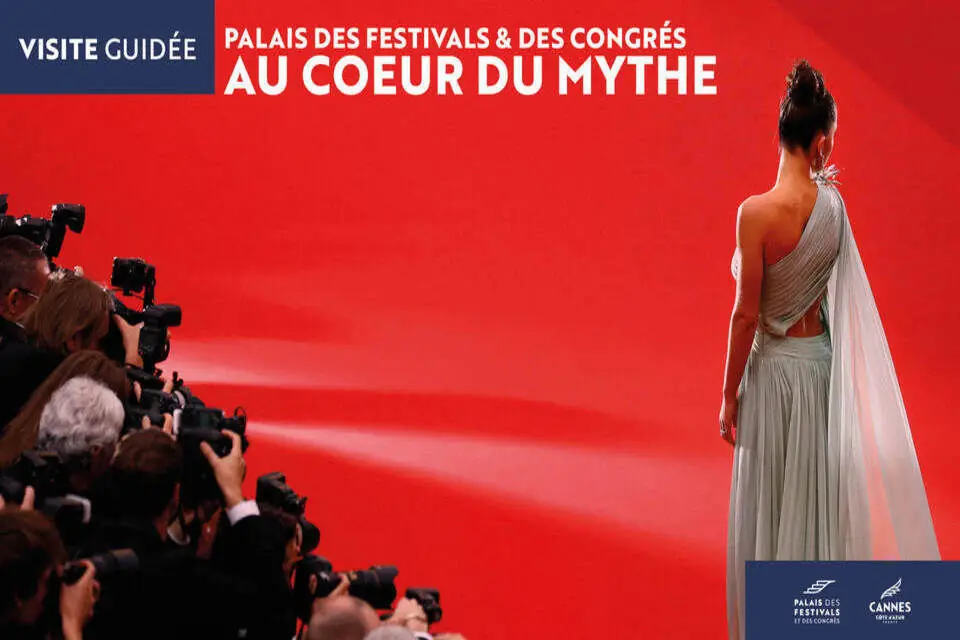
There is a particular quality to the light on the Croisette in late July — white and absolute, bouncing off the limestone pavement and the calm surface of the bay. By three in the afternoon the promenade has settled into its afternoon rhythm: a few determined walkers, the distant thrum of a boat engine, the occasional flash of a camera aimed at a red carpet that, today, belongs entirely to the public. That carpet leads into the Palais des Festivals et des Congrès, and on Friday, 31 July 2026 at 15h, a 90-minute guided tour opens its interior to anyone willing to follow.
The visit costs €6 for adults; children under 12 enter free. Those holding a Carte Mobilité Inclusion pay €3. The address is 1 boulevard de la Croisette, and the building is, as the French say with characteristic understatement, difficile à manquer — it is the concrete monolith that has anchored the eastern end of the Croisette since 1982, the year it replaced an earlier, more delicate structure that had hosted the festival since 1949.
A Building Designed to Carry Weight
Architecturally, the Palais has never been universally loved. Its brutalist bulk sits in deliberate contrast to the Belle Époque hotels that line the boulevard — the Carlton, the Martinez, the Majestic — and yet over four decades it has absorbed so much concentrated glamour that the building itself has become the symbol. More photographs are taken here than at almost any other single venue in France. The handprints pressed into the cement slabs along the Allée des Étoiles outside — a tradition borrowed loosely from Hollywood's Walk of Fame — have become a pilgrimage site in their own right, fingers tracing the impressions left by directors and actors whose names fill the credits of films that shaped the last half-century of cinema.
The Festival de Cannes, held each May, is the reason most visitors know the building at all. Since 1946, the festival has operated as both a market and a court of aesthetic judgment, where the Palme d'Or is awarded with a solemnity that the industry takes entirely seriously. The Palais is where the jury deliberates, where the press conferences happen, where deals are made in corridor conversations between screenings. In May, access is strictly credentialed. In July, the doors open differently.
What the Tour Covers
The guided visit traces the spaces that define the building's dual life: the grand auditorium where premieres unspool before an audience in evening dress, the congress halls that host medical conferences and technology summits the rest of the year, the backstage corridors that connect the two worlds. Guides contextualise not just the festival mythology but the building's year-round function — the Palais is the second-largest convention centre in France, a designation that says something about the economic architecture of a city of 75,000 that punches so far above its weight on the international calendar.
'Le Palais accueille des événements variés et constitue un moteur économique majeur de la région' — a fact that tends to surprise visitors who think of Cannes only in May.
The tour lasts an hour and a half — enough time to move through the building without rushing, to stand on the steps where the photographs happen, to understand the sightlines and the staging. There is something clarifying about seeing a mythologised space at a remove from the event that mythologised it. The red carpet, rolled away. The auditorium lit for maintenance rather than spectacle. The proportions become legible in a way they never are on screen.
Cannes in late July is warm and busy but not overwhelmed. The summer festivals — Jazz à Juan in nearby Antibes, Les Nuits du Suquet on the hill above the old port — have been running through the month, and the town carries the relaxed confidence of a place that knows how to receive visitors. The Marché Forville, a short walk from the Palais, is still selling the last of the season's peaches and the first of the figs. The old port, le Suquet rising behind it, looks exactly as it has for two centuries.
For anyone spending time on the Côte d'Azur this summer, the afternoon of the 31st offers something that the region's beaches and restaurants — excellent as they are — cannot: a chance to stand inside one of the most recognisable buildings in the world of culture, on a quiet afternoon, and simply look.