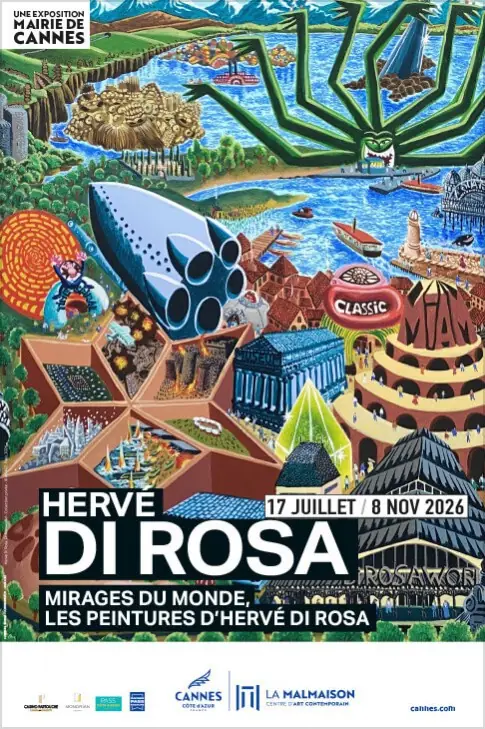
There is a particular quality of light on the boulevard de la Croisette in summer — the way it bounces off the bay and settles, warm and slightly dazed, on everything it touches. It seems fitting that La Malmaison, the neoclassical villa wedged between the palm trees and the sea, should spend the better part of 2026 hosting a painter whose entire career has been an argument against restraint. Hervé Di Rosa does not do subtle. He does colour, noise, narrative, and a kind of gleeful formal chaos that, standing in front of one of his large canvases, feels less like looking at art and more like being talked at, very fast, by someone who has just returned from somewhere extraordinary.
'Mirages du monde' opens at the Centre d'art contemporain La Malmaison on 17 July 2026 and runs through 8 November. The exhibition spans more than forty years of Di Rosa's output and brings together paintings, sculptures, drawings, ceramics, and tapestries — a breadth of medium that reflects the restlessness at the heart of his practice. It is organised in three chapters, moving from the charged, pop-inflected works of the 1980s through the travel cycles that define his middle period, and on to the most recent pieces. The address — 47 boulevard de la Croisette — places all of this directly on Cannes's most famous promenade, which adds a certain frisson: Di Rosa's riotous imagery set against the studied elegance of the Riviera.
A Sète Boy Who Went Everywhere
Di Rosa was born in Sète in 1959, a port city on the Languedoc coast whose working-class directness and Mediterranean colour have left a visible mark on his sensibility. In the early 1980s, alongside Robert Combas and a loose cohort of young painters, he helped found the Figuration Libre — a movement that rejected the austerity of conceptual art and reached instead toward comic strips, graffiti, urban folklore, and the visual languages of popular culture. The timing was pointed: while the art world was still processing minimalism and institutional critique, these painters brought back figures, stories, and an almost aggressive cheerfulness.
What distinguishes Di Rosa from his contemporaries, however, is the degree to which he subsequently left France behind — not in spirit, but in geography. Over the following decades he travelled extensively, spending sustained periods in Mexico, Brazil, Senegal, Japan, India, and elsewhere, each time absorbing local craft traditions and folk-art vocabularies and folding them into his own. The result is a body of work that sits, as the exhibition's own framing puts it, at the intersection of bande dessinée, graffiti, art brut, and international popular arts. It is a crowded crossroads, and Di Rosa navigates it with the confidence of someone who has been standing there for a very long time.
Three Chapters, One Restless Eye
The three-chapter structure of 'Mirages du monde' offers the visitor something rarer than a simple chronological hang: it traces the evolution of an artistic intelligence across radically different contexts. The 1980s works carry the energy of a movement announcing itself — dense with characters, flat perspectives, and a palette that seems to vibrate. The travel cycles that follow are more expansive, the figures sometimes mutating to accommodate new iconographies, the surfaces incorporating references that a Western eye might not immediately decode but that reward attention. The recent works, seen in this context, read as a kind of synthesis — the accumulated influences absorbed and made wholly personal.
The inclusion of ceramics and tapestries alongside the paintings is worth noting. Di Rosa has always treated the boundary between fine art and craft with the same indifference he shows toward most received hierarchies, and these objects ground the exhibition in a materiality that flat reproductions cannot convey. A tapestry carries weight; a ceramic holds the trace of hands. Encountering them in La Malmaison's cool, high-ceilinged rooms, after the heat of the Croisette outside, sharpens the senses considerably.
'L'univers de Di Rosa, coloré et joyeusement subversif, se situe à la croisée de la bande dessinée, du graffiti, de l'art brut et des arts populaires internationaux.'
Admission is 6,50 € at full price, with a reduced rate of 3,50 € for visitors aged 18 to 25 and holders of the Cannes Pass Culture. Entry is free for under-18s, students, job-seekers, and visitors with a disability card and their accompanying person — a pricing structure that, in a town more accustomed to exclusivity, feels quietly democratic and entirely in keeping with Di Rosa's own instincts.
The exhibition runs through the height of summer and well into autumn, which means it will be seen by very different crowds: festival-goers and tourists in July and August, then the quieter, more contemplative visitors of October and November, when the light on the bay turns amber and the terraces begin to empty. Both versions of Cannes suit Di Rosa. His work is loud enough to hold its own against a summer crowd and complex enough to reward a slow afternoon in the off-season. La Malmaison closes its doors on 8 November — which, given the forty-year span on display inside, gives you rather more time than you might expect to find your way there.