At half past six in the morning, the light over the Var coast does something particular. It arrives at an angle that makes stone walls glow amber and turns the tips of eucalyptus leaves translucent — a quality that landscape designer Gilles Augias must have understood when he planted the first specimens here, on terraced ground that steps down toward a view of the sea. At Parc Gonzalez, dawn is not an inconvenience. It is, arguably, the point.
From 5 to 7 June 2026, the park opens its gates for a guided discovery visit — Visite découverte de la flore australienne — beginning at 6:30 in the morning. The address is Boulevard du Soleil, which, in the context of this particular garden, feels less like a bureaucratic detail and more like an accurate description.
A Gift, a Garden, a Continent Transplanted
The story of Parc Gonzalez begins with an inheritance. When the heirs of painter Roberta Gonzalez bequeathed her former summer residence to the town of Bormes-les-Mimosas, the municipality turned to Augias, a local specialist in southern-hemisphere flora, to reimagine the grounds. The result, inaugurated in 2003, is a garden of approximately 5,000 square metres devoted entirely to Australian plant life — more than 550 species drawn from every region of the continent, set within walls, pathways, and paving stones cut from the local gneiss of Bormes itself.
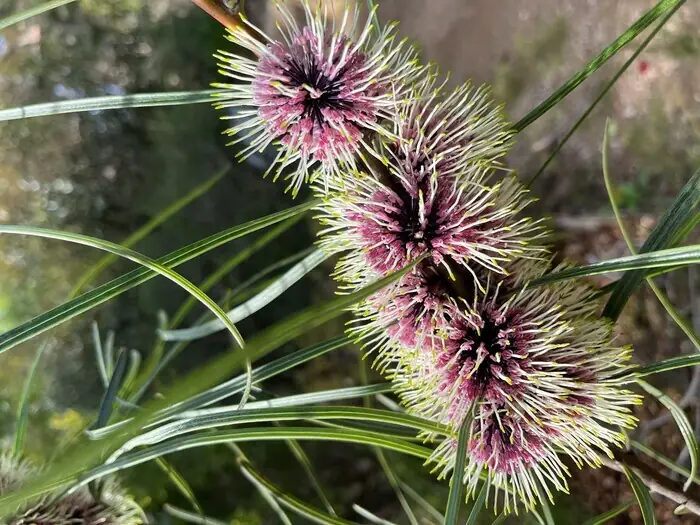
That material choice matters. The pale, mica-flecked stone ties the garden irrevocably to the village above it, so that what might otherwise feel like a botanical curiosity reads instead as an extension of the hillside. Acacias and grevilleas spill over dry-stone walls. Banksias and hakeas occupy the sunnier terraces. Melaleucas and erémophilas find their positions among the rockwork. Ferns and orchids retreat to the cooler, damper shadows near the old house. The golden mimosas — the flower that gave Bormes its surname — illuminate the whole composition in season, their scent carrying well beyond the garden's boundaries.
"Le climat méditerranéen étant favorable à leur adaptation, près de 500 espèces s'épanouissent aujourd'hui sur les terrasses." — Parc Gonzalez
Why the Mediterranean Receives Australia So Willingly
The convergence is not accidental. Both the Côte d'Azur and the coastal regions of southern and western Australia share what botanists call a Mediterranean climate — hot, dry summers, mild wet winters, and soils that reward drought-adapted plants. Eucalyptus, in fact, arrived on the French Riviera in the nineteenth century and has been naturalised here long enough that many visitors assume it indigenous. Augias built on that compatibility, selecting species with staggered flowering seasons so that the garden maintains colour and interest across all four seasons — a horticultural discipline that requires considerable knowledge of plants most European gardeners have never encountered.
The garden's terraced layout, following the natural slope of the hillside, offers what the park describes as spectacular views over the sea. The path rises and descends through the collections, passing agaves and aloes alongside the more unexpected antipodean specimens, with palms providing vertical punctuation throughout. It is a garden that rewards slow movement and a willingness to read the labels.
For the visitor arriving on 5 June at 6:30, the early hour means the garden before the heat of the day, the light at its most considered, and the kind of quiet that makes it possible to hear the difference between a eucalyptus in still air and one in the faintest breeze. Bormes-les-Mimosas sits in the Massif des Maures, that ancient range of schist and gneiss that runs between Hyères and Fréjus — one of the least-developed stretches of the Var coast, a fact its residents protect with some determination.
The town itself, classified among the Plus Beaux Villages de France, climbs a medieval hillside above the plain, its lanes narrow enough that two people cannot pass without negotiating. To visit the garden at the start of June, when the Riviera season is gathering momentum but has not yet reached its full, ungainly weight, is to see both the village and the coast at something close to their best. The discovery visit at Parc Gonzalez is, in that sense, an argument for earliness in all its forms — the early hour, the early summer, and the particular pleasure of encountering something carefully made before the crowd arrives to confirm its reputation.