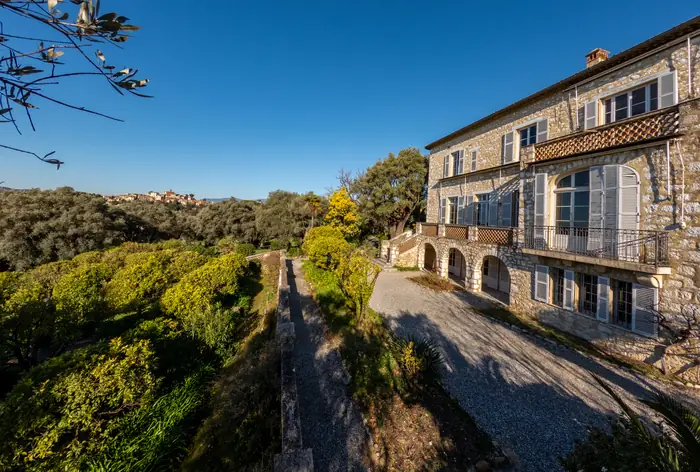
There is a particular quality of light on the hills above Cagnes-sur-Mer — something to do with the way it falls through the silver-grey canopy of ancient olive trees and lands, warm and diffuse, on the ground below. Pierre-Auguste Renoir noticed it too, which is precisely why he chose to spend the final years of his life here, at the Domaine des Collettes, painting what he could see from his garden and his studio windows. On a Saturday afternoon in early June, that same light will be the backdrop for something quietly remarkable: a guided family workshop that asks both children and adults to look at the world the way a painter does.
On Saturday 6 June 2026, at 14h30, the Musée Renoir at 19 Chemin des Collettes opens its doors to families for 'Les Couleurs et les Sens dans le Jardin de Renoir' — a combined guided visit and outdoor creative workshop held within the historic grounds of the Domaine. Children must be accompanied by an adult; entry is subject to available capacity, so arriving at the museum reception in good time is advised.
Walking the Ground Renoir Walked
The visit begins with a guided tour of the Domaine des Collettes itself — the estate Renoir purchased in 1907 to preserve a grove of centuries-old olive trees that were threatened with felling. The route is designed not merely as a chronological account of the painter's life, but as a perceptual exercise: participants trace the paths Renoir himself took, pausing at viewpoints that correspond to specific canvases, observing the garden as it appears — or appeared — within his paintings. The interplay of colour, shifting light and physical sensation that defined his late Impressionist work becomes, in this context, something one can actually stand inside.
The Domaine today retains much of the character Renoir would have known. The olive grove remains; the medieval village of Haut-de-Cagnes rises above, the sea glitters in the distance, and the surrounding hills complete a panorama that feels almost compositionally arranged. The city of Cagnes-sur-Mer has also restored Renoir's kitchen garden behind the Ferme des Collettes, adding a layer of domestic intimacy to the estate. The garden holds a 'Refuge LPO' designation — a French biodiversity label — with 36 recorded bird species living within the grounds, which lends the visit a kind of stillness that is increasingly rare along the Côte d'Azur.
Observe, Touch, Smell — Then Create
What distinguishes this afternoon from a standard museum visit is its sensory structure. The workshop portion is built around three verbs — observer, toucher, sentir — and guides participants through the plants and trees of the garden using all available senses before asking them to produce a personal artwork outdoors. The creative session takes place en plein air, in the same conditions, and beneath the same light, that shaped Renoir's own practice in his later years.
For younger visitors, this is an unusual kind of cultural engagement: not passive reception but active making, rooted in a specific place with a specific history. For adults accompanying them, the exercise has its own rewards — a slowing-down, a reorientation of attention toward texture, scent and colour rather than screens or schedules.
'Cette lumière qui baigne des oliviers séculaires illumine encore et pour toujours ses toiles dans le monde entier.' — Musée Renoir, Cagnes-sur-Mer
The museum at Chemin des Collettes is not a grand institutional space. It is, by design, an intimate one — a house and garden that retain the scale of private life. The Domaine has served as the setting for outdoor events including 'Un soir chez Renoir' and 'Déjeuner sur l'Herbe', which speaks to the way the site lends itself to experiences that blur the line between art and the outdoors. This June workshop belongs to that tradition.
For families visiting the Côte d'Azur in early summer — when the light is long and the hills above the coast are at their most generous — an afternoon at the Musée Renoir offers something that the seafront promenades and the hotel pools cannot: a reason to look carefully at a garden, and at the paintings it produced, and to understand, in a small but lasting way, why one of the great colourists of the nineteenth century never wanted to leave.