There is a particular quality of light in Nice on an October Thursday evening — the last of the summer warmth still caught in the stone, the hills above the city already cooling. The route de Turin runs inland from the coast, away from the promenade and the tourist geometry, into a quieter, more working Nice. It is here, at number 89, that the Forum d'Urbanisme et d'Architecture de la Ville de Nice holds its ground: a civic institution dedicated to the city's built environment, and an unlikely — which is to say, perfect — setting for what is planned for the evening of 22 October 2026.
The event begins at 18h30 and carries no entrance fee, though registration is required. It is organised in two distinct movements, each feeding the other.
A Conversation That Starts With the Sea
The first part is a public conversation, anchored in a video work titled Ode marítima — a title borrowed, unmistakably, from Fernando Pessoa, the Portuguese poet who wrote under a constellation of heteronyms and whose maritime ode remains one of the most physically charged poems in the European canon. The film was made by Fu Le, choreographer and video artist, who will be present in dialogue with the audience and with Nathalie Amae, independent curator, author, and artistic director of the OVNi festival.
The conversation will explore the narrative potential of architecture, bodies, dance, and film — in relation, here, to a literary work by Fernando Pessoa.
What that means in practice is something rarer than a lecture and more rigorous than a panel: a genuine triangulation between a visual and choreographic work, the literary text that provoked it, and the spatial intelligence of an architecture forum. The bodies of dancers, the volumes of buildings, the movement of film — these are not separate disciplines pressed together for an evening's programme. They share a common grammar of space and time, and the conversation is designed to make that grammar legible.
Polystyrene and Desire
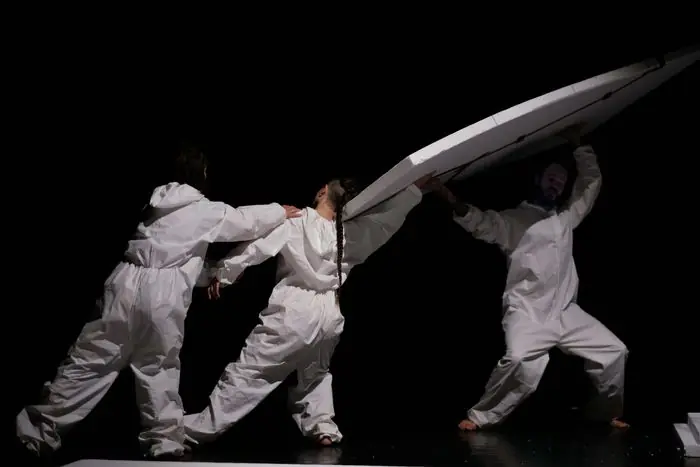
The second part is a ten-minute extract from a dance piece, Le Chant du Styrène, choreographed by Fu Le for his company, Compagnie Tetrapode. The three performers — Fu Le, Julie Gérardi, and Jeanne Durouchoux — work with polystyrene: a petroleum derivative, lightweight, ubiquitous, inert. The piece is described as combining dance with the physical handling of material, manutention in French, a word that carries both the sense of cargo work and of careful manual attention. Living bodies move against and through a substance that does not move back. The result, as the company frames it, is a concrete dance — one that resurrects inert matter and reconstructs, from scattered volumes, something resembling a lost paradise rendered entirely in plastic.
The conceptual weight here is not decorative. Polystyrene is the material of packaging, of disposability, of the petrochemical present. To choreograph desire within it — and the piece is explicitly about desire in a sanitised world — is to place the most intimate of human registers against the most synthetic of contemporary landscapes. It is also, quietly, a conversation with architecture: both disciplines deal in volumes, surfaces, and the human body's negotiation of space.
The OVNi festival, through which Nathalie Amae works as artistic director, has long positioned itself at the intersection of video art and the moving image — OVNi standing for Objets Vidéo Non Identifiés, a name that carries its own lightness. That the festival's director is in conversation here with a choreographer-filmmaker at an architecture forum is less a coincidence than a crystallisation of what contemporary interdisciplinary practice actually looks like when it is working well.
Nice itself is not an accidental backdrop. The city has a complicated relationship with its own built environment — the pressures of tourism, the memory of its Italian past, the ambitions of its civic institutions — and the Forum d'Urbanisme is one of the places where that relationship is examined seriously. To bring dance, film, and poetry into that space is to ask what architecture feels like from the inside of a body, rather than from the outside of a façade.
The evening is free. It asks only that you register in advance and arrive with some tolerance for ideas that do not resolve neatly. In return, it offers Pessoa's sea, Fu Le's polystyrene, and a conversation about what buildings and bodies have always had in common.