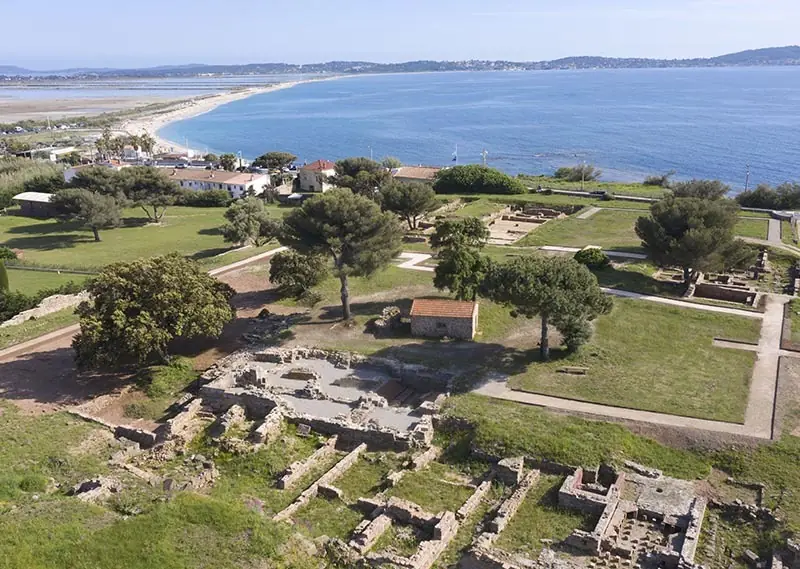
There is a particular quality to the light at L'Almanarre in early June — low and salt-bright, coming off the étang and the open Mediterranean in equal measure, softening the limestone ruins to the colour of old parchment. The archaeological site of Olbia sits on a gentle promontory just south of Hyères, where the Var coast begins its long retreat toward the Maures massif. Stand at the edge of the excavations on a quiet morning and it is not difficult to feel the layered weight of the place: Greek colonists, Roman merchants, medieval monks — each generation leaving its mark in stone before withdrawing into silence.
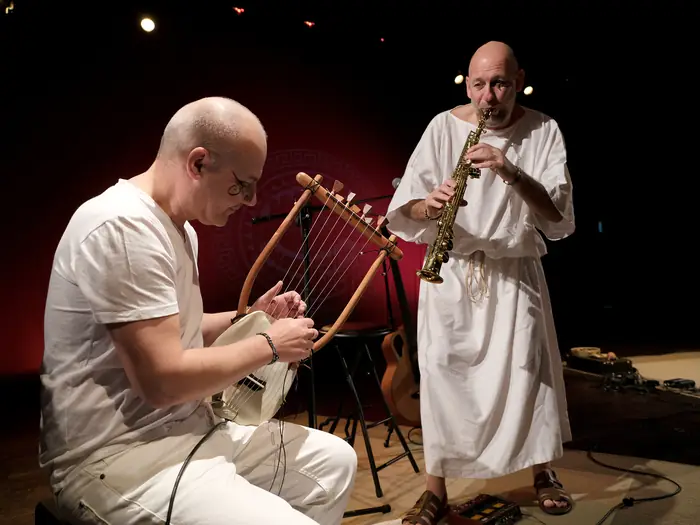
On Sunday 14 June 2026 at 10h30, that silence will be broken — carefully, thoughtfully — by two musicians and a collection of reconstructed instruments from the ancient world. The session, running one hour and bookable in advance through the site's online ticketing, is framed not as a performance but as a shared discovery: participants are invited to engage, ask questions, and follow the thread of musical practice from antiquity to the present day.
What Is a Phorminx, Exactly?
The questions at the heart of the morning are disarmingly simple. What is a phorminx? Where do musical notes actually come from? Who, in the ancient world, played music, and on what occasions? Cyrille Marche, a bassist, and Alain Angeli, a saxophonist, lead the session surrounded by reconstructions of antique instruments — physical objects that make abstract history tangible in a way that no diagram can. The approach is participatory: this is a conversation about musical archaeology, not a lecture.
The intellectual territory is richer than it might first appear. Ancient Greek music theory was inseparable from mathematics — Pythagoras famously derived his scale from the ratios of vibrating strings — and equally entangled with cosmology, poetry, and the rhythms of agricultural and civic life. The aulos accompanied athletic contests and religious processions; the kithara was the instrument of Apollo and of professional bards. Understanding these practices means understanding something fundamental about how Western musical thinking was assembled, note by note, over centuries.
'Partez à la découverte des pratiques musicales de l'Antiquité, leurs liens avec la nature, la littérature et les mathématiques, afin de comprendre comment elles ont donné naissance à nos pratiques actuelles.'
A Site Unlike Any Other on the Côte
The choice of venue is not incidental. Olbia — its name derived from the Greek for 'prosperous' — was founded in the fourth century BC by Greek colonists from Massalia, present-day Marseille. It is, by any measure, an exceptional survival: the only known example, preserved in its complete ground plan, of the network of fortified colonial settlements that Massalia established along this stretch of coastline to protect its maritime trade routes. The first Olbians were soldier-settlers, fishermen, and farmers; the city they built, and its successive Roman and late-antique inhabitants, left behind fortifications, paved streets with drainage channels and raised pavements, a communal well, residential blocks, shops, thermal baths, and sanctuaries. Beneath a later layer of the site, the ruins of the medieval abbey of Saint-Pierre de l'Almanarre add yet another stratum to the palimpsest.
To sit among these remains and discuss the musical scales that Greek colonists would have carried with them from Massalia — the same scales that Pythagoras was theorising in roughly the same century — is to experience history as something genuinely continuous rather than safely distant.
For visitors planning the day around the session, Hyères itself rewards a slower pace. The medieval old town climbs behind the modern centre, and the Presqu'île de Giens — the unusual double tombolo that connects the peninsula to the mainland — offers one of the more dramatic coastal walks on the Var. The Îles d'Or, visible from the shore at Olbia, are accessible by ferry from the port of Hyères-Plage.
Advance reservation is required via the online ticketing platform; given the site's intimate scale and the participatory format of the session, places are unlikely to be plentiful. The address is Route de l'Almanarre, 83400 Hyères — follow the coast road south from the town centre toward the isthmus, and the site will appear on the seaward side.
Some mornings in this part of Provence arrange themselves into something close to the ideal of what travel is supposed to be: a place that earns its age, a question worth asking, and enough quiet to actually hear the answer. This one, it seems, has all three.