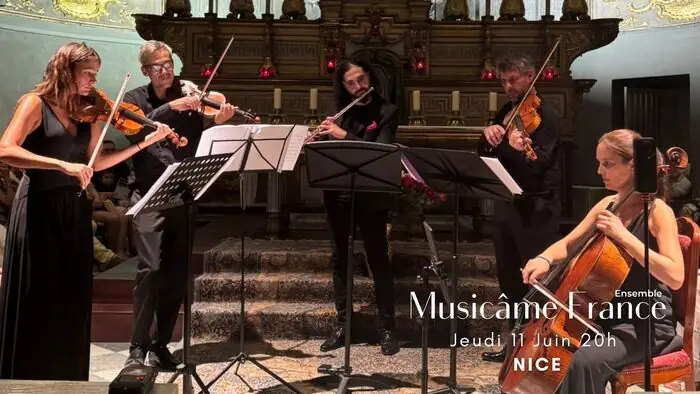
There is a particular quality of light in Nice on a June evening — the kind that lingers long after the sun has dropped behind the Alpes-Maritimes, turning the old city's ochre facades the colour of warm stone. It is the sort of evening that seems to ask for music. On Thursday 11 June 2026, Théâtre Francis Gag, tucked into the Rue de la Croix at the edge of the Vieille Ville, will provide exactly that: a chamber concert by Ensemble Musicâme France that draws together eleven composers across four centuries and at least as many emotional registers.
The ensemble is returning to Nice after a long absence from the city's stages — a homecoming of sorts, given that the group operates as a collective of both international and locally rooted musicians drawn from major orchestral formations. That organisational model — horizontal, collaborative, without a conductor imposing a single interpretive will — gives Musicâme France a particular intimacy, a sense of five musicians genuinely listening to one another. The five in question are Issam Garfi on flute, Sybille Cornaton Duchesne as solo violin, Matei Ioan on second violin, François Duchesne on viola, and Noé Natorp on cello.
The Programme: A Deliberate Arc
The evening opens with Rossini's Guillaume Tell Overture — a piece so familiar it risks being taken for granted, yet in chamber arrangement it strips away the orchestral bluster and reveals the melodic architecture underneath. From there, the programme moves with considerable range: Telemann's Concerto for Viola in G, the final movement; Taffanel's Nocturne & Allegro scherzando, a piece that sits at the intersection of late Romanticism and the emerging French flute tradition; Tchaikovsky's Valse sentimentale; and Bizet's Menuet & Farandole — the latter carrying, for anyone who knows Nice's own Carnival and Mediterranean street culture, a particular regional resonance.
The mid-programme turn is perhaps the most telling curatorial choice: Charles Aznavour's La bohème, a chanson in the company of Wieniawski's Scherzo-Tarantelle, Poulenc's Cantilène pour flûte, and Ibert's Concerto pour flûte — Allegro Scherzando. The inclusion of Aznavour — Armenian-French, beloved across generations — alongside the Polish Romantic Wieniawski and the distinctly Parisian wit of Poulenc and Ibert suggests an ensemble comfortable with the idea that the borders between 'classical' and 'popular' are, at best, administrative fictions. The programme closes with Piazzolla's Oblivion — one of the Argentine master's most quietly devastating pieces — and Vivaldi's Summer from The Four Seasons, final movement: a return to heat and velocity after the stillness of the tango.
'Présent dans plus de 100 villes à travers le monde, l'Ensemble Musicâme France défend une musique qui touche le cœur et élève l'esprit au-delà des frontières.'
Théâtre Francis Gag and the City Around It
The venue is worth a word of its own. Théâtre Francis Gag — named for the Niçois poet and playwright who wrote in the local niçard dialect — is a compact, characterful space that rewards proximity. It is not a concert hall engineered for acoustic perfection; it is a theatre that has absorbed decades of performance, and the room itself participates in the evening. The seating categories reflect this: the Prestige tier at €30 places the listener closest to the musicians, at a distance where breath and bow pressure become part of the experience; the Essentielle tier at €25 offers central placement for a full, balanced sound.
Nice in June is the city at its most inhabitable — the summer crowds of July and August still weeks away, the evenings long and warm enough to walk the Promenade des Anglais or take an aperitif in the Cours Saleya before the 8 p.m. curtain. The Vieille Ville, a ten-minute walk from the waterfront, operates at its own unhurried pace: narrow streets, baroque churches, the smell of socca from the market stalls. An evening at Francis Gag fits naturally into that rhythm.
For those arriving from elsewhere on the Côte d'Azur — from Cannes, Antibes, Monaco — the timing is generous. The train to Nice-Ville takes under an hour from most points along the coast, and the theatre is reachable from the station on foot in fifteen minutes. There is, in other words, no logistical reason not to come. The more interesting question is simply which seat to choose — and how long to linger in the old city afterwards.