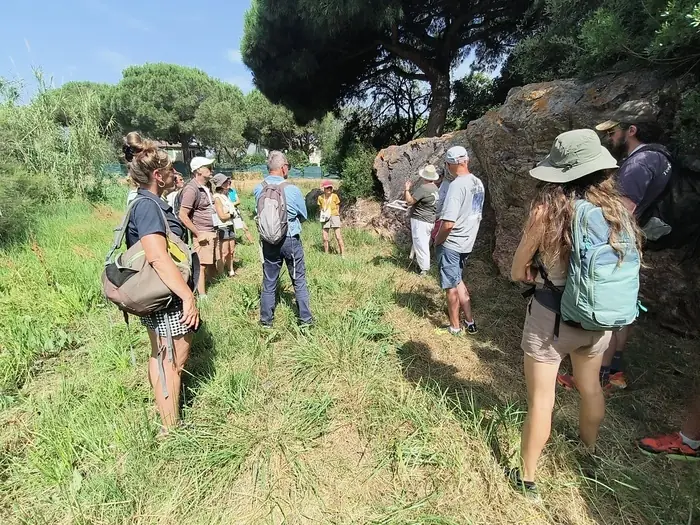
There is a particular quality of light on the Giens peninsula on a clear June morning — white and direct, the kind that makes limestone look almost phosphorescent and the sea beyond it an improbable shade of blue-green. It is, in other words, exactly the right light in which to go looking for ancient Greeks.
On Sunday 14 June, a guided outing organised with the mediators of the Parc national de Port-Cros takes participants from the sanctuary of Aristaeus, on the boulevard d'Alsace-Lorraine at La Badine in Giens, on a journey that spans roughly two and a half millennia — and, on foot, about four hours of walking, pausing and eating. The meeting point is at 10:30.
The Shrine and the God of Useful Things
Aristaeus is not one of the famous Olympians. He was a minor deity — son of Apollo and the nymph Cyrene, according to myth — credited with teaching mortals the arts of beekeeping, olive cultivation and cheese-making. His sanctuary here, on the edge of what was once the Greek trading port of Olbia, is a reminder that the Var coast was not always French, not always Roman, not always anything in particular. Greek settlers from Marseille established Olbia in the fourth century BC, and the traces they left behind — modest, practical, agricultural — speak less of glory than of the daily effort of making a foreign landscape productive. The 'visite-animée' of the sanctuary lasts approximately one hour and thirty minutes, long enough to begin to understand what that effort looked like.
The format matters here. This is not a conventional museum tour. The Parc national de Port-Cros runs what it calls animated visits — part guided explanation, part live interpretation — designed to make an archaeological site legible to anyone from the age of six upwards. Families are explicitly welcome; the only requirements are suitable shoes, water, and a packed lunch.
'Une randonnée accompagnée par les médiateurs du Parc national de Port-Cros jusqu'au fort du Pradeau vous permettra de mieux comprendre la presqu'île de Giens et son écosystème.'
From Antiquity to the Shoreline
After the sanctuary, the group sets off on foot toward Fort du Pradeau — a walk of approximately one hour and thirty minutes of actual movement, with around an hour's pause for the picnic. The fort sits at the tip of the peninsula near La Tour Fondue, looking out toward the Îles d'Hyères: Porquerolles, Port-Cros, the Île du Levant. The Pradeau fortification belongs to a much later chapter of local history, part of the coastal defence infrastructure that successive French administrations built and rebuilt from the early modern period onward to protect the rade de Hyères — one of the most strategically significant anchorages on the Mediterranean coast.
The walk itself crosses the isthmus of Giens, one of the more unusual landforms on the French Riviera: a double tombolo, two narrow sand spits that connect the peninsula to the mainland, enclosing a salt lagoon — the étang des Pesquiers — between them. The ecosystem here is fragile and closely managed within the national park's zone of influence. Flamingos use the lagoon. So do various species of migratory wading birds. The park mediators, who accompany the group throughout the afternoon section, are well placed to explain what you are actually looking at.
The full day moves, then, through several distinct registers: archaeological interpretation, physical landscape, ecological context, and the kind of unhurried midday pause — sitting on a coastal path with a sandwich and a view of the islands — that is harder to engineer than it sounds.
Practical notes for those planning to join:
- Meeting point: boulevard d'Alsace-Lorraine, La Badine, Giens (83400 Hyères)
- Start: 10:30, Sunday 14 June
- Suitable for ages 6 and up; an adult must accompany children
- Bring walking shoes, water and a packed lunch
- The return from Fort du Pradeau (La Tour Fondue) is by bus — line 67, with a bus every ten minutes
- Contact for information: fortdupradeau@portcros-parcnational.fr
The line 67 detail is worth noting: the route is linear, not circular. You do not walk back the way you came. You arrive somewhere different from where you started, which is, when you think about it, a reasonable description of what a good day out should do.