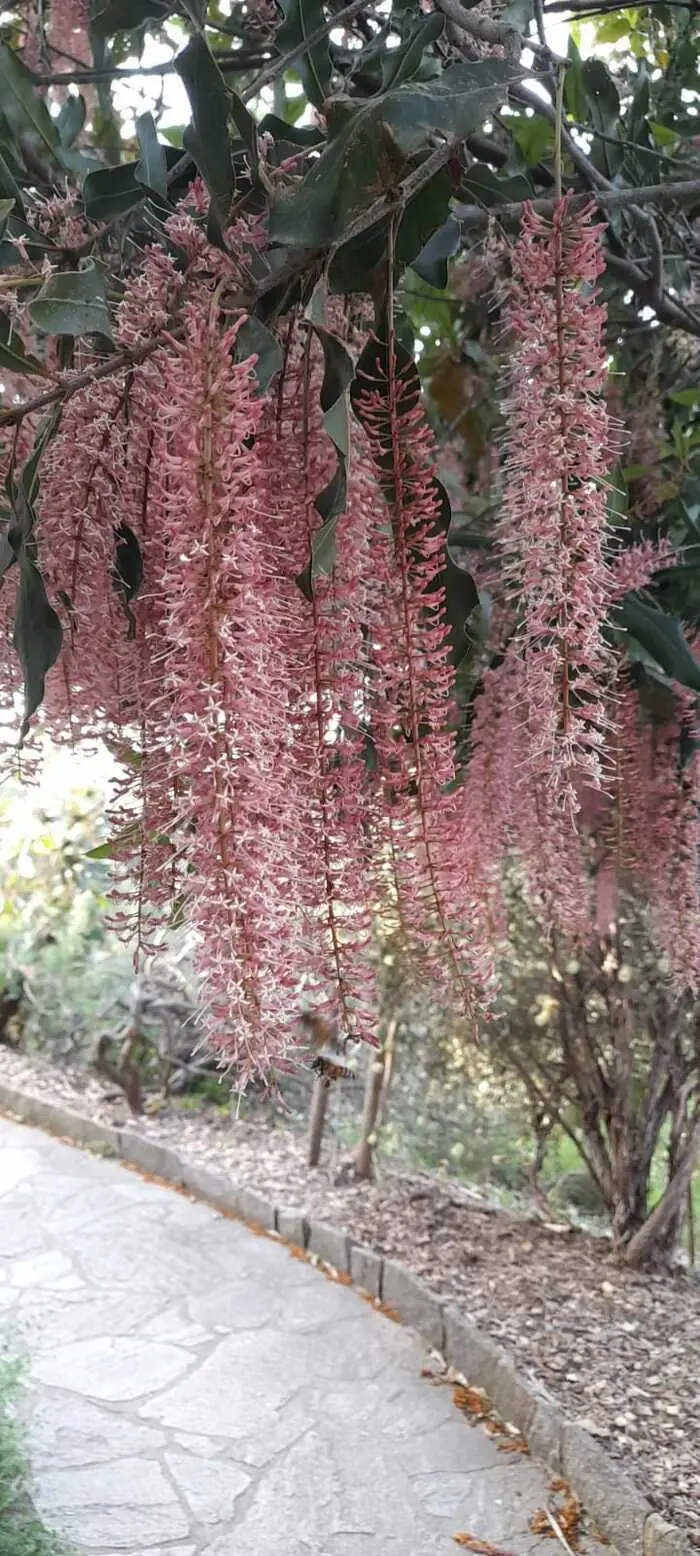
There is a particular quality of light on the Var coast in early June — low enough in the morning to catch the silver undersides of eucalyptus leaves, warm enough by eight o'clock to release the volatile oils that give the air its faint medicinal sweetness. On the terraced hillside above Boulevard du Soleil in Bormes-les-Mimosas, that scent mingles with something else entirely: the honey-and-pepper fragrance of grevillea in flower, the dry, papery smell of banksia cones. You are, technically, still in Provence. Botanically, you might be standing somewhere outside Perth.
The Parc Gonzalez occupies the former summer residence of the painter Roberta Gonzalez, whose heirs eventually bequeathed the property to the town with the intention of opening it to the public. The municipality turned to Gilles Augias, a landscape designer from Bormes with a specialism in southern-hemisphere plants, to transform the grounds into something genuinely coherent. What he created — over years of patient planting — is a collection of nearly 500 species, the majority from Australia, arranged across stone terraces built from the local gneiss and connected by staircases that occasionally demand a degree of commitment from the visitor.
A Garden Built for All Four Seasons
Augias's governing idea was succession: he selected plants with staggered flowering periods so that the garden would never go quiet. In practice, this means that a walk through the Parc Gonzalez in June rewards close attention. The acacias — cousins, in a sense, to the mimosas that give the town its name — may be past their winter gold, but the hakeas are opening, the melaleucas are in various stages of their bottlebrush bloom, and the erémophilas offer small tubular flowers in shades that range from cream to deep violet. Banksias, those strange architectural plants whose flower spikes look more like sculpture than botany, stand among the palms and agaves that have also found their footing here. Near the house itself, where the canopy closes and the air holds more moisture, ferns and orchids take advantage of the shade.
The Mediterranean climate has proved, perhaps unsurprisingly, hospitable to this antipodean collection. The summers are dry and hot; the winters mild. Many of the plants that struggle in the wetter, cooler gardens of northern Europe establish themselves here with ease, spilling over the gneiss walls and threading through the balustrades of the steeper stairways.
"Le parcours chemine parmi les collections d'acacia, eucalyptus et grevilleas" — and from the upper terraces, the sea appears between the branches, a flat blue distance that reorients the eye after so much botanical detail.
What the Visit Offers
On 5, 6, and 7 June 2026, the park opens for guided visits beginning at 8:00 in the morning — an hour chosen, one suspects, as much for the light and temperature as for any logistical reason. Entry is free. The visits are capped at twenty people, which is not an arbitrary figure: the terraces are not wide, the staircases are sometimes steep, and the point of the exercise is to look carefully at individual plants rather than to move through the garden in a crowd. A guide leads the group through the Australian flora, identifying species and explaining the logic of the collection.
Bormes-les-Mimosas itself is worth the journey independently of the garden. The medieval village climbs above the coast in a series of narrow lanes, its stone houses draped in bougainvillea and the eponymous mimosas that flower in January and February, drawing visitors from across the region for the annual Corso fleuri. The Boulevard du Soleil, where the park entrance sits, connects the upper village to the coast road and the beaches of the Cap Bénat peninsula beyond.
For those with a serious interest in Australian or Mediterranean-climate botany, the Parc Gonzalez represents a collection that is genuinely difficult to see elsewhere in France at this scale and in this state of maturity. For those without any particular botanical agenda, it offers something simpler: a quiet terraced garden above the sea, smelling of eucalyptus and warm stone, on a June morning before the heat arrives. The twenty places will fill. The garden website — bormeslesmimosas.com — is the place to confirm arrangements before you travel.