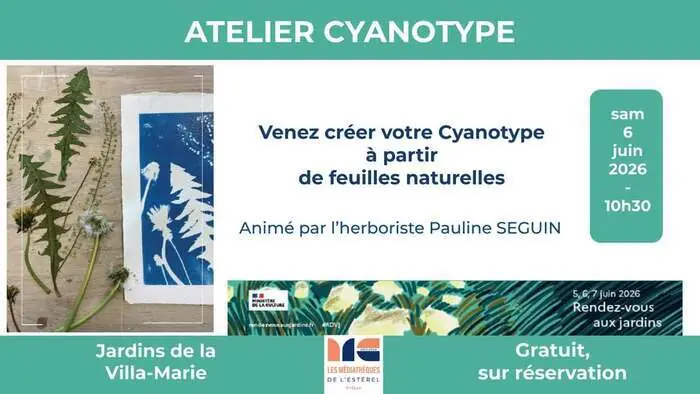
There is a particular quality of light in Fréjus on a June morning — the kind that arrives early, already warm, already purposeful. The town, founded by Julius Caesar and refined by two millennia of Mediterranean ambition, sits where the Esterel massif meets the sea, its Roman amphitheatre and cathedral baptistery holding their ground against the encroaching modernity of the coast. It is, in other words, a place where the past is never far from the surface — which makes it a fitting setting for a photographic process that predates even the daguerreotype.
On Saturday 6 June 2026, the Médiathèque Villa-Marie opens its doors at 10h30 for an Animation Cyanotype — a hands-on workshop in which participants create their own cyanotype prints using flowers and plant matter, guided by herbalist Pauline Seguin. The mediatheque is located at 447 Avenue Aristide Briand, in the heart of Fréjus, and reservations are required: call 04 94 51 01 89.
The Oldest Blue in Photography
Cyanotype is one of the earliest photographic printing processes, developed by the English scientist and polymath Sir John Herschel in 1842. Its chemistry is disarmingly simple: two iron compounds, water, and ultraviolet light. Place an object — a leaf, a stem, a flower head — on sensitised paper, expose it to sun, wash it in water, and what remains is a photographic negative rendered in the deepest Prussian blue, the silhouette of the plant preserved as if the paper had memorised it. The botanist Anna Atkins used the process the following year to create Photographs of British Algae: Cyanotype Impressions, now considered the first book illustrated with photographic images. The process never quite disappeared; it is the same chemistry that gave us architectural blueprints.
What makes the cyanotype particularly resonant as a craft is its intimacy with the natural world. You are not photographing a flower so much as pressing it into light, recording its geometry with the sun itself as your light source. In a region where the garrigue blooms with lavender, cistus, and wild thyme from late spring, the material palette available to a workshop like this one is quietly extraordinary.
A Mediatheque That Takes Culture Seriously
The Médiathèque Villa-Marie is not a peripheral venue. Part of the Esterel Médiatem network, the Fréjus municipal library holds around 200,000 documents and welcomes more than 30,000 visitors each year — a figure that reflects genuine civic engagement rather than tourist traffic. Some 106,000 items are borrowed annually, and the institution organises more than 400 activities aimed at young people, reaching approximately 4,150 children. The cyanotype workshop sits within that broader programming logic: culture as practice, not spectacle.
Herbalist Pauline Seguin leads the session, which means the botanical dimension of the work is taken seriously. Participants will bring together two disciplines that rarely share a table — the pharmacopoeia of plants and the chemistry of light — and the results will be their own to keep. The workshop is oriented around flowers and vegetation, though the source materials will depend on what is in season and in hand.
For visitors to the Côte d'Azur who have grown accustomed to the region's more polished cultural offerings — the art foundations of Saint-Paul-de-Vence, the festival calendars of Cannes and Nice — an afternoon in Fréjus making botanical prints in a working mediatheque offers something of a different register. The town itself rewards the detour: the archaeological museum, the Roman theatre, the octagonal baptistery of the early Christian cathedral. These are not monuments arranged for tourism; they are simply what remains.
Practical notes for those planning to attend:
- Date and time:** Saturday 6 June 2026, from 10h30
- Venue:** Médiathèque Villa-Marie, 447 Avenue Aristide Briand, 83600 Fréjus
- Reservations:** required — telephone 04 94 51 01 89
- Further information:** bm.esterel-mediatem.fr
Venez créer votre cyanotype à partir de fleurs et végétaux avec l'herboriste Pauline Seguin.
The light in Fréjus in early June is, as noted, reliable. That is precisely the point. Cyanotype asks nothing more of you than a morning, some plants, and the willingness to let the sun do its work.