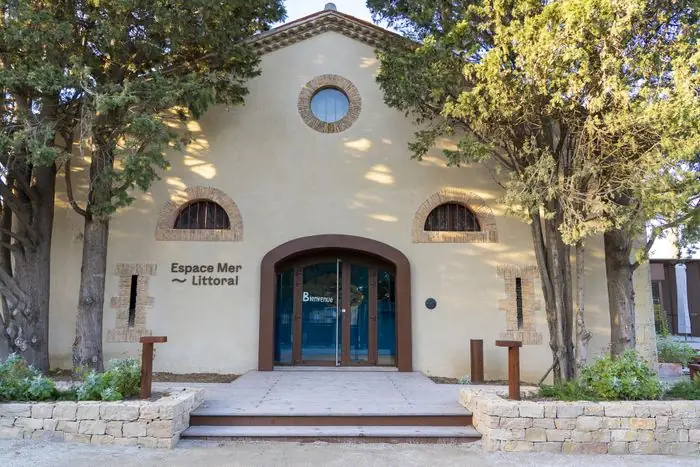
There is a particular quality of light at the southern tip of Cap d'Antibes that painters have been chasing for well over a century. The pine trees lean slightly seaward, the limestone cliffs drop clean into water that reads somewhere between turquoise and ink depending on the hour, and the air carries the faint resinous warmth that the Midi does better than anywhere else in Europe. On the morning of 19 September 2026, the gates of the Batterie du Graillon open freely to anyone who cares to walk in.
The occasion is a two-day free open visit to Posidonia Espace Mer et Littoral, the marine education and exhibition centre housed within this former military compound on the Rampe du Graillon. Entry is free and unticketed across both days — 19 and 20 September — making it one of the more quietly generous gestures on the autumn calendar of the Côte d'Azur.
A Battery Turned Sanctuary
The Batterie du Graillon has the kind of biography that takes a moment to absorb. For generations it served a strictly military function, its thick stone walls oriented toward the sea as a matter of defence rather than appreciation. Today the 2.2-hectare site belongs to the Conservatoire du Littoral — the French public body that has spent decades acquiring and protecting coastal land from development — and is managed by the municipality of Antibes Juan-les-Pins. The military architecture remains, repurposed and legible, framing a pine forest of 1.5 hectares that gives way at its edges to rocky cliffs and the crystalline water below.
It is, in short, a place that has earned its second life.
'The Mediterranean is not simply a sea — it is a system, and posidonia is its lungs.'
The name of the space gestures toward that system. Posidonia oceanica, the endemic seagrass meadow that carpets much of the Mediterranean seafloor, is among the most ecologically significant habitats in the basin — slow-growing, oxygen-producing, and under considerable pressure from anchoring, coastal construction, and warming waters. It is an apt namesake for a centre dedicated to making the marine environment legible to a general public.
What the Visit Offers
Over the two open days, visitors move at their own pace through the site. The programme is straightforward and unhurried:
- Exhibition rooms exploring Mediterranean marine life and coastal ecosystems
- Aquariums presenting local species
- The historic military building itself, worth examining as architecture
- The 1.5-hectare pine grove, which opens onto the cliff edge and the sea beyond
One detail worth noting: the virtual diving experience that Posidonia normally offers is not available on these two days. What remains is the physical site in its full extent — which, given the setting, is considerable.
At the end of the circuit, a terrace-facing relaxation and boutique space offers drinks and snacks with a direct view over the water. It is the kind of stopping point that earns its place: after an hour among exhibits and pine shade, sitting above the sea with something cold in hand is not a commercial afterthought but a natural conclusion.
The Longer View
Antibes has always occupied an interesting position on the Riviera — less theatrical than Nice, less manicured than Monaco, with a working port and a serious market and the Picasso Museum installed in a medieval castle on the ramparts. Cap d'Antibes, the pine-covered headland that juts into the sea to the south of the old town, carries a different register: quieter, residential in parts, wild in others. The Batterie du Graillon sits at its southernmost point, which means that on a clear September morning — and September on this coast tends toward the clear — the views extend across the Baie des Anges toward Nice and the Alps beyond.
September itself is a considered moment to visit. The summer crowds have thinned, the light has acquired that slightly lower, more golden angle that photographers and painters both covet, and the sea temperature remains warm enough to justify the walk down to the water's edge. The Côte d'Azur at this time of year is not a secret, but it is noticeably less loud.
For anyone already in Antibes or passing through the region that weekend, the Batterie du Graillon offers something that the coast does not always make easy to find: unmediated contact with the natural and historical landscape, at no cost, with no itinerary imposed.