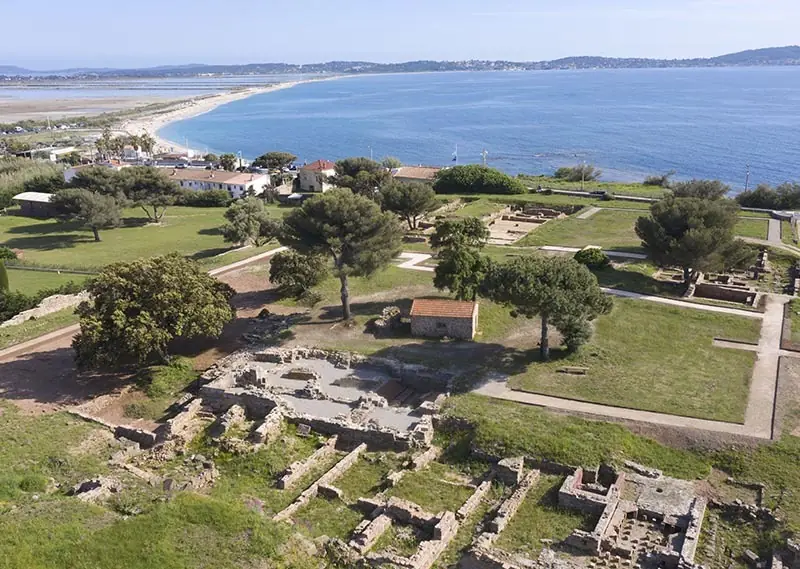
There is a particular quality of light on the Almanarre peninsula in early June — low, salt-bright, the kind that makes limestone glow and shadows sharpen. Stand at the edge of the Olbia site and the geometry of it announces itself almost before the eye can process what it is seeing: a grid of streets, the stubs of walls, the quiet logic of a city that has been here, in outline at least, for more than two thousand years.
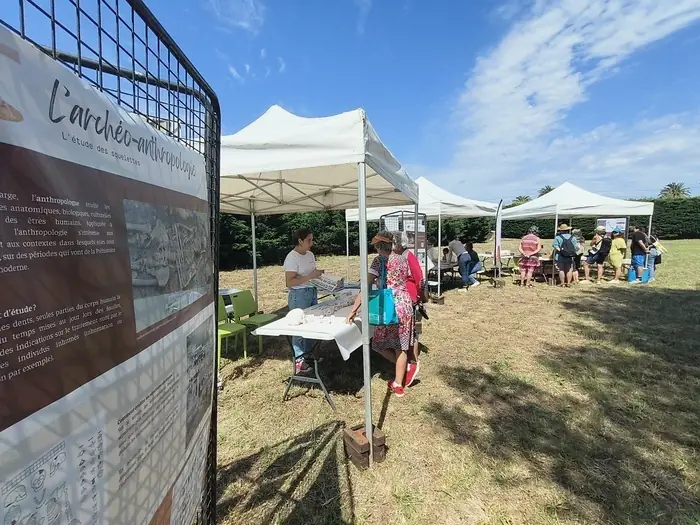
On 13 and 14 June 2026, that geometry becomes a classroom. The archaeological site of Olbia, on the Route de l'Almanarre in Hyères, opens its working spaces to visitors for a two-day encounter with the methods and professions of archaeology — from the moment a trowel breaks soil to the moment a fragment of pottery is catalogued under laboratory light. Entry is free and requires no reservation, subject to available capacity.
A City That Never Entirely Disappeared
Olbia is not a ruin in the romantic, collapsed sense. It is something rarer: a Greek colonial foundation — established by Marseille from the fourth century BC — whose entire urban plan survives intact in the ground. The site is the only known example of this kind of Marseillais fortress-colony preserved at full scale. Its first inhabitants were soldier-settlers: fishermen, farmers and traders whose primary mandate was to secure maritime commerce along a coastline that Massalia — ancient Marseille — depended upon absolutely.
What excavation has brought to light over the decades reads like a compressed urban history: fortification walls, paved streets with drainage channels and raised pavements, a collective well, residential blocks subdivided into houses, shops, baths and sanctuaries. The occupation spans roughly a thousand years. Layered into that chronology, archaeologists also uncovered the vestiges of a medieval abbey, Saint-Pierre de l'Almanarre, pressed into the same ground centuries later — as if the site itself refused to be abandoned.
'Les vestiges mis au jour permettent aux visiteurs de comprendre l'évolution urbaine d'une ville antique sur 1000 ans.'
From Trench to Analysis Table
The two-day programme is built around direct contact: archaeological objects and presentation models are brought out for visitors to examine, and specialists are on hand to explain the disciplines that turn a fragment of fired clay or a scatter of bone into historical knowledge. The fields represented include preventive archaeology — the investigative work carried out ahead of construction projects — along with archaeo-anthropology, the study of human remains and burial practices, and ceramology, the precise science of reading pottery as a chronological and cultural document.
The event is organised in partnership with the Service Départemental d'Archéologie du Var and the Institut national de recherches archéologiques préventives (Inrap), the French national body responsible for preventive excavation across the country. Both institutions bring working professionals rather than educators in the conventional sense: the people answering questions here are the people who were on site last week.
For a visitor with no background in the field, the encounter tends to reorganise the experience of walking around Olbia afterwards. A ceramic sherd that might previously have read as debris becomes, once a ceramologist has explained the typology of a rim profile or a glaze technique, a legible object — something that places a specific workshop in a specific century. The site does not change, but the way of looking at it does.
Hyères itself, the oldest resort town on the Côte d'Azur, sits a short drive inland, its medieval quarter climbing a hill above the modern town. The Almanarre peninsula stretches south toward the Giens tombolo, one of the few double sand spits in Europe, with the Îles d'Or — Porquerolles, Port-Cros, Le Levant — visible on a clear morning from the site's seaward edge. The setting is not incidental to the archaeology: Olbia was chosen for this promontory precisely because of the view it commanded over those waters.
No booking is needed for either day. Visitors should arrive with comfortable shoes and, if the June sun is already strong, a hat — the site offers little shade and the afternoon light on the Var coast in midsummer is unambiguous in its intentions. The specialists will be there, the objects will be on the tables, and the streets of a two-thousand-year-old city will be underfoot.