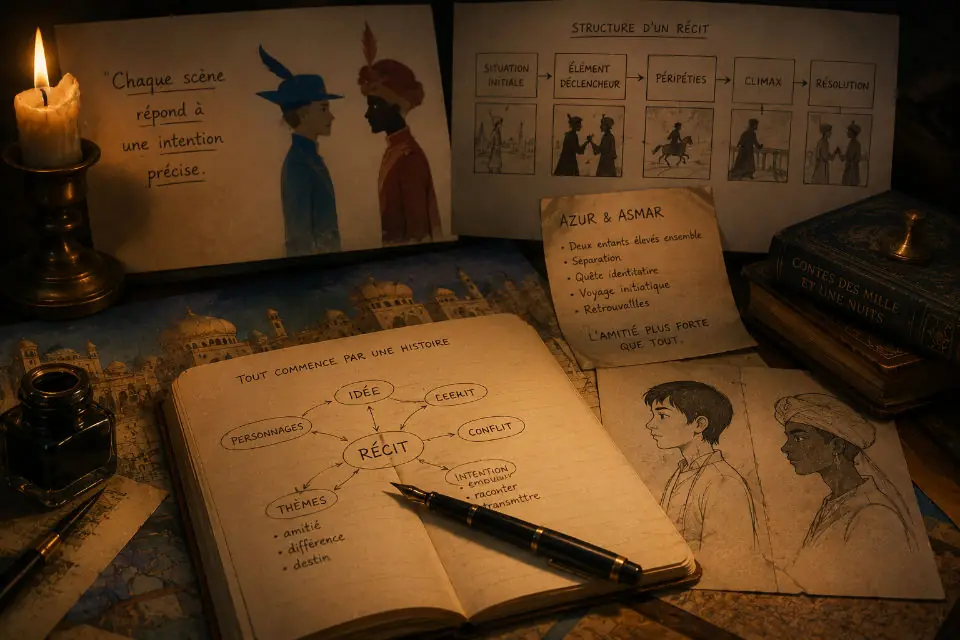
There is a particular quality of light in Cannes on a Wednesday afternoon in August — the kind that flattens shadows and sends most visitors in the direction of the beach. But on 5 August 2026, the coolness of Espaces Mimont on Rue de Mimont will offer something the sea cannot: a room full of children discovering, for the first time, that every film they have ever watched began as a single idea in someone's head.
The workshop is called Le cinéma, c'est magique — Mais d'où vient l'histoire ? — and the question embedded in that title is exactly the right one to ask. It runs for ninety minutes, starting at 14h30, at Espaces Mimont, 5 rue de Mimont, Cannes. Admission is free, with reservation required. Children from the age of seven are welcome.
The Architecture of a Story
The session works through a single, well-chosen lens: Michel Ocelot's animated feature Azur et Asmar, released in 2006. Ocelot — the French filmmaker behind the Kirikou series — built that film around two boys raised as brothers, one fair-skinned and one dark, who grow up to quest for the same mythical Djinn Fairy across a landscape drawn from North African and Moorish visual tradition. The film is, among other things, a meditation on cultural exchange, and it is precisely this layering — of character, of dramatic arc, of intersecting cultural worlds — that makes it useful material for a workshop about narrative intention.
The premise of the session is deceptively simple: how does an idea become a story, and how does a story become a structured film? Participants work through the choices a filmmaker makes — who the characters are, what they want, how the world they inhabit shapes what is possible for them — and come to understand that no scene exists by accident. Each one answers to a precise intention. That is the craft the workshop is designed to make visible.
'Every scene responds to a precise intention' — the central idea of the workshop, and perhaps the most useful thing a young person can learn about storytelling in any medium.
Cannes Beyond the Palme d'Or
It is worth noting where this takes place. Cannes is, of course, the city that hosts the world's most scrutinised film festival each May — a fortnight during which the Croisette becomes a stage for the global film industry. But the city's relationship with cinema does not begin and end with the Palais des Festivals. The Espaces Mimont, tucked a short walk from the seafront, is part of a municipal cultural infrastructure that runs year-round, offering workshops, exhibitions and performances to residents and visitors alike. A workshop like this one sits squarely in that tradition: cinema not as spectacle, but as craft to be understood and, eventually, practised.
For families spending the summer on the Côte d'Azur, the timing is well-judged. August in this part of France is generous with heat and crowds; a ninety-minute session that asks children to think carefully about structure and intention offers a different kind of engagement — slower, more considered, and likely more lasting than an afternoon at any screen.
What to expect in practical terms is modest and focused: a guided workshop for children aged seven and up, built around close attention to one animated film, with discussion of narrative choices, character construction, and the relationship between cultural context and storytelling. There are no details in the programme about materials or group size, but the format — a single film as a case study, a structured ninety minutes — suggests something closer to a seminar than a cinema screening.
Reservations can be made through the Cannes municipal agenda at cannes.com. The address is 5 rue de Mimont, 06400 Cannes. Entry is free.
The Croisette will still be there at four o'clock. The Mediterranean is not going anywhere. But the understanding that a story is built — choice by choice, scene by scene, with a reason behind each one — that takes a room, a guide, and ninety minutes of genuine attention.