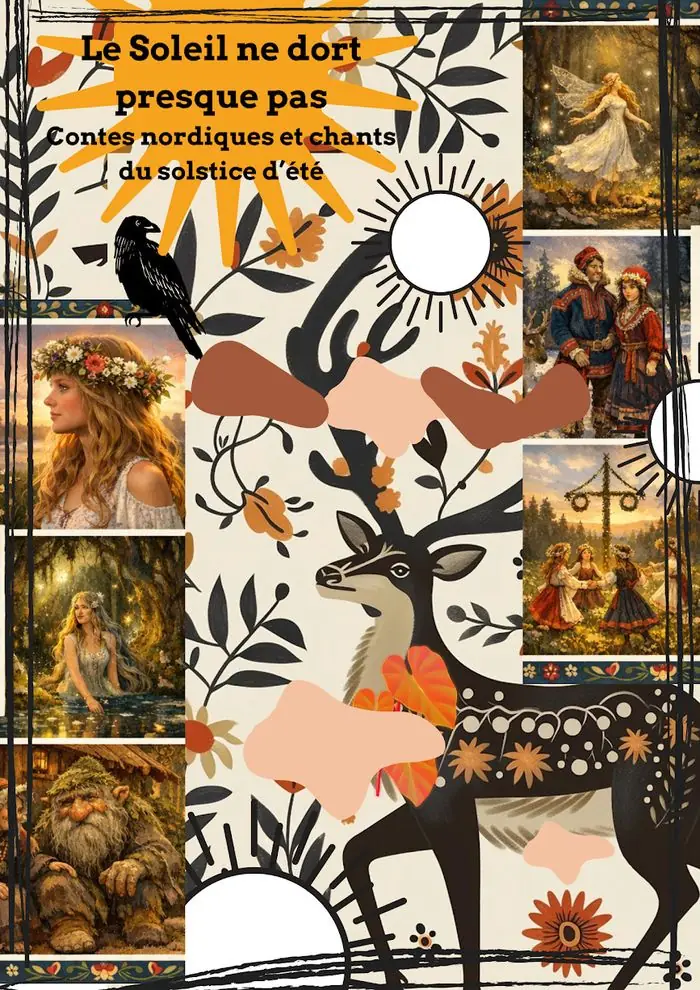
There is a particular quality to the light at altitude in late summer. At Isola 2000, a ski resort in the Mercantour massif that sits quietly between seasons in August, the sun lingers well past what feels reasonable — pressing against the ridgelines, refusing the valley. It is the kind of light that makes you believe, just for a moment, in the old stories.
On Wednesday 19 August 2026, that belief gets a voice. Christine Giraud brings her performance Le soleil ne dort presque pas — Nordic tales and songs of the summer solstice — to the Front de Neige at Isola 2000. The event begins at 18:00 and entry is free.
Myths of the Long Day
The programme draws from the oral traditions of northern and eastern Europe, the vast arc of cultures that have organised their spiritual calendars around the sun's extremes. Giraud weaves together a sequence of tales: impossible loves between day and night, fairy creatures dancing at Midsummer, solar mothers, gods locked in riddle contests, paths of light traced across the sky. Between and around the stories, traditional songs and music extend the narratives — described in the programme as 'an echo from the earth and the flames.'
The choice of Isola 2000 as a setting is quietly apt. The resort, perched at the end of a long road climbing from Saint-Sauveur-sur-Tinée, is one of the highest in the southern Alps. In winter it is a functional ski station; in August it becomes something stranger and more open — a plateau exposed to weather and sky, where the usual noise of a resort falls away and the landscape reasserts itself. The Front de Neige, the broad terrace at the foot of the pistes, faces west. The sun, in August, will still be high at six in the evening.
'La nuit du solstice devient alors un temps suspendu, une célébration du vivant, où l'on se rassemble autour du feu pour rappeler que la lumière revient toujours.'
The Midsummer traditions Giraud draws on — the Scandinavian midsommar, the Slavic Ivan Kupala, the French Saint-Jean bonfires — share a common anxiety and a common answer. The longest days carry within them the knowledge of their own end; the ceremonies exist to insist that the light will return. Sung around fires at the edge of forests, or told to children before the dark months, these stories were practical as much as poetic. They were a technology of reassurance.
An Evening at the Treeline
For the audience at Isola 2000, the experience will be shaped by the particular strangeness of being at altitude in summer. The air is cooler than on the coast — the resort sits at 2000 metres — and the silence between the stories will have a different texture than it would in a theatre or a town square. The mountains of the Mercantour, one of France's least-visited national parks, form the backdrop: a landscape that has its own slow mythology, its own long relationship with light and season.
Giraud's format — storytelling interwoven with traditional music — belongs to a European performance tradition that resists easy categorisation. It is neither concert nor theatre, neither lecture nor ritual, though it borrows from all of these. The tales 'answer each other,' as the programme puts it, building a cumulative world rather than delivering a single narrative. Listeners who arrive expecting a linear show may find themselves inside something more atmospheric and associative.
Admission is free, which means the evening asks only for your presence and, perhaps, a jacket. The drive up to Isola 2000 from Nice takes roughly an hour and a half; from the villages of the Tinée valley, considerably less. In August, the road is clear and the resort accessible. Come before six to find your footing on the Front de Neige, watch the light work its way across the peaks, and let the stories, when they begin, find you already paying attention.