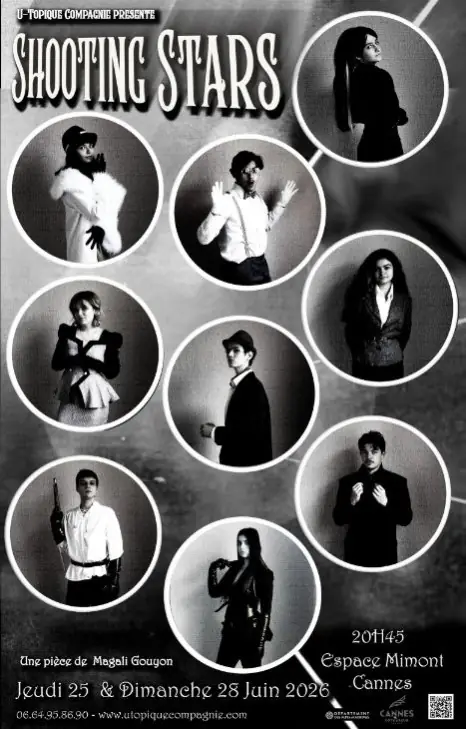
There is something fitting about a story of silent cinema being staged in Cannes. The city has spent the better part of a century worshipping moving images — the Palais des Festivals, the red carpet, the flashbulbs. But before all of that, there were the idols of the silent era: faces so luminous and so still that audiences projected entire inner worlds onto them. Shooting Stars, a new production by the U-topique Compagnie, takes that mythology and cracks it open.
The performance runs for 1 hour and 20 minutes and takes place at the Espaces Mimont, a cultural venue tucked at 5 rue de Mimont, on Thursday 25 June 2026 at 20h45. Tickets are priced at 8€ for adults and 6€ for under-18s — modest enough that it asks nothing more than your attention.
The Fall of Dada
At the centre of the piece is Dada, a beloved star of the silent screen whose world is, by all appearances, perfect and untouchable. Then she speaks. That single act — the acquisition of a voice — becomes the hinge on which everything turns. The story moves from glory to decadence, from carefully constructed mystery to an exposure that cannot be undone. The idols of the U-topique Compagnie's imagining are not brought down by scandal or rivalry, but by something far more unsettling: their own humanity.
'Between revolt and emancipation, these shooting stars wanted to create their own myth — but at what price?'
The question the company poses is not merely theatrical. The transition from silent film to sound in the late 1920s genuinely destroyed careers. Actors whose screen presence had been magnetic found that their voices — too high, too accented, too ordinary — shattered the illusion entirely. The mythology of stardom had always depended on a certain distance, a silence in which the audience could hear whatever it wished. Shooting Stars is interested in what happens when that distance collapses.
The Stage, the Screen, and the City
The Espaces Mimont sits in the older, quieter part of Cannes, away from the Croisette's particular theatre of appearances. It is a venue that hosts theatre, dance and music throughout the year — the kind of mid-scale cultural space that sustains a city's creative life between the grand festivals. On a warm June evening, with the light still holding over the Esterel hills to the west, it offers a different register of Cannes entirely.
The U-topique Compagnie brings to the piece a form that mirrors its subject: the language of silent cinema — gesture, posture, the choreography of expression — pressed against the demands of live performance. The result, according to the company's own framing, sits somewhere between theatre and spectacle, drawing on the visual grammar of an art form that predates sound. Whether that means film projections, stylised movement, or something stranger is left, deliberately, to the imagination.
What the production does make clear is its thematic ambition. The arc from adulation to ruin is old, but the specific texture here — the idol confronted with her own ordinariness, the myth-making machine turning against its subject — feels contemporary in ways that go well beyond cinema history. The shooting stars of the title are, after all, beautiful precisely because they burn.
For those spending the last week of June on the Côte d'Azur, an evening at the Espaces Mimont offers something the coastline rarely provides: a room that goes dark, a story that demands attention, and a question left hanging in the warm night air as you step back outside.