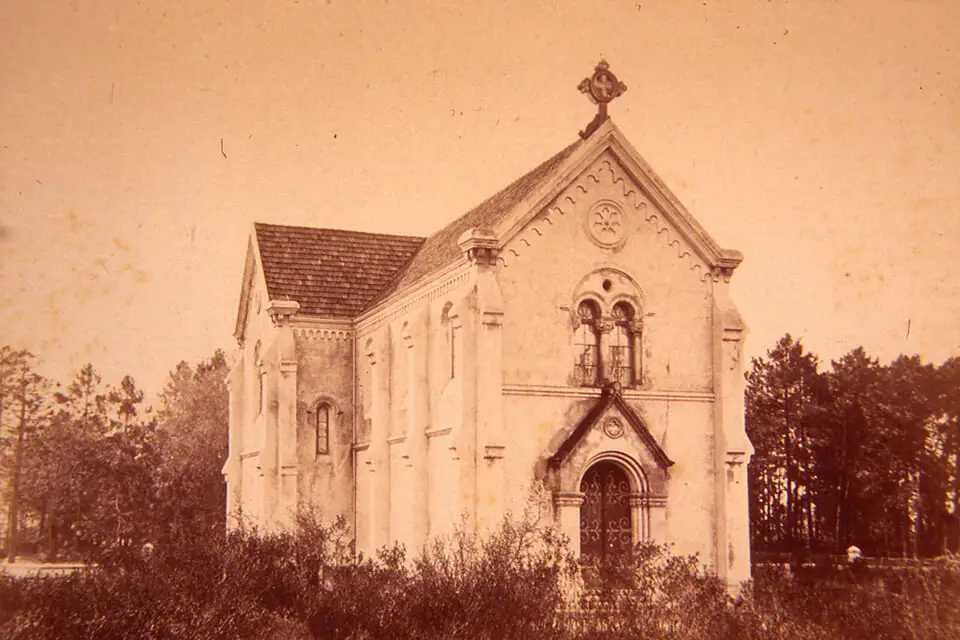
There is a particular quality to Cannes in November. The summer crowds are gone, the light has turned low and lateral, and the city — stripped of its festival armour — becomes something quieter and more legible. It is the right season, in other words, to read the architecture. To notice the ornamentation above a doorway, the curve of a roofline, the cross above a chapel that does not quite belong to the Latin tradition. November was, after all, the month the Russians arrived.
From the mid-nineteenth century onward, the Russian aristocracy adopted the French Riviera as their winter address. Cannes, Nice, Menton — each town accumulated its own Russian quarter, its own Orthodox churches, its own villas bearing names that sounded faintly out of place among the mimosa. The practice was not mere tourism. These were extended seasonal residences, sometimes lasting months, sometimes generations. They left an architectural residue that is still legible in the streetscape today, if you know where to look.
A Walk Through a Layered City
On Monday 16 November 2026, at 9h30, a guided tour sets out from in front of the Alexandra Palace — itself a building with a name that gestures toward a certain imperial sensibility — at 81 avenue du Maréchal Juin. The walk lasts an hour and a half and is organised by the City of Cannes as part of its heritage programme. Booking is required; the tour does not run in rain.
The route traces the footprint left by Russian winter residents during the Belle Époque and the early twentieth century: villas, hotels, a chapel, churches. These are not monuments in the obvious civic sense — no plaques announce their significance from a distance. They are woven into the fabric of a neighbourhood that has continued to live and change around them. The guided format matters here. Without a narrator, the Russian layer of Cannes is easy to walk past without registering.
'À travers les constructions du début du XXe siècle — somptueuses villas, hôtels, chapelle et églises — les participants découvrent l'apport de la communauté russe à la vie locale.'
The Orthodox tradition brought its own visual grammar to the Riviera: onion domes, iconostases, a different geometry of sacred space. On the Côte d'Azur, this grammar was often softened or hybridised — Russian patrons working with French and Italian architects, or importing their own from Saint Petersburg, producing buildings that sit in a productive tension between two aesthetic worlds. A Belle Époque villa with Orthodox detailing is not an anomaly here; it is a record of how Cannes actually grew.
What the Tour Offers
The walk is conducted in French. It is a heritage visit in the municipal tradition — scholarly in intent, unhurried in pace, priced to be accessible rather than exclusive. Admission is €8.50 at standard rate, €6.50 for Cannes residents and Pass Culture holders, and free for under-18s, job-seekers, and holders of a mobility inclusion card. For a city that can feel defined by its luxury economy, there is something quietly significant about a programme that puts this kind of urban history within reach of anyone who wants it.
The departure point, the Alexandra Palace on avenue du Maréchal Juin, sits in a part of Cannes that most visitors pass through rather than pause in — which is precisely the point. Heritage walks of this kind perform a small act of reorientation. They ask you to slow down in a place you thought you understood, and to look again.
November in Cannes has its own rewards: restaurant tables available without a wait, parking that does not require strategy, a city going about its actual life. Adding a ninety-minute walk through a chapter of European history that played out on these specific streets — among people who came here for the light and the warmth and never quite left — seems, in that context, like a reasonable way to spend a Monday morning.