The valley of the Roya has always asked something physical of those who enter it. The road climbs in long, deliberate curves; the light arrives at angles that flatten distance and sharpen silhouette. By the time you reach Tende — the last French town before the Italian border, its slate rooftops stacked like a hand of cards against the mountain — you understand, in your legs and your lungs, why the people who lived here long before us were not sedentary. Movement was not a choice. It was the condition of existence.
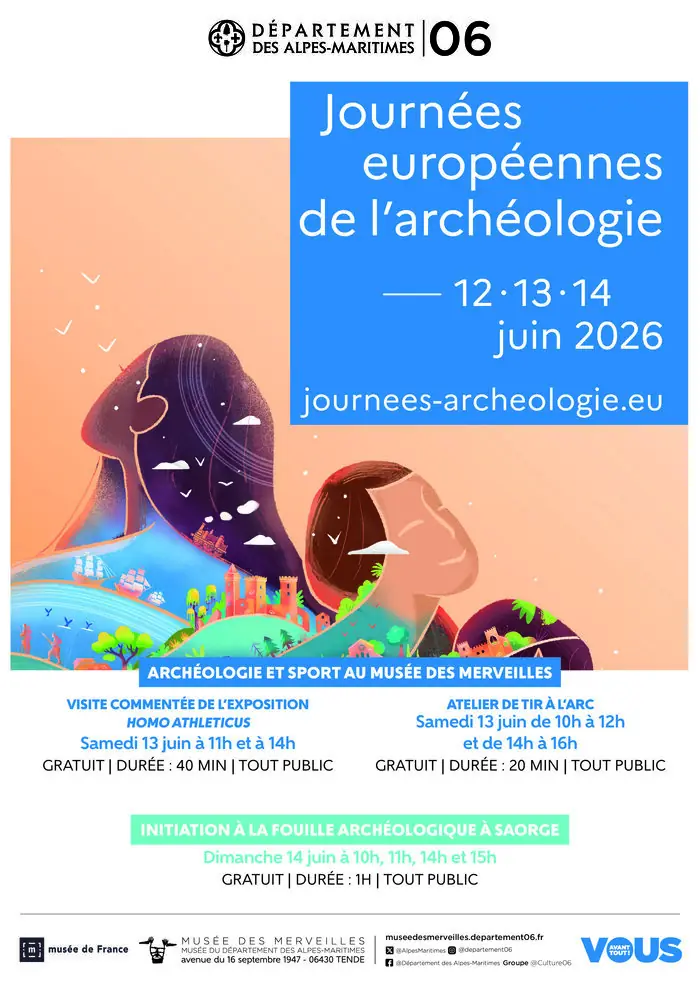
It is precisely this intuition that the Musée des Merveilles formalises on Saturday, 13 June 2026. Housed on avenue du 16 Septembre 1947, the museum — a dedicated space for the archaeological and ethnological heritage of the upper Roya valley — hosts Archéologie et Sport, a free public event built around two distinct but complementary experiences: a guided visit to the exhibition Homo Athleticus, developed in collaboration with Inrap (Institut national de recherches archéologiques préventives), and a practical archery workshop running from 10h to 12h and again from 14h to 16h. Guided tours of the exhibition depart at 11h00 and 14h00, each lasting forty minutes. Entry is free; the event is open to all ages.
The Question Behind the Exhibition
The premise of Homo Athleticus is deceptively simple: when did humans begin to 'do sport', and what do we actually mean by that word? The exhibition pushes the answer back well beyond the canonical date of 776 BC — the year of the first recorded Games at Olympia — and argues, through archaeological evidence, that the body in motion has always been a social, cultural and political fact. Long before formalised competition existed, humans ran, threw, climbed and wrestled: to hunt, to survive, to defend territory, but also to perform, to play, to establish hierarchy and identity.
This is the kind of reframing that archaeology does quietly but insistently. A flint point is also evidence of a thrown projectile; a burial arrangement can speak to the physical prestige of the interred. By reading movement through its material traces, the exhibition builds what it calls 'une lecture originale des sociétés passées' — an original reading of past societies through the prism of the body in motion. Inrap, whose researchers work across France on preventive excavations triggered by construction and development, brings scientific rigour to a subject that might otherwise tip into speculation.
'Depuis quand les humains font-ils du sport? Et que met-on vraiment derrière ce mot?' — the question the exhibition places at its centre, and the one that lingers longest after you leave.
From Flint to Fletching
The archery workshop offers something rarer than most museum programming: the chance to feel, however briefly, the muscular logic of a practice that predates writing. Archery is among the oldest attested forms of directed physical effort; its mechanics — the draw, the anchor, the release — have changed remarkably little across millennia. To stand in the shadow of the Mercantour massif and attempt the same gesture that a hunter in this valley might have made thousands of years ago is not a reconstruction. It is a reminder that the body carries its own archive.
The Musée des Merveilles is well placed to host this kind of event. Its permanent collections document the extraordinary rock engravings of the nearby Mont Bégo area — one of the densest concentrations of prehistoric carved figures in Europe — and the ethnological life of a valley that remained, until the mid-twentieth century, genuinely remote. The museum's address, avenue du 16 Septembre 1947, carries its own history: that date marks the day Tende and the surrounding territory were formally ceded by Italy to France, a transfer that reshaped the identity of a community already shaped by centuries of transalpine movement.
What to expect on the day: - Guided visits to Homo Athleticus at 11h00 and 14h00 (40 minutes each) - Archery workshop from 10h to 12h and from 14h to 16h - Free admission; suitable for all audiences - Full details at museedesmerveilles.departement06.fr
Tende sits roughly ninety minutes by road from Nice, or reachable by the scenic Train des Merveilles — a rail line that climbs from the coast through a landscape of gorges and medieval villages. Plan to arrive with time before the session; the town itself, with its covered market street and the Gothic façade of its collegiate church, rewards an unhurried hour. The mountains will be there when you look up. They always are.