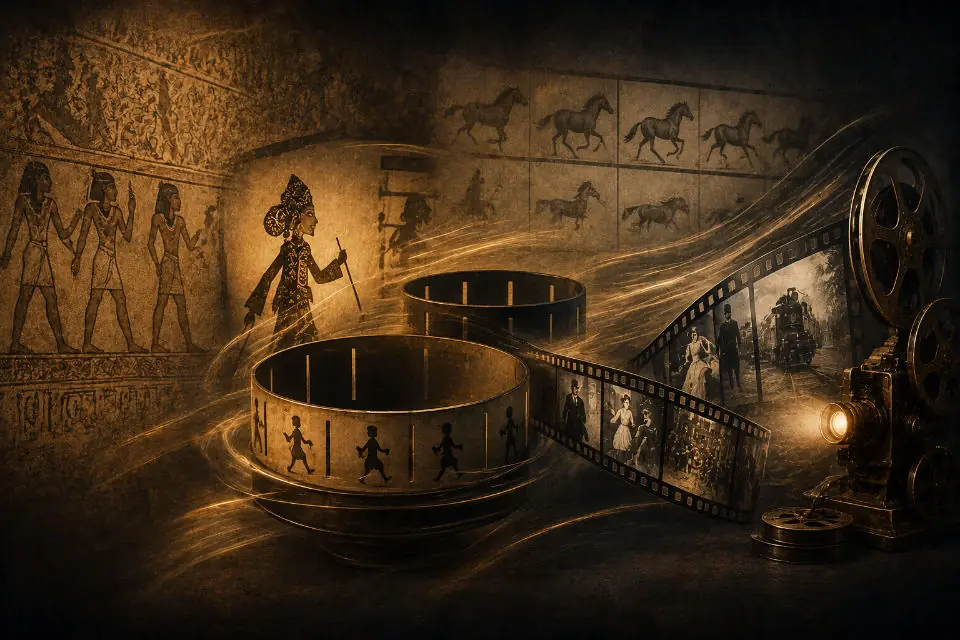
There is a fresco in an Egyptian tomb — figures rendered in sequential poses around a wrestling scene — that some historians read as the world's first attempt at animation. Whether or not that reading holds, the impulse it represents is undeniable: long before a projector threw light through celluloid, human beings were obsessed with making pictures move. That obsession is the subject of a one-hour lecture arriving at the Espaces Mimont in Cannes this August.
'Et l'image se mit à bouger' — the title translates, roughly, as 'and then the image began to move' — takes place on Saturday, 22 August 2026 at 14h30 at 5 rue de Mimont, a short walk from the Palais des Festivals. Entry is free, with reservation required.
From Shadow Plays to the Zoetrope
The lecture opens not with the Lumière brothers but with prehistory, tracing the arc from Egyptian wall paintings through Chinese shadow theatre, the phenakistoscope, and the zoetrope — those Victorian spinning drums that gave the illusion of galloping horses and tumbling acrobats to anyone patient enough to peer through the slots. Each of these devices addressed the same fundamental problem: how to trick the eye into perceiving continuous motion from a series of frozen instants.
The pivot point of the talk is Eadweard Muybridge, the British-American photographer whose chronophotographic sequences of the 1870s and 1880s settled, once and for all, the question of whether a galloping horse ever lifts all four hooves simultaneously. (It does.) Muybridge's grid of sequential images — a racehorse named Occident, a woman descending a staircase, a man throwing a baseball — were not cinema, but they were its direct ancestors. The lecture uses his work as the hinge between art history and film history.
'Composition, colour and music converge to give birth to the living image' — the closing argument of the lecture distils centuries of experimentation into a single, elegant formula.
Cannes is, of course, an appropriate setting for this kind of inquiry. The city's identity is so thoroughly bound up with the Festival de Cannes that it can be easy to forget the deeper, stranger history of moving images that preceded it. The Espaces Mimont, a cultural venue run by the city, regularly hosts lectures and events that push against that festival-season myopia — offering residents and visitors alike a chance to engage with ideas rather than red carpets.
The Art History of an Illusion
What makes this lecture worth an afternoon is its scope. An hour is not long, but the ground covered is genuinely wide: Egyptian frescos, shadow puppetry from East Asia, the mechanical ingenuity of 19th-century optical toys, the scientific rigour of chronophotography. The final section closes the loop, showing how the formal elements that painters had developed over centuries — composition, colour, the organisation of space — were absorbed wholesale into the grammar of cinema. The moving image did not replace painting; it inherited it.
For anyone travelling the Côte d'Azur in late August, the timing is worth noting. The summer crowds thin slightly after the 15th, the light over the Esterel turns amber earlier in the evening, and Cannes itself — stripped of its festival scaffolding — reveals something quieter and more considered. An afternoon lecture on art history, free of charge, in a city that has spent 80 years at the intersection of image and spectacle, feels less like a cultural footnote and more like the point.
Reservations can be made through the city of Cannes events portal. Arrive early: the Espaces Mimont is a modest venue, and a subject this broad tends to draw a curious crowd.