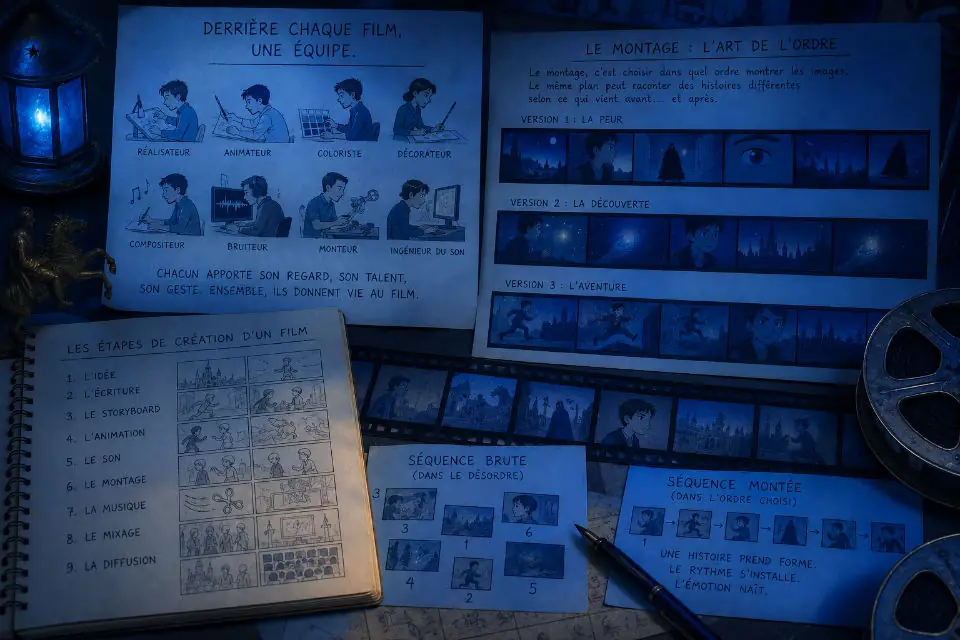
There is a particular kind of silence that settles over a cinema just before the lights go down — the hush of an audience that has, for the moment, agreed to forget how the trick is done. Cannes, a city whose identity is inseparable from the moving image, understands this contract better than almost anywhere else on earth. Every May the Croisette turns itself over to the machinery of cinema's illusions. But on a Wednesday afternoon in August, a small venue tucked into the Espaces Mimont neighbourhood invites its visitors to do the opposite: to look behind the screen rather than at it.
On Wednesday 19 August 2026 at 14h30, the Micro-Folie Espaces Mimont hosts a hands-on discovery workshop titled, in its original French, Le cinéma, c'est magique — Mais qui se cache derrière le film? The session runs for ninety minutes and is open to anyone aged seven and above. Admission is free, though advance reservation is required.
The Invisible Workforce
The workshop opens with a question that most filmgoers never think to ask: who, exactly, is responsible for the world you see — and hear — on screen? Animation, more than any other genre, depends on a dense web of specialists whose contributions vanish completely into the finished work. The session works through this hidden labour systematically, tracing the journey from the animator who gives a drawn character its weight and breath, to the composer who scores the emotional arc of a scene, to the bruiteur — the Foley artist — whose craft involves recreating the sound of footsteps on gravel, a door swinging shut, or rain on a tin roof, often using objects that bear no resemblance to the sounds they produce.
For children raised on streaming services, where a film simply appears, fully formed, this kind of archaeology can be quietly revelatory. The trades involved in a single animated feature number in the dozens; the workshop makes that complexity legible without making it daunting.
'How the order of images constructs meaning, rhythm and emotion — and how the same raw material can tell radically different stories depending on how it is assembled.'
The Logic of the Cut
The second half of the session shifts from production to post-production, and specifically to editing — arguably the most conceptually rich of all filmmaking disciplines. Participants explore how the sequence of images is not a neutral record of events but an argument: a set of choices about what to show, for how long, and in what order. The same footage, reassembled differently, can produce comedy or menace, clarity or confusion. This is not an abstract proposition. The workshop works through it practically, demonstrating how rhythm and emotional tone are constructed at the editing table rather than on set.
It is the kind of lesson that tends to stay with people. Anyone who has sat through a film that felt inexplicably slow, or been surprised by how quickly a tense sequence passed, has experienced editing without knowing it. The workshop gives that experience a name and a logic.
The Micro-Folie network — a national French initiative bringing digital cultural resources to neighbourhoods outside major museum circuits — makes an apt setting for this kind of inquiry. The Espaces Mimont venue serves the residential western districts of Cannes, a quieter counterpart to the festival glamour of the seafront. Coming here feels less like attending an event and more like dropping in on a working cultural space that happens to be doing something interesting that afternoon.
Practical details are straightforward: the workshop runs once, on 19 August 2026 at 14h30, lasts ninety minutes, and costs nothing beyond a reservation made in advance through the Cannes city agenda. It is designed for children from age seven, though the subject matter — the invisible labour behind a finished film, the editorial construction of meaning — is the kind of thing adults find themselves thinking about long after the session ends.
Cannes in August is a different city from Cannes in May: the festival scaffolding is long gone, the light sits heavy and golden over the bay, and the Croisette belongs to summer visitors rather than industry delegates. It is, in some ways, the better time to think about what cinema actually is — not as spectacle or commerce, but as a set of crafts practised by people whose names scroll past in the closing credits while the audience is already reaching for their coats.