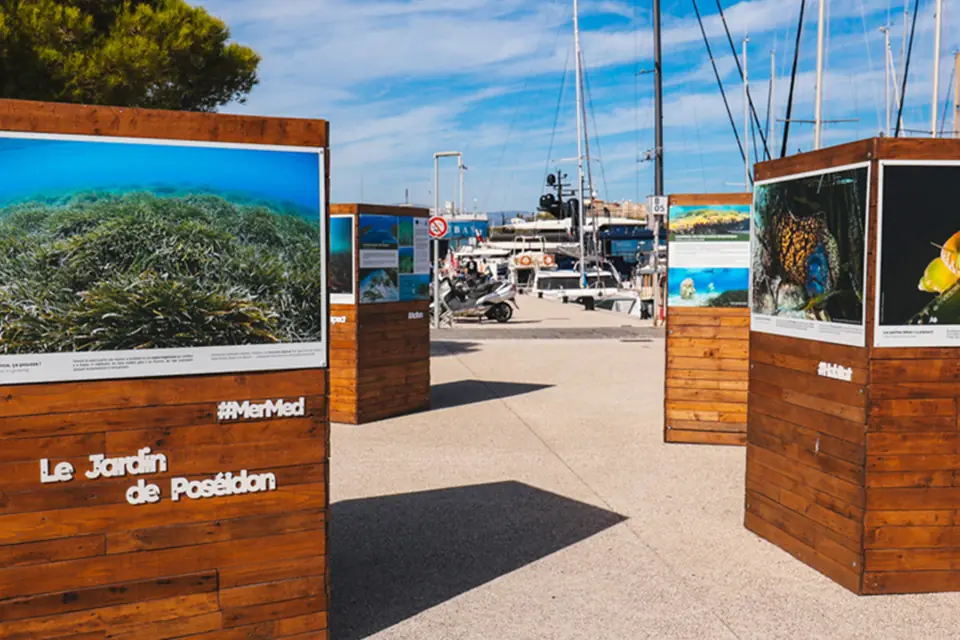
There is a version of the Côte d'Azur that never makes it onto a postcard. Below the pleasure boats and the glittering surface of the Mediterranean, beyond the reach of the sunbathers on the Croisette, lies one of the most consequential ecosystems in the sea — a vast, slow-growing meadow of Posidonia oceanica that stretches across the seabed and quietly sustains much of the life above it. This October, a library in Cannes is asking visitors to look down.
From 2 to 16 October 2026, the Médiathèque Noailles — at 1 avenue Jean de Noailles, a short walk from the old port — hosts Posidonia, a photographic exhibition produced by the association NaturDive. Entry is free. The show is presented as part of La Fête de la Science, the annual French national festival that brings scientific research out of the laboratory and into public spaces. It is, in that sense, a civic gesture as much as an artistic one.
The Plant Nobody Talks About
Posidonia is not seaweed. That distinction, easy to overlook, matters enormously. Posidonia oceanica is a flowering plant — a true vascular plant, with roots, leaves, and seeds — that is endemic to the Mediterranean. Its meadows grow at a rate of roughly a centimetre a year, which means that what appears on the seabed today may have been establishing itself for centuries, or millennia. Scientists estimate that a single square metre of posidonia meadow can produce up to 14 litres of oxygen per day, making it one of the most productive ecosystems on the planet. It is a nursery for juvenile fish, a filter for coastal waters, and a carbon sink. It is also, as NaturDive's work suggests, largely unknown to the people who live and holiday alongside it.
NaturDive is an association that brings together marine biologists and scientific divers committed to the protection of Mediterranean underwater ecosystems. The exhibition is the result of more than five years of photographic work — a sustained, disciplined engagement with a single subject, conducted beneath the surface of the same sea that generations of artists and writers have celebrated from above. The images, described as 'impactantes' in the association's own words, do not traffic in the picturesque. They are scientific in intent, documentary in method.
'La posidonie, plante marine essentielle à la vie en Méditerranée et pourtant largement méconnue.' — NaturDive
Science at Street Level
The Médiathèque Noailles is not a gallery in the conventional sense, which is precisely what makes it the right venue. Libraries in France have long operated as community anchors, places where knowledge moves laterally — from specialist to general reader, from researcher to curious teenager. Placing a scientific photography exhibition in this kind of space is a deliberate act of translation: the work of marine biologists rendered legible, and free, to anyone who walks in.
La Fête de la Science, which has taken place every October since 1991, operates on this same principle. It is a national framework that encourages researchers and institutions across France to engage directly with the public, and the Cannes edition typically draws on the city's particular relationship with the Mediterranean — a sea that is, for this stretch of coastline, both backdrop and subject.
For visitors to Cannes in October — a month when the summer crowds have thinned, the light has softened, and the city returns to something closer to its year-round self — the exhibition offers a different kind of engagement with the coast. The programme at the Médiathèque Noailles runs across a fortnight, giving ample time to visit without the pressure of a single-day event. What the photographs ask, ultimately, is a simple reorientation: to consider the Mediterranean not only as a view, but as a living system with its own fragile chronology.
The posidonia meadows off the Côte d'Azur have been damaged by boat anchoring, coastal development, and water pollution. Some of what NaturDive has photographed over five years may already look different. That tension — between the image and the present moment — is what gives documentary nature photography its particular weight. The Médiathèque Noailles, free and open to all, is where Cannes is choosing to hold that conversation this autumn.