There is a particular quality to the Côte d'Azur after dark in August — the air still warm from the day, the sea a shade of navy that has no precise name, the lights of the corniche towns strung like a loose necklace along the hills. On the evening of 14 August 2026, that familiar tableau acquires something more: colour, percussion, and the particular collective silence that falls over a crowd in the seconds before a firework bursts.
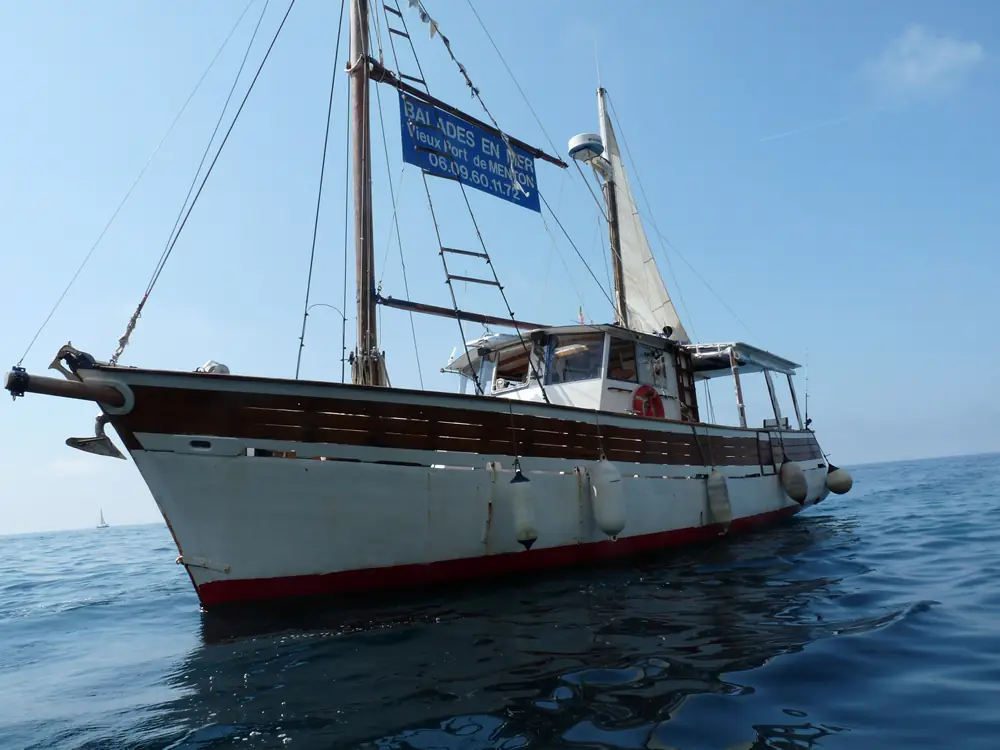
The departure point is the Vieux Port de Menton — specifically the Société Maritime on Quai Napoléon III, a working quay that has been sending small boats out along this stretch of coast for years. The premise is straightforward: board one of the company's vessels and sail towards Roquebrune-Cap-Martin for the annual fireworks display, watching the show unfold from the water rather than from a crowded promenade. The sea, in this case, is not backdrop but vantage point.
Between Two Towns
Menton and Roquebrune-Cap-Martin sit almost adjacently on the final curve of the French Riviera before the border with Italy — a geography that has always made this corner feel slightly apart from the louder glamour of Cannes or Nice. Roquebrune itself divides neatly in two: the medieval hill village of narrow vaulted lanes and a keep that dates to the tenth century, and the low-slung cape below it, where modernist architecture found some of its most serious patrons. Eileen Gray built E-1027 here. Le Corbusier spent his summers on this coastline and, in 1965, drowned while swimming just offshore. The cape carries history quietly, without advertising it.
The fireworks display is tied to the 14 August calendar — the eve of the Feast of the Assumption, a date that triggers celebrations across Catholic southern France and, on the Riviera in particular, produces a summer-long sequence of sea-facing pyrotechnic displays. Each coastal commune has its own evening; Roquebrune-Cap-Martin's falls on this night.
On the Water After Dark
What the boat offers is distance and angle. From a quayside or a beach, fireworks are overhead, sometimes obscured by the crowd in front of you. From the sea, the display sits above the dark mass of the cape and its hills, with no obstruction between the vessel and the sky. The reflection on the water — that second, inverted performance — is not incidental.
'Profitez d'une vue imprenable pour apprécier le spectacle et la douceur d'une navigation de nuit,' reads the description from the organisers — and the phrase 'douceur d'une navigation de nuit' is worth sitting with. Night sailing on a calm summer sea has its own register entirely.
The crossing from Menton's old port to the waters off Roquebrune-Cap-Martin is short — the two communes share a coastline — which means the evening is less an expedition than an excursion: time enough to settle on deck, let the harbour lights recede, and let the eyes adjust to the wider dark before the display begins.
Menton's Vieux Port is itself worth arriving early for. The town — the easternmost on the French Riviera, pressed against the Italian border — has a character distinct from its neighbours: Baroque church facades in ochre and yellow, a lemon festival in February that draws growers from across the region, markets that still function as markets rather than as tourist attractions. The port sits below the old town, and on a summer evening the cafés along the quay are occupied by people who appear to have nowhere particular to be, which is precisely the right disposition for a night like this.
Bookings and practical details are handled through the Société Maritime directly at balade-en-mer-menton.fr. Pricing was not confirmed at the time of writing; the site carries current availability and rates.
The Côte d'Azur in August is many things — crowded, luminous, occasionally exhausting in its own beauty. An hour on the water, away from the coast road and the parked cars and the people jostling for position on the sea wall, is a reminder that the best view of this coastline has always been from the sea itself. The fireworks are the occasion. The crossing is the point.