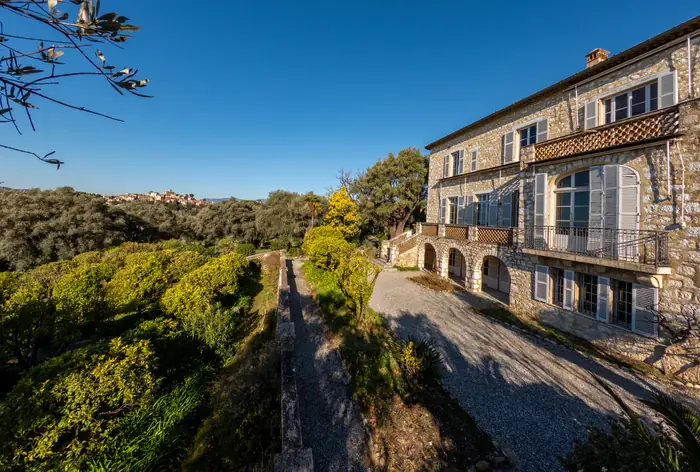
There is a particular quality to the light at Les Collettes in early summer — not the blinding white of high August, but something softer, more considered, filtering through the silver-green canopy of olive trees that have stood here for centuries. It is the kind of light that stops you mid-step. It stopped Pierre-Auguste Renoir, too, when he first came to Cagnes-sur-Mer at the turn of the twentieth century, searching, as he put it, for his light on the Côte d'Azur. He found it here, on this hillside above the old village, and he never really left.
On Sunday 7 June 2026, the Musée Renoir — housed in the very villa Renoir built and lived in at 19 Chemin des Collettes — opens its garden for a self-guided botanical trail, the Sentier Botanique. Beginning at 10 in the morning, visitors are invited to set their own pace through the estate's grounds, discovering the principal Mediterranean species that have shaped the landscape of Les Collettes over generations. The walk is unhurried by design: no guided group, no fixed itinerary, simply a path through one of the Riviera's most quietly resonant outdoor spaces.
The Garden That Shaped a Painter
Renoir purchased the Domaine des Collettes in 1907, partly to save its ancient olive trees from being felled for a carnation farm — a decision that tells you something about the man. He had the villa constructed on the property and spent the final twelve years of his life painting here, his canvases increasingly saturated with the warm ochres and dappled greens of this specific hillside. Today, the estate functions simultaneously as a museum, a garden, and something closer to a living document of late Impressionism. The olive trees he fought to preserve are still standing.
The garden holds a formal LPO designation as a wildlife refuge — the Ligue pour la Protection des Oiseaux has recorded 36 bird species within the domain, which gives the place a layered ecology that goes well beyond ornament. The city of Cagnes-sur-Mer has also recreated Renoir's kitchen garden behind the Ferme des Collettes, restoring a productive dimension to the estate that connects it to the rhythms of Mediterranean cultivation rather than mere preservation. Standing in the vegetable garden with the medieval village of Haut-de-Cagnes visible on the ridge above, and the sea glinting in the distance beyond the hills, the panorama feels less like a backdrop than a protagonist.
'Cette lumière qui baigne des oliviers séculaires illumine encore et pour toujours ses toiles dans le monde entier.' — Musée Renoir
What the Trail Offers
The Sentier Botanique is organised around the Mediterranean plant species that define the character of Les Collettes — the olive, naturally, but also the broader vocabulary of garrigue and Provençal horticulture that Renoir's brushwork so often absorbed. Walking at your own pace means the experience is genuinely elastic: a quick circuit for those with young children, a longer, more contemplative loop for those who want to cross-reference what they see in the garden with what they know from the museum's collection inside.
The estate has hosted open-air events before — summer evenings, outdoor lunches, storytelling sessions beneath the trees — so the grounds are accustomed to being inhabited rather than merely visited. The botanical trail belongs to that same tradition: the garden as a place of active engagement with the landscape rather than passive admiration of it.
For anyone travelling along the Côte d'Azur in early June, before the summer crowds have fully settled in, the timing is well chosen. The light at Les Collettes on a June morning — long, lateral, extraordinarily clear — is as close as most of us will get to understanding what Renoir saw when he decided to stay. The olive trees are the same ones. The hills have not moved. The museum's website, ville.cagnes.fr/musee-renoir, carries current visitor information and access details for the day.