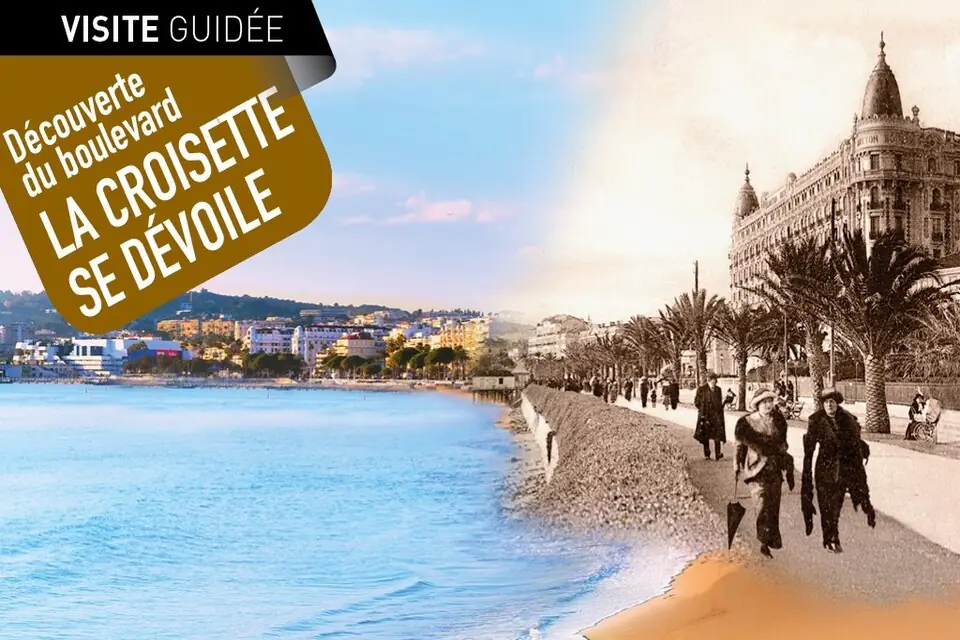
There is a particular quality to La Croisette in late October. The summer crowds have dissolved, the parasols are folded away, and the boulevard recovers something of its original composure — a long, palm-lined promenade facing a sea that turns pewter and silver in the autumn light. The grand façades of the palace hotels stand unhurried, their awnings still, their histories intact. It is precisely the right moment to look at this street properly.
On Tuesday, 27 October 2026 at 3 p.m., the Cannes Tourist Office organises a guided walking tour of La Croisette — a 90-minute itinerary conducted in French that traces the boulevard's role in shaping the identity of the city itself. Departure is from the Office de tourisme at the Palais des Festivals et des Congrès. Tickets are priced at 6 € for adults, 3 € with a Carte Mobilité Inclusion, and free for children under 12. Advance reservation through the Tourist Office is required.
The Street That Rewrote a Fishing Village
Before La Croisette, Cannes was a modest fishing settlement on the Var coast — known to locals, invisible to the wider world. The transformation began in the 1830s when Lord Brougham, the British Lord Chancellor, was stranded here by a quarantine closure at the Sardinian border and, captivated by the mild winter climate, decided to build a villa and return each season. English and European aristocracy followed. By the mid-nineteenth century, Cannes had become a winter resort of considerable standing, and the Croisette — then a narrow coastal path — was gradually widened and formalised into the ceremonial boulevard it is today.
The tour invites participants to inhabit two very different versions of that history. The guide asks you to step into the shoes of a 19th-century aristocrat arriving for the winter season — when the Croisette's grand hotels were built for extended residence, not weekend breaks, and the promenade was a stage for the social rituals of European high society. Then the register shifts: imagine yourself a starlet of the 1950s, when the Cannes Film Festival was still young and glamorous enough to be genuinely dangerous, and the palace hotels became temporary addresses for directors, producers, and faces that would appear on cinema screens across the continent.
'The Croisette is not just a street — it is a series of eras laid one on top of another, each one still visible if you know where to look.'
Architecture as Biography
What makes this particular walk worthwhile is its architectural focus. The boulevard's hotels and monuments are not merely backdrops — they are documents. The Hôtel Carlton, with its twin grey domes said to have been modelled on the breasts of the courtesan La Belle Otero, was completed in 1913 and has hosted nearly every significant figure who has passed through the festival since its founding in 1946. The Hôtel Martinez, built in Art Deco style in 1929, represents a different ambition — sleeker, more modern, a building that looked forward rather than back. Walking the length of the Croisette with someone who can read these façades as texts is a different experience from walking it alone.
The tour also touches on the Palais des Festivals itself — a building that provokes strong opinions architecturally, but whose cultural weight is undeniable. Since the current structure opened in 1982, it has been the fixed point around which the festival's ceremonies orbit, the red-carpeted steps a threshold between ordinary life and the particular theatre of cinema.
For a visitor who has come to Cannes outside the festival season, this guided walk offers something the summer cannot: the city without its costume. The Croisette in October belongs to the people who live here, and to those willing to look at it slowly. An hour and a half, a knowledgeable guide, and the low autumn sun on the water — that is sufficient.