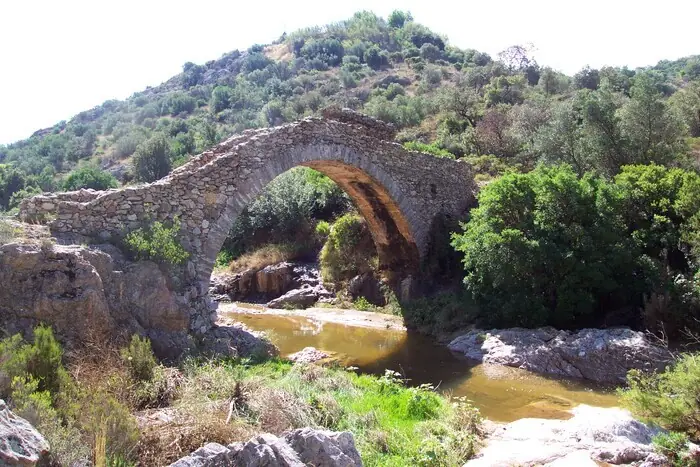
There is a particular quality of light in the Var in late September — softer than the hard glare of August, angled low enough to catch the silver undersides of olive leaves. The garrigue smells of thyme and dried grass. It is the kind of morning that makes a walk feel less like exercise and more like reading.
On Sunday, 20 September 2026, the village of Grimaud invites up to 35 people to do exactly that — read a landscape. The guided hiking visit, free of charge and departing at 10h00 from the Parking Saint-Roch (located below the village cemetery and the old Saint-Roch mill, at 83310 Grimaud), centres on one of the commune's most quietly remarkable structures: the Pont des Fées, a medieval aqueduct whose name — the Fairies' Bridge — hints at the slightly mythologised reverence the locals have long extended to it.
A Bridge That Once Kept a Village Alive
The Pont des Fées dates to the Middle Ages, and its original purpose was entirely practical: to carry water into Grimaud, a hilltop village of the kind that dots the Maures massif, where elevation provided defence but complicated the most basic logistics of daily life. For a settlement perched above the plain, a reliable water supply was not a convenience — it was survival. The aqueduct was, according to the event's own description, one of the most important constructions ever undertaken for the village's water supply.
For reasons history does not fully record in a single clean sentence, the structure was eventually abandoned. It fell into the slow custody of the surrounding vegetation, the roots and the rain doing what they do to any stonework left without a keeper. And yet it did not disappear. Today the Pont des Fées is the subject of an active preservation and enhancement campaign — which is precisely why this walk exists, and why its title carries a note of urgency: Patrimoine en danger. Heritage at risk.
'Patrimoine en danger' — the phrase is not alarmist. It is an honest description of what happens to medieval stonework when attention lapses.
Grimaud itself rewards that attention. The village is one of the better-preserved medieval settlements on the Côte d'Azur's hinterland — its castle ruins, Romanesque church, and tightly wound lanes have survived where others were lost to tourism-led reconstruction. The commune also includes the coastal resort of Port Grimaud, but the old village operates on a different register entirely: quieter, stonier, more interested in its own continuity than in its own reflection.
What the Walk Actually Offers
The route is a randonnée — a proper hike, not a stroll. Organisers note that the paths include rocky stretches and advise comfortable footwear or walking boots. The terrain is described as potentially difficult for very young children, which is a useful calibration for anyone planning a family outing.
Beyond the aqueduct itself, the walk moves through the living landscape that has grown up around it — the flora and fauna of these semi-wild spaces, which the organisers frame, deliberately, as a second kind of heritage. The garrigue of the Maures is botanically rich: cistus, kermes oak, strawberry tree, the occasional glimpse of a Hermann's tortoise if you are quiet enough. The walk asks you to attend to all of it, not only the stonework.
The group is capped at 35 participants, which keeps the experience closer to a conversation than a lecture. Admission is free. The meeting point is the Parking Saint-Roch, in the lower part of Grimaud, beneath the cemetery and the mill.
For a Sunday morning in the Var, there are worse ways to spend the hours before lunch: walking slowly toward something old, learning why it matters, and coming back with a clearer sense of what a village actually is — not just its postcard facade, but the infrastructure of water and stone that made it possible in the first place.