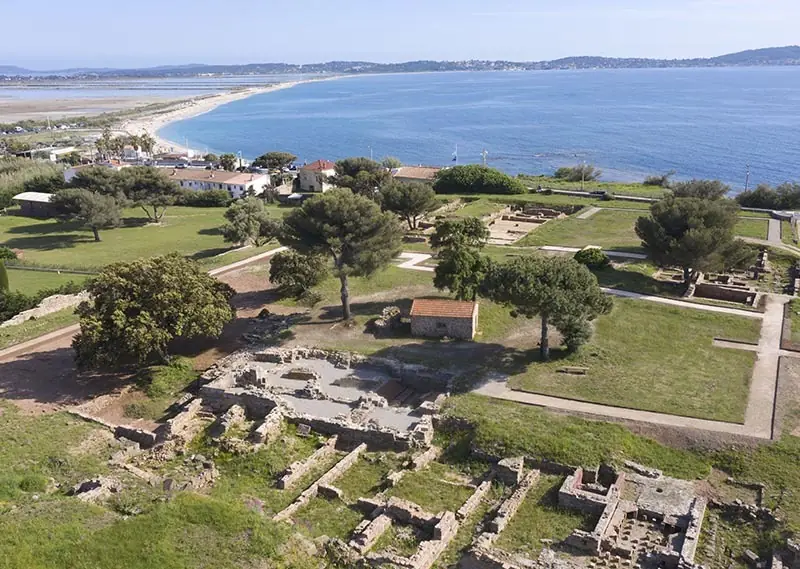
The road to Olbia runs low along the coast, between the salt flats and the sea. By the time you reach the site at L'Almanarre — a slight promontory south of Hyères where the land barely rises above the water — the Mediterranean is already visible on three sides, silver-grey in the morning light. There is no grand entrance, no museum forecourt. Just the ancient stones themselves, and the particular stillness that accumulates over two millennia.
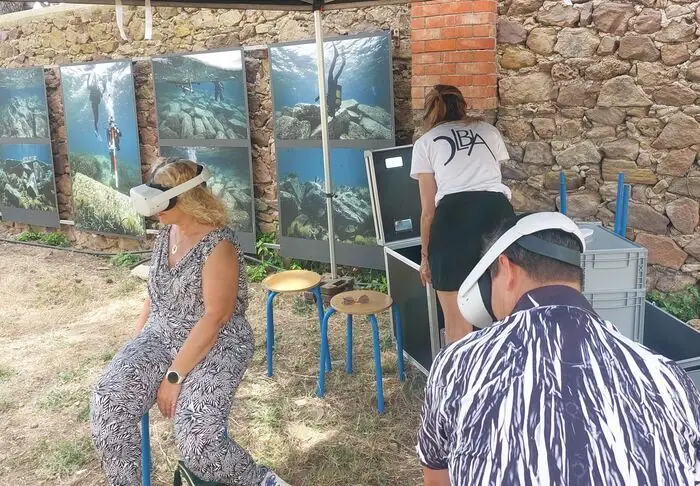
On 13 and 14 June 2026, the archaeological site at Olbia is hosting open-air virtual reality sessions that allow visitors to explore two aspects of the ancient city that are otherwise invisible to the naked eye: the Roman thermal baths and the submerged remains of the port. The sessions are free to attend without prior reservation, subject to availability, and run with a maximum of eight participants at a time. Visitors aged twelve and over are welcome, provided an adult is present. Each session lasts approximately twenty minutes.
A City That Survived a Thousand Years
Olbia is not a ruin in the conventional sense — a collapsed temple, a fragment of wall. It is something rarer: a Greek colonial settlement whose urban plan has survived almost intact, making it the only known example of a Marseille-founded fortress-colony preserved in its entirety. The city was established in the fourth century BC, when Massalia (present-day Marseille) sent soldier-colonists south along the coast to secure maritime trade routes. Those first Olbians were farmers and fishermen as much as soldiers, and the city they built reflects that double life — fortifications on the perimeter, but inside, a fully articulated urban fabric of streets with drainage channels and raised pavements, communal wells, housing blocks divided into individual homes, shops, sanctuaries, and baths.
What the excavations reveal is not a single frozen moment but a continuous urban evolution across a thousand years. The Roman period layered new architecture over the Greek foundations; later still, the remains of a medieval abbey — Saint-Pierre de l'Almanarre — were found within the same site. Olbia is, in that sense, a kind of stratigraphic biography of the northern Mediterranean coast.
'Les premiers Olbiens étaient des soldats-colons, pêcheurs, agriculteurs' — the site's own description of its founders captures the pragmatic complexity that archaeology here keeps confirming.
What the Headset Shows
The practical difficulty with Olbia, for any visitor, is that some of its most significant structures are either partially reconstructed from foundations alone or, in the case of the port, lying beneath the sea. This is where the outdoor digital installation becomes genuinely useful rather than merely novel. Equipped with a VR headset on the open-air site, visitors can choose between two experiences:
- The Roman thermal baths of Olbia** — the hypocaust systems, the sequence of heated rooms, the architectural logic of a public bathing complex as it would have functioned in daily life
- The submerged remains of Olbia's port — the underwater vestiges that no standard site visit can reach
Each experience runs to around twenty minutes and focuses specifically on construction methods and the principles of ancient architecture. The intention is explanatory rather than spectacular: to answer the question of how, exactly, a city like this was built and how it worked.
The setting amplifies everything. You are not watching a reconstruction on a screen inside a visitor centre — you are standing on the actual ground of the ancient city, with the coast of the Var stretching away in both directions and the Giens peninsula visible to the south. The gap between the digital image inside the headset and the physical reality around you is unusually small.
For anyone spending time in the Hyères area in early June — a moment when the crowds of high summer have not yet arrived and the light on the coast has a particular clarity — the Olbia site repays a visit on its own terms, with or without the VR component. The stones are legible, the scale is human, and the position on the water's edge makes the original logic of the place — watch the sea, control the trade routes, hold the coast — immediately apparent. The virtual sessions on the 13th and 14th simply extend what the site already offers: a way of reading time.